Event submissions
Published
This submission belongs to the session S3. Use of Toxins as Tools for Research, Drug Discovery, and Therapeutics of the event The 3rd International Online Conference on Toxins
Published date
08 Sep, 2025
Academic Editor
'%3e%3cpath%20d='M12.6657%2010.9104C12.4185%2010.325%2012.0599%209.79327%2011.6097%209.34482C11.1609%208.89508%2010.6293%208.5365%2010.0442%208.28888C10.0389%208.28626%2010.0337%208.28495%2010.0285%208.28233C10.8446%207.69279%2011.3752%206.73249%2011.3752%205.64904C11.3752%203.8542%209.92103%202.39999%208.1262%202.39999C6.33136%202.39999%204.87715%203.8542%204.87715%205.64904C4.87715%206.73249%205.40774%207.69279%206.22393%208.28364C6.21869%208.28626%206.21345%208.28757%206.20821%208.29019C5.62129%208.5378%205.09463%208.89284%204.64265%209.34613C4.1929%209.79493%203.83432%2010.3266%203.58671%2010.9117C3.34345%2011.4845%203.21226%2012.0987%203.20023%2012.7209C3.19988%2012.7349%203.20233%2012.7488%203.20744%2012.7619C3.21255%2012.7749%203.22022%2012.7867%203.22998%2012.7968C3.23975%2012.8068%203.25142%2012.8147%203.26431%2012.8202C3.2772%2012.8256%203.29105%2012.8284%203.30504%2012.8284H4.09109C4.14874%2012.8284%204.19459%2012.7825%204.1959%2012.7262C4.2221%2011.7148%204.62823%2010.7676%205.34617%2010.0497C6.08899%209.30683%207.0755%208.89808%208.1262%208.89808C9.17689%208.89808%2010.1634%209.30683%2010.9062%2010.0497C11.6242%2010.7676%2012.0303%2011.7148%2012.0565%2012.7262C12.0578%2012.7838%2012.1037%2012.8284%2012.1613%2012.8284H12.9474C12.9613%2012.8284%2012.9752%2012.8256%2012.9881%2012.8202C13.001%2012.8147%2013.0126%2012.8068%2013.0224%2012.7968C13.0322%2012.7867%2013.0398%2012.7749%2013.0449%2012.7619C13.0501%2012.7488%2013.0525%2012.7349%2013.0522%2012.7209C13.0391%2012.0947%2012.9094%2011.4855%2012.6657%2010.9104ZM8.1262%207.9024C7.52486%207.9024%206.9589%207.6679%206.53312%207.24211C6.10733%206.81633%205.87283%206.25037%205.87283%205.64904C5.87283%205.0477%206.10733%204.48174%206.53312%204.05596C6.9589%203.63018%207.52486%203.39567%208.1262%203.39567C8.72753%203.39567%209.29349%203.63018%209.71927%204.05596C10.1451%204.48174%2010.3796%205.0477%2010.3796%205.64904C10.3796%206.25037%2010.1451%206.81633%209.71927%207.24211C9.29349%207.6679%208.72753%207.9024%208.1262%207.9024Z'%20fill='%235D1EE1'/%3e%3c/g%3e%3c/svg%3e) Nilgun E. Tumer
Nilgun E. TumerCitation
Ayoub Lafnoune, Saad Harrizi, Bouchra Darkaoui, Asmaa Chbel, Hicham Wahnou, Ismail Guenaou, Imane Nait Irahal, Bee Venom as a Source of Anti-Angiogenic Agents: A Computational Study, in Proceedings of The 3rd International Online Conference on Toxins, 10 September–12 September 2025, MDPI: Basel, Switzerland
Share
Email
Facebook
Twitter
LinkedIn
Bee Venom as a Source of Anti-Angiogenic Agents: A Computational Study
'%3e%3cpath%20d='M12.6647%2010.9104C12.4176%2010.325%2012.0589%209.7933%2011.6088%209.34485C11.16%208.89511%2010.6283%208.53653%2010.0432%208.28891C10.038%208.28629%2010.0327%208.28498%2010.0275%208.28236C10.8437%207.69282%2011.3743%206.73252%2011.3743%205.64907C11.3743%203.85423%209.92005%202.40002%208.12522%202.40002C6.33038%202.40002%204.87618%203.85423%204.87618%205.64907C4.87618%206.73252%205.40677%207.69282%206.22296%208.28367C6.21772%208.28629%206.21248%208.2876%206.20724%208.29022C5.62031%208.53783%205.09365%208.89287%204.64167%209.34616C4.19192%209.79496%203.83334%2010.3266%203.58573%2010.9117C3.34247%2011.4846%203.21128%2012.0987%203.19925%2012.721C3.1989%2012.735%203.20135%2012.7489%203.20646%2012.7619C3.21157%2012.7749%203.21924%2012.7868%203.22901%2012.7968C3.23877%2012.8068%203.25045%2012.8148%203.26334%2012.8202C3.27623%2012.8256%203.29007%2012.8284%203.30406%2012.8284H4.09012C4.14776%2012.8284%204.19362%2012.7825%204.19493%2012.7262C4.22113%2011.7148%204.62726%2010.7676%205.34519%2010.0497C6.08802%209.30686%207.07452%208.89811%208.12522%208.89811C9.17592%208.89811%2010.1624%209.30686%2010.9052%2010.0497C11.6232%2010.7676%2012.0293%2011.7148%2012.0555%2012.7262C12.0568%2012.7839%2012.1027%2012.8284%2012.1603%2012.8284H12.9464C12.9604%2012.8284%2012.9742%2012.8256%2012.9871%2012.8202C13%2012.8148%2013.0117%2012.8068%2013.0214%2012.7968C13.0312%2012.7868%2013.0389%2012.7749%2013.044%2012.7619C13.0491%2012.7489%2013.0515%2012.735%2013.0512%2012.721C13.0381%2012.0947%2012.9084%2011.4856%2012.6647%2010.9104ZM8.12522%207.90243C7.52388%207.90243%206.95792%207.66793%206.53214%207.24215C6.10636%206.81636%205.87185%206.2504%205.87185%205.64907C5.87185%205.04773%206.10636%204.48177%206.53214%204.05599C6.95792%203.63021%207.52388%203.3957%208.12522%203.3957C8.72655%203.3957%209.29252%203.63021%209.7183%204.05599C10.1441%204.48177%2010.3786%205.04773%2010.3786%205.64907C10.3786%206.2504%2010.1441%206.81636%209.7183%207.24215C9.29252%207.66793%208.72655%207.90243%208.12522%207.90243Z'%20fill='%235D1EE1'/%3e%3c/g%3e%3c/svg%3e)
Ayoub Lafnoune 1
Saad Harrizi 1
Bouchra Darkaoui 1
Asmaa Chbel 1
Hicham Wahnou 2
Ismail Guenaou 3
Imane Nait Irahal 1
1. Laboratoire Santé et Environnement, Faculté Des Sciences Ain Chock, Université Hassan II de Casablanca, BP5366 Maarif, Casablanca, Morocco
2. Laboratoire Immunologie et biodiversité, Faculté Des Sciences Ain Chock, Université Hassan II de Casablanca, BP5366 Maarif, Casablanca, Morocco
3. Département de biologie, Faculté Pluridisciplinaire de Nador, Université Mohammed Premier, BP300, Nador, Morocco
Abstract
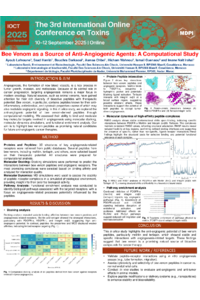
Angiogenesis, the formation of new blood vessels, is a fundamental process in tumor development, progression, and metastasis, making it a critical target in modern cancer therapy. Among natural bioactive compounds, animal venoms have emerged as a rich source of pharmacologically active peptides with potential anti-angiogenic effects. In this in silico study, we explored the therapeutic potential of bee venom peptides, focusing particularly on melittin and tertiapin, as inhibitors of tumor-induced angiogenesis. Using molecular docking techniques, these peptides were evaluated for their binding affinity toward key angiogenesis-related receptors, including platelet-derived growth factor receptor alpha (PDGFR-α), vascular endothelial growth factor receptors (VEGFRs), fibroblast growth factor receptors (FGFRs), and integrin αvβ3. Both melittin and tertiapin exhibited strong and specific binding affinities, with melittin showing notable interaction with PDGFR-α and tertiapin demonstrating a high affinity for integrin αvβ3. Molecular dynamics simulations further confirmed the stability and integrity of these peptide–receptor complexes over time, suggesting the potential for sustained biological activity. Additionally, functional enrichment analysis using the Reactome database revealed significant modulation of angiogenesis-related pathways, particularly those involved in cell migration and vascular remodeling. These findings highlight the potential of bee venom peptides as natural, targeted modulators of angiogenesis and support their further development as candidates for anti-cancer drug discovery.
Keywords
Angiogenesis
Bee venom
Bioactive peptides
Cancer
Natural compounds
Poster
Bee Venom as a Source of Anti-Angiogenic Agents A Computational Study.pdf
Selective Anticancer Activity of Moroccan Naja haje Venom and Purified Cytotoxins Against Hepatocellular Carcinoma in 2D and 3D Tumor Models
Epsilon Toxin from Clostridium perfringens Induces the Generation of Extracellular Vesicles in T-Lymphocytes.