Event submissions
Published
This submission belongs to the session S2. Novel Insights on the Mechanism of Action and/or Pathophysiology of Toxins of the event The 3rd International Online Conference on Toxins
Published date
08 Sep, 2025
Academic Editor
'%3e%3cpath%20d='M12.6657%2010.9104C12.4185%2010.325%2012.0599%209.79327%2011.6097%209.34482C11.1609%208.89508%2010.6293%208.5365%2010.0442%208.28888C10.0389%208.28626%2010.0337%208.28495%2010.0285%208.28233C10.8446%207.69279%2011.3752%206.73249%2011.3752%205.64904C11.3752%203.8542%209.92103%202.39999%208.1262%202.39999C6.33136%202.39999%204.87715%203.8542%204.87715%205.64904C4.87715%206.73249%205.40774%207.69279%206.22393%208.28364C6.21869%208.28626%206.21345%208.28757%206.20821%208.29019C5.62129%208.5378%205.09463%208.89284%204.64265%209.34613C4.1929%209.79493%203.83432%2010.3266%203.58671%2010.9117C3.34345%2011.4845%203.21226%2012.0987%203.20023%2012.7209C3.19988%2012.7349%203.20233%2012.7488%203.20744%2012.7619C3.21255%2012.7749%203.22022%2012.7867%203.22998%2012.7968C3.23975%2012.8068%203.25142%2012.8147%203.26431%2012.8202C3.2772%2012.8256%203.29105%2012.8284%203.30504%2012.8284H4.09109C4.14874%2012.8284%204.19459%2012.7825%204.1959%2012.7262C4.2221%2011.7148%204.62823%2010.7676%205.34617%2010.0497C6.08899%209.30683%207.0755%208.89808%208.1262%208.89808C9.17689%208.89808%2010.1634%209.30683%2010.9062%2010.0497C11.6242%2010.7676%2012.0303%2011.7148%2012.0565%2012.7262C12.0578%2012.7838%2012.1037%2012.8284%2012.1613%2012.8284H12.9474C12.9613%2012.8284%2012.9752%2012.8256%2012.9881%2012.8202C13.001%2012.8147%2013.0126%2012.8068%2013.0224%2012.7968C13.0322%2012.7867%2013.0398%2012.7749%2013.0449%2012.7619C13.0501%2012.7488%2013.0525%2012.7349%2013.0522%2012.7209C13.0391%2012.0947%2012.9094%2011.4855%2012.6657%2010.9104ZM8.1262%207.9024C7.52486%207.9024%206.9589%207.6679%206.53312%207.24211C6.10733%206.81633%205.87283%206.25037%205.87283%205.64904C5.87283%205.0477%206.10733%204.48174%206.53312%204.05596C6.9589%203.63018%207.52486%203.39567%208.1262%203.39567C8.72753%203.39567%209.29349%203.63018%209.71927%204.05596C10.1451%204.48174%2010.3796%205.0477%2010.3796%205.64904C10.3796%206.25037%2010.1451%206.81633%209.71927%207.24211C9.29349%207.6679%208.72753%207.9024%208.1262%207.9024Z'%20fill='%235D1EE1'/%3e%3c/g%3e%3c/svg%3e) Joseph Barbieri
Joseph BarbieriCitation
Jonatan Dorca-Arévalo, Inmaculada Gómez de Aranda, Juan Blasi, Benjamín Torrejón-Escribano, Mireia Martín-Satué, Epsilon Toxin from Clostridium perfringens Induces the Generation of Extracellular Vesicles in T-Lymphocytes., in Proceedings of The 3rd International Online Conference on Toxins, 10 September–12 September 2025, MDPI: Basel, Switzerland
Share
Email
Facebook
Twitter
LinkedIn
Epsilon Toxin from Clostridium perfringens Induces the Generation of Extracellular Vesicles in T-Lymphocytes.
'%3e%3cpath%20d='M12.6647%2010.9104C12.4176%2010.325%2012.0589%209.7933%2011.6088%209.34485C11.16%208.89511%2010.6283%208.53653%2010.0432%208.28891C10.038%208.28629%2010.0327%208.28498%2010.0275%208.28236C10.8437%207.69282%2011.3743%206.73252%2011.3743%205.64907C11.3743%203.85423%209.92005%202.40002%208.12522%202.40002C6.33038%202.40002%204.87618%203.85423%204.87618%205.64907C4.87618%206.73252%205.40677%207.69282%206.22296%208.28367C6.21772%208.28629%206.21248%208.2876%206.20724%208.29022C5.62031%208.53783%205.09365%208.89287%204.64167%209.34616C4.19192%209.79496%203.83334%2010.3266%203.58573%2010.9117C3.34247%2011.4846%203.21128%2012.0987%203.19925%2012.721C3.1989%2012.735%203.20135%2012.7489%203.20646%2012.7619C3.21157%2012.7749%203.21924%2012.7868%203.22901%2012.7968C3.23877%2012.8068%203.25045%2012.8148%203.26334%2012.8202C3.27623%2012.8256%203.29007%2012.8284%203.30406%2012.8284H4.09012C4.14776%2012.8284%204.19362%2012.7825%204.19493%2012.7262C4.22113%2011.7148%204.62726%2010.7676%205.34519%2010.0497C6.08802%209.30686%207.07452%208.89811%208.12522%208.89811C9.17592%208.89811%2010.1624%209.30686%2010.9052%2010.0497C11.6232%2010.7676%2012.0293%2011.7148%2012.0555%2012.7262C12.0568%2012.7839%2012.1027%2012.8284%2012.1603%2012.8284H12.9464C12.9604%2012.8284%2012.9742%2012.8256%2012.9871%2012.8202C13%2012.8148%2013.0117%2012.8068%2013.0214%2012.7968C13.0312%2012.7868%2013.0389%2012.7749%2013.044%2012.7619C13.0491%2012.7489%2013.0515%2012.735%2013.0512%2012.721C13.0381%2012.0947%2012.9084%2011.4856%2012.6647%2010.9104ZM8.12522%207.90243C7.52388%207.90243%206.95792%207.66793%206.53214%207.24215C6.10636%206.81636%205.87185%206.2504%205.87185%205.64907C5.87185%205.04773%206.10636%204.48177%206.53214%204.05599C6.95792%203.63021%207.52388%203.3957%208.12522%203.3957C8.72655%203.3957%209.29252%203.63021%209.7183%204.05599C10.1441%204.48177%2010.3786%205.04773%2010.3786%205.64907C10.3786%206.2504%2010.1441%206.81636%209.7183%207.24215C9.29252%207.66793%208.72655%207.90243%208.12522%207.90243Z'%20fill='%235D1EE1'/%3e%3c/g%3e%3c/svg%3e)
Jonatan Dorca-Arévalo 1,2
Inmaculada Gómez de Aranda 1
Juan Blasi 1,2
Benjamín Torrejón-Escribano 1,3
Mireia Martín-Satué 1,4
1. Department of Pathology and Experimental Therapeutics, Faculty of Medicine and Health Sciences, Campus of Bellvitge, University of Barcelona, Hospitalet de Llobregat, 08907 Barcelona, Spain.
2. Biomedical Research Institute of Bellvitge (IDIBELL), L'Hospitalet de Llobregat, Barcelona, Spain.
3. Centres Científics i Tecnològics, Universitat de Barcelona, Campus Bellvitge, Barcelona, Spain.
4. Biomedical Research Institute of Bellvitge (IDIBELL), Oncobell Program, CIBERONC, L'Hospitalet de Llobregat, Barcelona, Spain.
Abstract
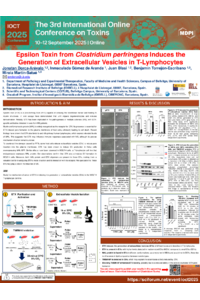
Epsilon toxin (ETX) is a pore-forming toxin (PFT) capable of crossing the blood–brain barrier and binding to myelin structures. In vitro assays have demonstrated that ETX impairs oligodendrocytes and induces demyelination. Notably, ETX has been implicated in the pathogenesis of multiple sclerosis (MS), with ETX-specific antibodies detected in sera from MS patients.
Myelin and lymphocyte protein (MAL) is widely recognized as the receptor for ETX. Its presence is essential for ETX-induced pore formation in the plasma membrane of host cells, ultimately leading to cell death. Recent findings have shown that ETX also binds to and kills primary human lymphocytes, which express elevated levels of MAL. This suggests that ETX may influence immune responses associated with MS, although its precise mechanism of action remains unclear.
To counteract the damage caused by PFTs, some host cells release extracellular vesicles (EVs) to reduce pore insertion into the plasma membrane. ETX has been shown to induce EV production in HeLa cells overexpressing MAL-GFP. Similar effects have been observed in MOLT4 cells, a T-lymphocyte line that endogenously expresses MAL protein. Our observations confirm that ETX also stimulates EV formation in MOLT4 cells. Moreover, both MAL protein and ETX oligomers are present in these EVs, making them a valuable tool for investigating ETX’s mode of action and its interaction with its receptor. We speculate that these EVs may play a role in the induction of MS.
Keywords
Epsilon toxin
MAL protein
Clostridium perfringens
extracellular microvesicles
T-Lymphocytes
MOLT4 cells
Poster
poster Jonatan Dorca-Arévalo Toxins.pdf
Bee Venom as a Source of Anti-Angiogenic Agents: A Computational Study
In Vivo High-Resolution MSSR Microscopy Reveals Cry Toxin-Induced Actin Disruption, Endocytic Activity, and Vesicle Release in Insect Midgut Cells