Event submissions
Published
This submission belongs to the session S6. Foodborne Toxins of the event The 3rd International Online Conference on Toxins
Published date
08 Sep, 2025
Academic Editor
'%3e%3cpath%20d='M12.6657%2010.9104C12.4185%2010.325%2012.0599%209.79327%2011.6097%209.34482C11.1609%208.89508%2010.6293%208.5365%2010.0442%208.28888C10.0389%208.28626%2010.0337%208.28495%2010.0285%208.28233C10.8446%207.69279%2011.3752%206.73249%2011.3752%205.64904C11.3752%203.8542%209.92103%202.39999%208.1262%202.39999C6.33136%202.39999%204.87715%203.8542%204.87715%205.64904C4.87715%206.73249%205.40774%207.69279%206.22393%208.28364C6.21869%208.28626%206.21345%208.28757%206.20821%208.29019C5.62129%208.5378%205.09463%208.89284%204.64265%209.34613C4.1929%209.79493%203.83432%2010.3266%203.58671%2010.9117C3.34345%2011.4845%203.21226%2012.0987%203.20023%2012.7209C3.19988%2012.7349%203.20233%2012.7488%203.20744%2012.7619C3.21255%2012.7749%203.22022%2012.7867%203.22998%2012.7968C3.23975%2012.8068%203.25142%2012.8147%203.26431%2012.8202C3.2772%2012.8256%203.29105%2012.8284%203.30504%2012.8284H4.09109C4.14874%2012.8284%204.19459%2012.7825%204.1959%2012.7262C4.2221%2011.7148%204.62823%2010.7676%205.34617%2010.0497C6.08899%209.30683%207.0755%208.89808%208.1262%208.89808C9.17689%208.89808%2010.1634%209.30683%2010.9062%2010.0497C11.6242%2010.7676%2012.0303%2011.7148%2012.0565%2012.7262C12.0578%2012.7838%2012.1037%2012.8284%2012.1613%2012.8284H12.9474C12.9613%2012.8284%2012.9752%2012.8256%2012.9881%2012.8202C13.001%2012.8147%2013.0126%2012.8068%2013.0224%2012.7968C13.0322%2012.7867%2013.0398%2012.7749%2013.0449%2012.7619C13.0501%2012.7488%2013.0525%2012.7349%2013.0522%2012.7209C13.0391%2012.0947%2012.9094%2011.4855%2012.6657%2010.9104ZM8.1262%207.9024C7.52486%207.9024%206.9589%207.6679%206.53312%207.24211C6.10733%206.81633%205.87283%206.25037%205.87283%205.64904C5.87283%205.0477%206.10733%204.48174%206.53312%204.05596C6.9589%203.63018%207.52486%203.39567%208.1262%203.39567C8.72753%203.39567%209.29349%203.63018%209.71927%204.05596C10.1451%204.48174%2010.3796%205.0477%2010.3796%205.64904C10.3796%206.25037%2010.1451%206.81633%209.71927%207.24211C9.29349%207.6679%208.72753%207.9024%208.1262%207.9024Z'%20fill='%235D1EE1'/%3e%3c/g%3e%3c/svg%3e) Saji George
Saji GeorgeCitation
Daniel Tavío, María José Ramos-Sosa, Andres Sanchez-Henao, Daniel Padilla, Yefermin Darias-Dágfeel, Paula María Poquet-Blat, Alejandro Doramas Cabrera-Peñate, Breixo Sánchez Alemán, Fernando Real, Evaluation of Ciguatoxin-like Activity in Non-Native Fish Species from the Canary Islands, in Proceedings of The 3rd International Online Conference on Toxins, 10 September–12 September 2025, MDPI: Basel, Switzerland
Share
Email
Facebook
Twitter
LinkedIn
Evaluation of Ciguatoxin-like Activity in Non-Native Fish Species from the Canary Islands
'%3e%3cpath%20d='M12.6647%2010.9104C12.4176%2010.325%2012.0589%209.7933%2011.6088%209.34485C11.16%208.89511%2010.6283%208.53653%2010.0432%208.28891C10.038%208.28629%2010.0327%208.28498%2010.0275%208.28236C10.8437%207.69282%2011.3743%206.73252%2011.3743%205.64907C11.3743%203.85423%209.92005%202.40002%208.12522%202.40002C6.33038%202.40002%204.87618%203.85423%204.87618%205.64907C4.87618%206.73252%205.40677%207.69282%206.22296%208.28367C6.21772%208.28629%206.21248%208.2876%206.20724%208.29022C5.62031%208.53783%205.09365%208.89287%204.64167%209.34616C4.19192%209.79496%203.83334%2010.3266%203.58573%2010.9117C3.34247%2011.4846%203.21128%2012.0987%203.19925%2012.721C3.1989%2012.735%203.20135%2012.7489%203.20646%2012.7619C3.21157%2012.7749%203.21924%2012.7868%203.22901%2012.7968C3.23877%2012.8068%203.25045%2012.8148%203.26334%2012.8202C3.27623%2012.8256%203.29007%2012.8284%203.30406%2012.8284H4.09012C4.14776%2012.8284%204.19362%2012.7825%204.19493%2012.7262C4.22113%2011.7148%204.62726%2010.7676%205.34519%2010.0497C6.08802%209.30686%207.07452%208.89811%208.12522%208.89811C9.17592%208.89811%2010.1624%209.30686%2010.9052%2010.0497C11.6232%2010.7676%2012.0293%2011.7148%2012.0555%2012.7262C12.0568%2012.7839%2012.1027%2012.8284%2012.1603%2012.8284H12.9464C12.9604%2012.8284%2012.9742%2012.8256%2012.9871%2012.8202C13%2012.8148%2013.0117%2012.8068%2013.0214%2012.7968C13.0312%2012.7868%2013.0389%2012.7749%2013.044%2012.7619C13.0491%2012.7489%2013.0515%2012.735%2013.0512%2012.721C13.0381%2012.0947%2012.9084%2011.4856%2012.6647%2010.9104ZM8.12522%207.90243C7.52388%207.90243%206.95792%207.66793%206.53214%207.24215C6.10636%206.81636%205.87185%206.2504%205.87185%205.64907C5.87185%205.04773%206.10636%204.48177%206.53214%204.05599C6.95792%203.63021%207.52388%203.3957%208.12522%203.3957C8.72655%203.3957%209.29252%203.63021%209.7183%204.05599C10.1441%204.48177%2010.3786%205.04773%2010.3786%205.64907C10.3786%206.2504%2010.1441%206.81636%209.7183%207.24215C9.29252%207.66793%208.72655%207.90243%208.12522%207.90243Z'%20fill='%235D1EE1'/%3e%3c/g%3e%3c/svg%3e)
Daniel Tavío 1
María José Ramos-Sosa 1
Andres Sanchez-Henao 1
Daniel Padilla 1
Yefermin Darias-Dágfeel 1
Paula María Poquet-Blat 1
Alejandro Doramas Cabrera-Peñate 1
Breixo Sánchez Alemán 1
Fernando Real 1
1. Fish health for aquaculture and wild species, University Institute of Animal Health and Food Safety (IUSA), University of Las Palmas de Gran Canaria, 35416 Arucas, Spain
Abstract
Marine biotoxins are natural chemical contaminants produced by a wide variety of microorganisms, such as bacteria and algae, among which ciguatoxins (CTXs) stand out.
CTXs enter the human food chain through the consumption of contaminated fish and other marine organisms, resulting in Ciguatera poisoning (CP), which is one of the most prevalent foodborne intoxications worldwide.
Although CP was historically confined to tropical and subtropical regions, the ongoing process of global warming is contributing to its geographical expansion. This occurs not only through the enhancement of environmental conditions favorable to CP-associated dinoflagellates but also via the introduction of non-native species. These invasive organisms may disrupt local ecosystems, establish new toxin reservoirs, and facilitate the persistence and spread of CTXs in previously unaffected marine environments.
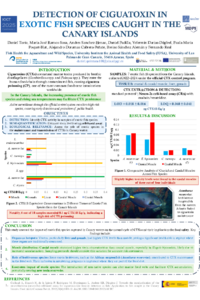
This study focuses on the Canary Islands, a recognized hotspot for CTXs and one of the few regions with an established official CTX monitoring program. Seven specimens from six different species [(Caranx crysos, n=1), (Acanthurus monroviae, n=2), (Synaphobranchus sp., n=1), (Elagatis bipinnulata, n=1), (Cephalopholis taeniops, n=1), and (Lutjanus endecacanthus, n=1)] were analyzed. CTX-like activity was assessed in muscle, liver, and gonadal tissues (when available) using the Neuro-2a MTT cell-based assay.
CTX-like toxicity was detected in six of the seven fish analyzed. Liver and gonad samples showed higher levels of toxicity compared to muscle tissue. No significant differences were observed between cranial and caudal samples in terms of toxic potential.
In conclusion, the detection of CTX-like toxicity in the majority of the specimens analyzed underscores the importance of continued surveillance of and research on non-native fish species that might act as new vectors and reservoirs for the toxin. The early detection of CTXs in exotic marine organisms is essential, as it may pose an emerging risk to food safety, public health, and the environment.
Keywords
Ciguatoxins
Non-native species
Exotic species
Canary Islands
Cell-based assay
Poster
POSTER TOXINS - Daniel Quintana Tavío - 31.08.25.pdf
The Detection of Ciguatoxins in Fish Species from two hotspot Coastal Areas of Gran Canaria (Spain): A Two-Year Study
Edulitin 2, a Ribotoxin-like protein from Boletus edulis: Assessment of its Cytotoxic Effects on Colon Adenocarcinoma Cell Lines