Event submissions
Published
This submission belongs to the session S2. Novel Insights on the Mechanism of Action and/or Pathophysiology of Toxins of the event The 3rd International Online Conference on Toxins
Published date
08 Sep, 2025
Academic Editor
'%3e%3cpath%20d='M12.6657%2010.9104C12.4185%2010.325%2012.0599%209.79327%2011.6097%209.34482C11.1609%208.89508%2010.6293%208.5365%2010.0442%208.28888C10.0389%208.28626%2010.0337%208.28495%2010.0285%208.28233C10.8446%207.69279%2011.3752%206.73249%2011.3752%205.64904C11.3752%203.8542%209.92103%202.39999%208.1262%202.39999C6.33136%202.39999%204.87715%203.8542%204.87715%205.64904C4.87715%206.73249%205.40774%207.69279%206.22393%208.28364C6.21869%208.28626%206.21345%208.28757%206.20821%208.29019C5.62129%208.5378%205.09463%208.89284%204.64265%209.34613C4.1929%209.79493%203.83432%2010.3266%203.58671%2010.9117C3.34345%2011.4845%203.21226%2012.0987%203.20023%2012.7209C3.19988%2012.7349%203.20233%2012.7488%203.20744%2012.7619C3.21255%2012.7749%203.22022%2012.7867%203.22998%2012.7968C3.23975%2012.8068%203.25142%2012.8147%203.26431%2012.8202C3.2772%2012.8256%203.29105%2012.8284%203.30504%2012.8284H4.09109C4.14874%2012.8284%204.19459%2012.7825%204.1959%2012.7262C4.2221%2011.7148%204.62823%2010.7676%205.34617%2010.0497C6.08899%209.30683%207.0755%208.89808%208.1262%208.89808C9.17689%208.89808%2010.1634%209.30683%2010.9062%2010.0497C11.6242%2010.7676%2012.0303%2011.7148%2012.0565%2012.7262C12.0578%2012.7838%2012.1037%2012.8284%2012.1613%2012.8284H12.9474C12.9613%2012.8284%2012.9752%2012.8256%2012.9881%2012.8202C13.001%2012.8147%2013.0126%2012.8068%2013.0224%2012.7968C13.0322%2012.7867%2013.0398%2012.7749%2013.0449%2012.7619C13.0501%2012.7488%2013.0525%2012.7349%2013.0522%2012.7209C13.0391%2012.0947%2012.9094%2011.4855%2012.6657%2010.9104ZM8.1262%207.9024C7.52486%207.9024%206.9589%207.6679%206.53312%207.24211C6.10733%206.81633%205.87283%206.25037%205.87283%205.64904C5.87283%205.0477%206.10733%204.48174%206.53312%204.05596C6.9589%203.63018%207.52486%203.39567%208.1262%203.39567C8.72753%203.39567%209.29349%203.63018%209.71927%204.05596C10.1451%204.48174%2010.3796%205.0477%2010.3796%205.64904C10.3796%206.25037%2010.1451%206.81633%209.71927%207.24211C9.29349%207.6679%208.72753%207.9024%208.1262%207.9024Z'%20fill='%235D1EE1'/%3e%3c/g%3e%3c/svg%3e) Joseph Barbieri
Joseph BarbieriCitation
Francesco Biscotti, Federica Falà, Massimo Bortolotti, Letizia Polito, Andrea Bolognesi, Oxidative stress and apoptosis are strongly involved in ricin-induced intestinal cell intoxication, in Proceedings of The 3rd International Online Conference on Toxins, 10 September–12 September 2025, MDPI: Basel, Switzerland
Share
Email
Facebook
Twitter
LinkedIn
Oxidative stress and apoptosis are strongly involved in ricin-induced intestinal cell intoxication

Francesco Biscotti 1

Federica Falà 1

Massimo Bortolotti 1

Letizia Polito 1

Andrea Bolognesi 1
1. Department of Medical and Surgical Sciences (DIMEC), Alma Mater Studiorum University of Bologna, 40126 Bologna, Italy
Abstract
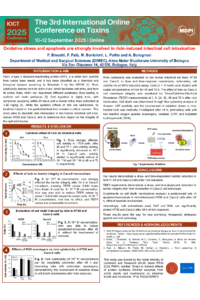
Introduction: Ricin, a type 2 ribosome-inactivating protein, is a potent lethal toxin purified from castor bean seeds and has been classed as a chemical and biological weapon according to Schedule 1 by the OPCW. Ricin's cytotoxicity results from its lectin chain, which enables cell entry, and its active chain, which can depurinate different substrates, leading to multiple cell death pathways. Although the systemic toxicity of ricin has been extensively studied, its localized effects on the gastrointestinal tract remain a critical concern, particularly in cases of oral ingestion. The aim of this study is to elucidate ricin intoxication in human intestinal cell lines and determine its impact on the integrity of the epithelial barrier.
Methods: Ricin cytotoxicity in intestinal-derived HT29 and Caco-2 cells was evaluated in dose– and time–response experiments, with cell viability determined via an MTS-reduction assay. The effect of ricin on Caco-2 cell layer integrity was monitored by Trans-Epithelial-Electrical Resistance (TEER) measurements. The involvement of oxidative stress in ricin-treated cells was indirectly investigated by pretreating cells with reactive oxygen species scavengers. Cell death was determined through cytofluorimetric analysis of AnnexinV/PI positivity.
Results: Ricin showed high cytotoxicity toward HT29 and Caco-2 cells, with EC50s ranging from 10 to 0.1 nM after 24-72 h of intoxication. Ricin strongly reduced TEER values in Caco-2 cells at 1-0.1 nM after 24 h of treatment. Ricin cytotoxicity (at 1 nM concentration) can be completely prevented by pre-incubating cells with antioxidant scavengers, demonstrating the involvement of oxidative stress in ricin cell death mechanisms. Moreover, ricin triggered only apoptosis without necrosis involvement.
Conclusions: Ricin has a potent cytotoxic effect on human intestinal cell lines that can be prevented by antioxidant scavengers. This study could pave the way for new pharmacological strategies to tackle ricin intoxication.
Keywords
ricin
ricin intoxication
intestinal-derived cell lines
toxic lectins
ribosome-inactivating proteins
rRNA glycosylases
plant toxins
chemical weapons
Poster
Biscotti_Poster Toxins 2025.pdf
Edulitin 2, a Ribotoxin-like protein from Boletus edulis: Assessment of its Cytotoxic Effects on Colon Adenocarcinoma Cell Lines
Structural Analysis of Saxitoxin and its Analogs: a Computational Study