Event submissions
Published
This submission belongs to the session S1. Plant, Animal, Insect and Microbial Toxins: New Developments of the event The 3rd International Online Conference on Toxins
Published date
08 Sep, 2025
Academic Editor
'%3e%3cpath%20d='M12.6657%2010.9104C12.4185%2010.325%2012.0599%209.79327%2011.6097%209.34482C11.1609%208.89508%2010.6293%208.5365%2010.0442%208.28888C10.0389%208.28626%2010.0337%208.28495%2010.0285%208.28233C10.8446%207.69279%2011.3752%206.73249%2011.3752%205.64904C11.3752%203.8542%209.92103%202.39999%208.1262%202.39999C6.33136%202.39999%204.87715%203.8542%204.87715%205.64904C4.87715%206.73249%205.40774%207.69279%206.22393%208.28364C6.21869%208.28626%206.21345%208.28757%206.20821%208.29019C5.62129%208.5378%205.09463%208.89284%204.64265%209.34613C4.1929%209.79493%203.83432%2010.3266%203.58671%2010.9117C3.34345%2011.4845%203.21226%2012.0987%203.20023%2012.7209C3.19988%2012.7349%203.20233%2012.7488%203.20744%2012.7619C3.21255%2012.7749%203.22022%2012.7867%203.22998%2012.7968C3.23975%2012.8068%203.25142%2012.8147%203.26431%2012.8202C3.2772%2012.8256%203.29105%2012.8284%203.30504%2012.8284H4.09109C4.14874%2012.8284%204.19459%2012.7825%204.1959%2012.7262C4.2221%2011.7148%204.62823%2010.7676%205.34617%2010.0497C6.08899%209.30683%207.0755%208.89808%208.1262%208.89808C9.17689%208.89808%2010.1634%209.30683%2010.9062%2010.0497C11.6242%2010.7676%2012.0303%2011.7148%2012.0565%2012.7262C12.0578%2012.7838%2012.1037%2012.8284%2012.1613%2012.8284H12.9474C12.9613%2012.8284%2012.9752%2012.8256%2012.9881%2012.8202C13.001%2012.8147%2013.0126%2012.8068%2013.0224%2012.7968C13.0322%2012.7867%2013.0398%2012.7749%2013.0449%2012.7619C13.0501%2012.7488%2013.0525%2012.7349%2013.0522%2012.7209C13.0391%2012.0947%2012.9094%2011.4855%2012.6657%2010.9104ZM8.1262%207.9024C7.52486%207.9024%206.9589%207.6679%206.53312%207.24211C6.10733%206.81633%205.87283%206.25037%205.87283%205.64904C5.87283%205.0477%206.10733%204.48174%206.53312%204.05596C6.9589%203.63018%207.52486%203.39567%208.1262%203.39567C8.72753%203.39567%209.29349%203.63018%209.71927%204.05596C10.1451%204.48174%2010.3796%205.0477%2010.3796%205.64904C10.3796%206.25037%2010.1451%206.81633%209.71927%207.24211C9.29349%207.6679%208.72753%207.9024%208.1262%207.9024Z'%20fill='%235D1EE1'/%3e%3c/g%3e%3c/svg%3e) Joseph Barbieri
Joseph BarbieriCitation
Antonio Cascajosa Lira, Angeles Jos, Mário J. Araújo, Isabel Benta Oliveira, María Inés Rivadeneira, Aldo Berreiro-Felpeto, Begoña Espiña, Ivone Pinheiro, Ana M. Cameán, Alexandre Campos, Growth and Metabolic Responses of Microcystis aeruginosa to Titanium Dioxide Nanoparticles, in Proceedings of The 3rd International Online Conference on Toxins, 10 September–12 September 2025, MDPI: Basel, Switzerland
Share
Email
Facebook
Twitter
LinkedIn
Growth and Metabolic Responses of Microcystis aeruginosa to Titanium Dioxide Nanoparticles

Antonio Cascajosa Lira 1

Angeles Jos 1

Mário J. Araújo 2
'%3e%3cpath%20d='M12.6647%2010.9104C12.4176%2010.325%2012.0589%209.7933%2011.6088%209.34485C11.16%208.89511%2010.6283%208.53653%2010.0432%208.28891C10.038%208.28629%2010.0327%208.28498%2010.0275%208.28236C10.8437%207.69282%2011.3743%206.73252%2011.3743%205.64907C11.3743%203.85423%209.92005%202.40002%208.12522%202.40002C6.33038%202.40002%204.87618%203.85423%204.87618%205.64907C4.87618%206.73252%205.40677%207.69282%206.22296%208.28367C6.21772%208.28629%206.21248%208.2876%206.20724%208.29022C5.62031%208.53783%205.09365%208.89287%204.64167%209.34616C4.19192%209.79496%203.83334%2010.3266%203.58573%2010.9117C3.34247%2011.4846%203.21128%2012.0987%203.19925%2012.721C3.1989%2012.735%203.20135%2012.7489%203.20646%2012.7619C3.21157%2012.7749%203.21924%2012.7868%203.22901%2012.7968C3.23877%2012.8068%203.25045%2012.8148%203.26334%2012.8202C3.27623%2012.8256%203.29007%2012.8284%203.30406%2012.8284H4.09012C4.14776%2012.8284%204.19362%2012.7825%204.19493%2012.7262C4.22113%2011.7148%204.62726%2010.7676%205.34519%2010.0497C6.08802%209.30686%207.07452%208.89811%208.12522%208.89811C9.17592%208.89811%2010.1624%209.30686%2010.9052%2010.0497C11.6232%2010.7676%2012.0293%2011.7148%2012.0555%2012.7262C12.0568%2012.7839%2012.1027%2012.8284%2012.1603%2012.8284H12.9464C12.9604%2012.8284%2012.9742%2012.8256%2012.9871%2012.8202C13%2012.8148%2013.0117%2012.8068%2013.0214%2012.7968C13.0312%2012.7868%2013.0389%2012.7749%2013.044%2012.7619C13.0491%2012.7489%2013.0515%2012.735%2013.0512%2012.721C13.0381%2012.0947%2012.9084%2011.4856%2012.6647%2010.9104ZM8.12522%207.90243C7.52388%207.90243%206.95792%207.66793%206.53214%207.24215C6.10636%206.81636%205.87185%206.2504%205.87185%205.64907C5.87185%205.04773%206.10636%204.48177%206.53214%204.05599C6.95792%203.63021%207.52388%203.3957%208.12522%203.3957C8.72655%203.3957%209.29252%203.63021%209.7183%204.05599C10.1441%204.48177%2010.3786%205.04773%2010.3786%205.64907C10.3786%206.2504%2010.1441%206.81636%209.7183%207.24215C9.29252%207.66793%208.72655%207.90243%208.12522%207.90243Z'%20fill='%235D1EE1'/%3e%3c/g%3e%3c/svg%3e)
Isabel Benta Oliveira 2
María Inés Rivadeneira 2
Aldo Berreiro-Felpeto 2

Begoña Espiña 3
Ivone Pinheiro 3

Ana M. Cameán 1

Alexandre Campos 2
1. Area of Toxicology, Faculty of Pharmacy, University of Seville, Seville, Spain
2. CIIMAR- Interdisciplinary Center of Marine and Environmental Research, Av General Norton de Matos S/N, 4450-208 Matosinhos, Portugal
3. International Iberian Nanotechnology Laboratory, Braga, Portugal
Abstract
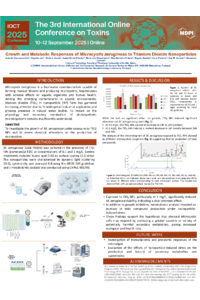
Microcystis aeruginosa is a freshwater cyanobacterium capable of forming massive blooms and producing microcystins, hepatotoxins with adverse effects on aquatic organisms and human health. Among the emerging contaminants in aquatic environments, titanium dioxide (TiO₂) in nanoparticle (NP) form has garnered increasing attention due to its widespread industrial application and growing presence in natural water bodies. Its impact on the physiology and secondary metabolism of photosynthetic microorganisms remains insufficiently understood. In this study, M. aeruginosa (LEGE-91096) was cultured in the presence of TiO₂ NPs (commercial P25) at concentrations of 0.1 and 1 mg/L. Control treatments included humic acid as a surface coating (1:1 ratio). The stability of the nanoparticles in the culture medium was characterized by DLS, and their growth rate was assessed using the OECD 201 protocol. Metabolite profiling was performed via UHPLC-MS/MS, and data analysis was conducted using Compound Discoverer software to identify variations in bioactive compound production. According to OECD 201 results, TiO₂ nanoparticles at 0.1 and 1 mg/L did not significantly affect Microcystis aeruginosa growth. Ongoing analysis will further allow us to explain the molecular mechanisms underlying the interaction between TiO₂ nanoparticles and cyanobacterial metabolic pathways, particularly those involved in microcystin and other bioactive compound biosynthesis.
Acknowledgement: ACL wishes to thank AUIP for the awarding of the mobility scholarship within the Magallanes Program (2025). This work was also supported by the Portuguese Foundation for the Science and Technology (FCT) through the project NanoPlanet 2022.02340.PTDC and UIDB/04423/2020 and UIDP/04423/2020 contracts. IBO and MJA also acknowledge FCT funding for the Scientific Employment Stimulus Program (10.13039/501100001871.CEECIND/01368/2018 and 2023.06491.CEECIND).
Keywords
Nanoparticles
Cyanobacteria
Titanium Dioxide
Microcystin
UHPLC-MS/MS
Poster
poster IOCT ACL DEF.pdf
A further elucidation of the venom proteome of Australian Elapid Pseudechis australis
Determination of Cannabinoids in Hemp Seeds, Oil, and Tea Samples Using LC-MS/MS