Event submissions
Published
This submission belongs to the session S6. Foodborne Toxins of the event The 3rd International Online Conference on Toxins
Published date
08 Sep, 2025
Academic Editor
'%3e%3cpath%20d='M12.6657%2010.9104C12.4185%2010.325%2012.0599%209.79327%2011.6097%209.34482C11.1609%208.89508%2010.6293%208.5365%2010.0442%208.28888C10.0389%208.28626%2010.0337%208.28495%2010.0285%208.28233C10.8446%207.69279%2011.3752%206.73249%2011.3752%205.64904C11.3752%203.8542%209.92103%202.39999%208.1262%202.39999C6.33136%202.39999%204.87715%203.8542%204.87715%205.64904C4.87715%206.73249%205.40774%207.69279%206.22393%208.28364C6.21869%208.28626%206.21345%208.28757%206.20821%208.29019C5.62129%208.5378%205.09463%208.89284%204.64265%209.34613C4.1929%209.79493%203.83432%2010.3266%203.58671%2010.9117C3.34345%2011.4845%203.21226%2012.0987%203.20023%2012.7209C3.19988%2012.7349%203.20233%2012.7488%203.20744%2012.7619C3.21255%2012.7749%203.22022%2012.7867%203.22998%2012.7968C3.23975%2012.8068%203.25142%2012.8147%203.26431%2012.8202C3.2772%2012.8256%203.29105%2012.8284%203.30504%2012.8284H4.09109C4.14874%2012.8284%204.19459%2012.7825%204.1959%2012.7262C4.2221%2011.7148%204.62823%2010.7676%205.34617%2010.0497C6.08899%209.30683%207.0755%208.89808%208.1262%208.89808C9.17689%208.89808%2010.1634%209.30683%2010.9062%2010.0497C11.6242%2010.7676%2012.0303%2011.7148%2012.0565%2012.7262C12.0578%2012.7838%2012.1037%2012.8284%2012.1613%2012.8284H12.9474C12.9613%2012.8284%2012.9752%2012.8256%2012.9881%2012.8202C13.001%2012.8147%2013.0126%2012.8068%2013.0224%2012.7968C13.0322%2012.7867%2013.0398%2012.7749%2013.0449%2012.7619C13.0501%2012.7488%2013.0525%2012.7349%2013.0522%2012.7209C13.0391%2012.0947%2012.9094%2011.4855%2012.6657%2010.9104ZM8.1262%207.9024C7.52486%207.9024%206.9589%207.6679%206.53312%207.24211C6.10733%206.81633%205.87283%206.25037%205.87283%205.64904C5.87283%205.0477%206.10733%204.48174%206.53312%204.05596C6.9589%203.63018%207.52486%203.39567%208.1262%203.39567C8.72753%203.39567%209.29349%203.63018%209.71927%204.05596C10.1451%204.48174%2010.3796%205.0477%2010.3796%205.64904C10.3796%206.25037%2010.1451%206.81633%209.71927%207.24211C9.29349%207.6679%208.72753%207.9024%208.1262%207.9024Z'%20fill='%235D1EE1'/%3e%3c/g%3e%3c/svg%3e) Saji George
Saji GeorgeCitation
Ewelina Kowalczyk, Determination of Cannabinoids in Hemp Seeds, Oil, and Tea Samples Using LC-MS/MS, in Proceedings of The 3rd International Online Conference on Toxins, 10 September–12 September 2025, MDPI: Basel, Switzerland
Share
Email
Facebook
Twitter
LinkedIn
Determination of Cannabinoids in Hemp Seeds, Oil, and Tea Samples Using LC-MS/MS
'%3e%3cpath%20d='M12.6647%2010.9104C12.4176%2010.325%2012.0589%209.7933%2011.6088%209.34485C11.16%208.89511%2010.6283%208.53653%2010.0432%208.28891C10.038%208.28629%2010.0327%208.28498%2010.0275%208.28236C10.8437%207.69282%2011.3743%206.73252%2011.3743%205.64907C11.3743%203.85423%209.92005%202.40002%208.12522%202.40002C6.33038%202.40002%204.87618%203.85423%204.87618%205.64907C4.87618%206.73252%205.40677%207.69282%206.22296%208.28367C6.21772%208.28629%206.21248%208.2876%206.20724%208.29022C5.62031%208.53783%205.09365%208.89287%204.64167%209.34616C4.19192%209.79496%203.83334%2010.3266%203.58573%2010.9117C3.34247%2011.4846%203.21128%2012.0987%203.19925%2012.721C3.1989%2012.735%203.20135%2012.7489%203.20646%2012.7619C3.21157%2012.7749%203.21924%2012.7868%203.22901%2012.7968C3.23877%2012.8068%203.25045%2012.8148%203.26334%2012.8202C3.27623%2012.8256%203.29007%2012.8284%203.30406%2012.8284H4.09012C4.14776%2012.8284%204.19362%2012.7825%204.19493%2012.7262C4.22113%2011.7148%204.62726%2010.7676%205.34519%2010.0497C6.08802%209.30686%207.07452%208.89811%208.12522%208.89811C9.17592%208.89811%2010.1624%209.30686%2010.9052%2010.0497C11.6232%2010.7676%2012.0293%2011.7148%2012.0555%2012.7262C12.0568%2012.7839%2012.1027%2012.8284%2012.1603%2012.8284H12.9464C12.9604%2012.8284%2012.9742%2012.8256%2012.9871%2012.8202C13%2012.8148%2013.0117%2012.8068%2013.0214%2012.7968C13.0312%2012.7868%2013.0389%2012.7749%2013.044%2012.7619C13.0491%2012.7489%2013.0515%2012.735%2013.0512%2012.721C13.0381%2012.0947%2012.9084%2011.4856%2012.6647%2010.9104ZM8.12522%207.90243C7.52388%207.90243%206.95792%207.66793%206.53214%207.24215C6.10636%206.81636%205.87185%206.2504%205.87185%205.64907C5.87185%205.04773%206.10636%204.48177%206.53214%204.05599C6.95792%203.63021%207.52388%203.3957%208.12522%203.3957C8.72655%203.3957%209.29252%203.63021%209.7183%204.05599C10.1441%204.48177%2010.3786%205.04773%2010.3786%205.64907C10.3786%206.2504%2010.1441%206.81636%209.7183%207.24215C9.29252%207.66793%208.72655%207.90243%208.12522%207.90243Z'%20fill='%235D1EE1'/%3e%3c/g%3e%3c/svg%3e)
Ewelina Kowalczyk 1
1. Department of Chemical Research of Food and Feed, National Veterinary Research Institute, Puławy, 24 - 100, Poland
Abstract
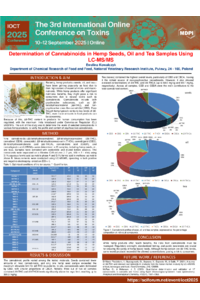
Introduction: Recently, hemp products—seeds, oil, and tea—have been gaining popularity as food due to their high content of essential micro- and macro-nutrients. While hemp products offer significant nutritional benefits, they might pose a risk to consumers due to natural toxins such as cannabinoids. Cannabinoids include both psychoactive substances, such as Δ9-tetrahydrocannabinol (Δ9-THC), and non-psychoactive ones like cannabidiol (CBD). Even though hemp typically contains low levels of Δ9-THC, even trace amounts in food products can be concerning. Because of this, Δ9-THC content in products for human consumption has been regulated, with the maximum limits introduced under Commission Regulation (EU) 2023/915.
Methods: Nine cannabinoids—Δ9-tetrahydrocannabinol, Δ8-tetrahydrocannabinol, cannabinol, cannabidiol, Δ9-tetrahydrocannabivarin, cannabigerol, Δ9-tetrahydrocannabinolic acid (Δ9-THCA), cannabidiolic acid (CBDA), and cannabigerolic acid—were determined in 25 samples, including hemp seeds, oil, and teas. Samples were extracted with acetonitrile and diluted before analysis. Measurements were conducted using LC-MS/MS, operating in both positive and negative electrospray ionization (ESI+/-).
Results: Cannabinoid content varied with the tested materials. The highest concentrations of Δ9-THC and Δ9-THCA were found in tea samples (37.6–168.0 mg/kg and 28.2–69.7 mg/kg). Three of five oils contained significantly more (up to 398.3 mg/kg) Δ9-THC and Δ9-THCA than allowed. Only one hemp seed sample had Δ9-THC equivalents exceeding the maximum limit. Among all compounds, CBD and CBDA were found in the highest concentrations across all samples.
Conclusions: While hemp products offer health benefits, the risks from cannabinoids must be managed. Regulatory oversight, standardized testing, and public awareness are crucial for ensuring the safety of hemp-based foods. Although hemp contains low Δ9-THC levels, some tested foods exceeded the allowed concentrations, posing a risk to consumers.
Keywords
cannabinoids
food
LC-MS/MS
Poster
Determination of Cannabinoids in Hemp Seeds, Oil and Tea Samples Using LC-MSMS E.Kowalczyk.pdf
Growth and Metabolic Responses of Microcystis aeruginosa to Titanium Dioxide Nanoparticles
Bee Venom Proteins Modulate the Ability of Phospholipid Membranes of the Myelin Sheath and Endoplasmic Reticulum to Absorb Protons from Bulk Water: Pharmacological Relevance