Event submissions
Published
This submission belongs to the session S3. Use of Toxins as Tools for Research, Drug Discovery, and Therapeutics of the event The 3rd International Online Conference on Toxins
Published date
08 Sep, 2025
Academic Editor
'%3e%3cpath%20d='M12.6657%2010.9104C12.4185%2010.325%2012.0599%209.79327%2011.6097%209.34482C11.1609%208.89508%2010.6293%208.5365%2010.0442%208.28888C10.0389%208.28626%2010.0337%208.28495%2010.0285%208.28233C10.8446%207.69279%2011.3752%206.73249%2011.3752%205.64904C11.3752%203.8542%209.92103%202.39999%208.1262%202.39999C6.33136%202.39999%204.87715%203.8542%204.87715%205.64904C4.87715%206.73249%205.40774%207.69279%206.22393%208.28364C6.21869%208.28626%206.21345%208.28757%206.20821%208.29019C5.62129%208.5378%205.09463%208.89284%204.64265%209.34613C4.1929%209.79493%203.83432%2010.3266%203.58671%2010.9117C3.34345%2011.4845%203.21226%2012.0987%203.20023%2012.7209C3.19988%2012.7349%203.20233%2012.7488%203.20744%2012.7619C3.21255%2012.7749%203.22022%2012.7867%203.22998%2012.7968C3.23975%2012.8068%203.25142%2012.8147%203.26431%2012.8202C3.2772%2012.8256%203.29105%2012.8284%203.30504%2012.8284H4.09109C4.14874%2012.8284%204.19459%2012.7825%204.1959%2012.7262C4.2221%2011.7148%204.62823%2010.7676%205.34617%2010.0497C6.08899%209.30683%207.0755%208.89808%208.1262%208.89808C9.17689%208.89808%2010.1634%209.30683%2010.9062%2010.0497C11.6242%2010.7676%2012.0303%2011.7148%2012.0565%2012.7262C12.0578%2012.7838%2012.1037%2012.8284%2012.1613%2012.8284H12.9474C12.9613%2012.8284%2012.9752%2012.8256%2012.9881%2012.8202C13.001%2012.8147%2013.0126%2012.8068%2013.0224%2012.7968C13.0322%2012.7867%2013.0398%2012.7749%2013.0449%2012.7619C13.0501%2012.7488%2013.0525%2012.7349%2013.0522%2012.7209C13.0391%2012.0947%2012.9094%2011.4855%2012.6657%2010.9104ZM8.1262%207.9024C7.52486%207.9024%206.9589%207.6679%206.53312%207.24211C6.10733%206.81633%205.87283%206.25037%205.87283%205.64904C5.87283%205.0477%206.10733%204.48174%206.53312%204.05596C6.9589%203.63018%207.52486%203.39567%208.1262%203.39567C8.72753%203.39567%209.29349%203.63018%209.71927%204.05596C10.1451%204.48174%2010.3796%205.0477%2010.3796%205.64904C10.3796%206.25037%2010.1451%206.81633%209.71927%207.24211C9.29349%207.6679%208.72753%207.9024%208.1262%207.9024Z'%20fill='%235D1EE1'/%3e%3c/g%3e%3c/svg%3e) Nilgun E. Tumer
Nilgun E. TumerCitation
Jay Yourist, John A Bogdan, Development of Broad-Spectrum Antiviral and Antitumor Therapeutics from Cobra Toxin (NT3) for Veterinary and Human Use, in Proceedings of The 3rd International Online Conference on Toxins, 10 September–12 September 2025, MDPI: Basel, Switzerland
Share
Email
Facebook
Twitter
LinkedIn
Development of Broad-Spectrum Antiviral and Antitumor Therapeutics from Cobra Toxin (NT3) for Veterinary and Human Use
'%3e%3cpath%20d='M12.6647%2010.9104C12.4176%2010.325%2012.0589%209.7933%2011.6088%209.34485C11.16%208.89511%2010.6283%208.53653%2010.0432%208.28891C10.038%208.28629%2010.0327%208.28498%2010.0275%208.28236C10.8437%207.69282%2011.3743%206.73252%2011.3743%205.64907C11.3743%203.85423%209.92005%202.40002%208.12522%202.40002C6.33038%202.40002%204.87618%203.85423%204.87618%205.64907C4.87618%206.73252%205.40677%207.69282%206.22296%208.28367C6.21772%208.28629%206.21248%208.2876%206.20724%208.29022C5.62031%208.53783%205.09365%208.89287%204.64167%209.34616C4.19192%209.79496%203.83334%2010.3266%203.58573%2010.9117C3.34247%2011.4846%203.21128%2012.0987%203.19925%2012.721C3.1989%2012.735%203.20135%2012.7489%203.20646%2012.7619C3.21157%2012.7749%203.21924%2012.7868%203.22901%2012.7968C3.23877%2012.8068%203.25045%2012.8148%203.26334%2012.8202C3.27623%2012.8256%203.29007%2012.8284%203.30406%2012.8284H4.09012C4.14776%2012.8284%204.19362%2012.7825%204.19493%2012.7262C4.22113%2011.7148%204.62726%2010.7676%205.34519%2010.0497C6.08802%209.30686%207.07452%208.89811%208.12522%208.89811C9.17592%208.89811%2010.1624%209.30686%2010.9052%2010.0497C11.6232%2010.7676%2012.0293%2011.7148%2012.0555%2012.7262C12.0568%2012.7839%2012.1027%2012.8284%2012.1603%2012.8284H12.9464C12.9604%2012.8284%2012.9742%2012.8256%2012.9871%2012.8202C13%2012.8148%2013.0117%2012.8068%2013.0214%2012.7968C13.0312%2012.7868%2013.0389%2012.7749%2013.044%2012.7619C13.0491%2012.7489%2013.0515%2012.735%2013.0512%2012.721C13.0381%2012.0947%2012.9084%2011.4856%2012.6647%2010.9104ZM8.12522%207.90243C7.52388%207.90243%206.95792%207.66793%206.53214%207.24215C6.10636%206.81636%205.87185%206.2504%205.87185%205.64907C5.87185%205.04773%206.10636%204.48177%206.53214%204.05599C6.95792%203.63021%207.52388%203.3957%208.12522%203.3957C8.72655%203.3957%209.29252%203.63021%209.7183%204.05599C10.1441%204.48177%2010.3786%205.04773%2010.3786%205.64907C10.3786%206.2504%2010.1441%206.81636%209.7183%207.24215C9.29252%207.66793%208.72655%207.90243%208.12522%207.90243Z'%20fill='%235D1EE1'/%3e%3c/g%3e%3c/svg%3e)
Jay Yourist 1
John A Bogdan 1
1. CYGNOS BioTech, LLC, P.O. Box 160471, Miami, Fl 33116-0471, USA
Abstract
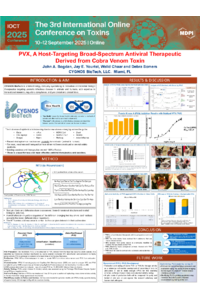
Introduction: CYGNOS BioTech is pioneering the development of broad-spectrum antiviral (PVX) and antitumor (MMX) biologic products for both veterinary and human applications. Our innovative technology has led to the issuance of nine patents covering composition, process, and usage. The US FDA has granted two Investigational New Animal Drug Applications for 1) a non-specific antiviral drug for companion animals and 2) an antitumor drug for stage II and III canine oral malignant melanoma.
Methods: PVX and MMX are derived from cobra venom toxin (NT3) through fractionation followed by proprietary chemical processes to achieve detoxification and specific biologic activities.
Results: Preliminary data suggest that PVX's antiviral activity targets host-cell mechanisms rather than the virus. PVX inhibits Protein Kinase activities, potentially affecting cellular pathways related to transcription and translation. Clinical studies in dogs, cats, and horses demonstrate significant antiviral and antitumor effects without adverse events. PVX appears effective for most viral infections, including enveloped RNA and DNA viruses such as canine distemper virus (paramyxovirus), Human and Feline Herpes viruses, and Feline Corona virus causing Feline Infectious Peritonitis (FIP).
Conclusions: The global community faces increasing threats from emerging zoonotic diseases and bio-terrorism activities. The potential for a new pandemic or the release of genetically engineered viruses is a real and devastating concern. CYGNOS BioTech’s technology serves as a potential platform to treat infectious diseases, applicable across veterinary, public health, and military sectors. The availability of a drug capable of addressing emerging and genetically engineered viruses as a first line of defense could have a profound impact.
Keywords
Broad-Spectrum
Antiviral
Enveloped RNA and DNA viruses
Antitumor
Cobra Toxin
NT3
Zoonotic Diseases
Recombinant NT3
Poster
CYGNOS_Poster_IOCT2025_Bogdan final.pdf
Bee Venom Proteins Modulate the Ability of Phospholipid Membranes of the Myelin Sheath and Endoplasmic Reticulum to Absorb Protons from Bulk Water: Pharmacological Relevance
Structural Analysis of Saxitoxin and Neosaxitoxin Toxins with Potential Therapeutic Targets