Event submissions
Published
This submission belongs to the session S3. Use of Toxins as Tools for Research, Drug Discovery, and Therapeutics of the event The 3rd International Online Conference on Toxins
Published date
08 Sep, 2025
Academic Editor
'%3e%3cpath%20d='M12.6657%2010.9104C12.4185%2010.325%2012.0599%209.79327%2011.6097%209.34482C11.1609%208.89508%2010.6293%208.5365%2010.0442%208.28888C10.0389%208.28626%2010.0337%208.28495%2010.0285%208.28233C10.8446%207.69279%2011.3752%206.73249%2011.3752%205.64904C11.3752%203.8542%209.92103%202.39999%208.1262%202.39999C6.33136%202.39999%204.87715%203.8542%204.87715%205.64904C4.87715%206.73249%205.40774%207.69279%206.22393%208.28364C6.21869%208.28626%206.21345%208.28757%206.20821%208.29019C5.62129%208.5378%205.09463%208.89284%204.64265%209.34613C4.1929%209.79493%203.83432%2010.3266%203.58671%2010.9117C3.34345%2011.4845%203.21226%2012.0987%203.20023%2012.7209C3.19988%2012.7349%203.20233%2012.7488%203.20744%2012.7619C3.21255%2012.7749%203.22022%2012.7867%203.22998%2012.7968C3.23975%2012.8068%203.25142%2012.8147%203.26431%2012.8202C3.2772%2012.8256%203.29105%2012.8284%203.30504%2012.8284H4.09109C4.14874%2012.8284%204.19459%2012.7825%204.1959%2012.7262C4.2221%2011.7148%204.62823%2010.7676%205.34617%2010.0497C6.08899%209.30683%207.0755%208.89808%208.1262%208.89808C9.17689%208.89808%2010.1634%209.30683%2010.9062%2010.0497C11.6242%2010.7676%2012.0303%2011.7148%2012.0565%2012.7262C12.0578%2012.7838%2012.1037%2012.8284%2012.1613%2012.8284H12.9474C12.9613%2012.8284%2012.9752%2012.8256%2012.9881%2012.8202C13.001%2012.8147%2013.0126%2012.8068%2013.0224%2012.7968C13.0322%2012.7867%2013.0398%2012.7749%2013.0449%2012.7619C13.0501%2012.7488%2013.0525%2012.7349%2013.0522%2012.7209C13.0391%2012.0947%2012.9094%2011.4855%2012.6657%2010.9104ZM8.1262%207.9024C7.52486%207.9024%206.9589%207.6679%206.53312%207.24211C6.10733%206.81633%205.87283%206.25037%205.87283%205.64904C5.87283%205.0477%206.10733%204.48174%206.53312%204.05596C6.9589%203.63018%207.52486%203.39567%208.1262%203.39567C8.72753%203.39567%209.29349%203.63018%209.71927%204.05596C10.1451%204.48174%2010.3796%205.0477%2010.3796%205.64904C10.3796%206.25037%2010.1451%206.81633%209.71927%207.24211C9.29349%207.6679%208.72753%207.9024%208.1262%207.9024Z'%20fill='%235D1EE1'/%3e%3c/g%3e%3c/svg%3e) Nilgun E. Tumer
Nilgun E. TumerCitation
Anastasia A. Ignatova, Anastasia V. Efremenko, Denis V. Abramochkin, Irina Dzhumaniiazova, Victoria A. Toporova, Ivan I. Shmatin, Alexey V. Feofanov, Oksana V. Nekrasova, Epilepsy-associated mutation T226R in Kv1.1 subunit: properties of heterotetrameric Kv1.1(T226R)-Kv1.2 channel, in Proceedings of The 3rd International Online Conference on Toxins, 10 September–12 September 2025, MDPI: Basel, Switzerland
Share
Email
Facebook
Twitter
LinkedIn
Epilepsy-associated mutation T226R in Kv1.1 subunit: properties of heterotetrameric Kv1.1(T226R)-Kv1.2 channel
'%3e%3cpath%20d='M12.6647%2010.9104C12.4176%2010.325%2012.0589%209.7933%2011.6088%209.34485C11.16%208.89511%2010.6283%208.53653%2010.0432%208.28891C10.038%208.28629%2010.0327%208.28498%2010.0275%208.28236C10.8437%207.69282%2011.3743%206.73252%2011.3743%205.64907C11.3743%203.85423%209.92005%202.40002%208.12522%202.40002C6.33038%202.40002%204.87618%203.85423%204.87618%205.64907C4.87618%206.73252%205.40677%207.69282%206.22296%208.28367C6.21772%208.28629%206.21248%208.2876%206.20724%208.29022C5.62031%208.53783%205.09365%208.89287%204.64167%209.34616C4.19192%209.79496%203.83334%2010.3266%203.58573%2010.9117C3.34247%2011.4846%203.21128%2012.0987%203.19925%2012.721C3.1989%2012.735%203.20135%2012.7489%203.20646%2012.7619C3.21157%2012.7749%203.21924%2012.7868%203.22901%2012.7968C3.23877%2012.8068%203.25045%2012.8148%203.26334%2012.8202C3.27623%2012.8256%203.29007%2012.8284%203.30406%2012.8284H4.09012C4.14776%2012.8284%204.19362%2012.7825%204.19493%2012.7262C4.22113%2011.7148%204.62726%2010.7676%205.34519%2010.0497C6.08802%209.30686%207.07452%208.89811%208.12522%208.89811C9.17592%208.89811%2010.1624%209.30686%2010.9052%2010.0497C11.6232%2010.7676%2012.0293%2011.7148%2012.0555%2012.7262C12.0568%2012.7839%2012.1027%2012.8284%2012.1603%2012.8284H12.9464C12.9604%2012.8284%2012.9742%2012.8256%2012.9871%2012.8202C13%2012.8148%2013.0117%2012.8068%2013.0214%2012.7968C13.0312%2012.7868%2013.0389%2012.7749%2013.044%2012.7619C13.0491%2012.7489%2013.0515%2012.735%2013.0512%2012.721C13.0381%2012.0947%2012.9084%2011.4856%2012.6647%2010.9104ZM8.12522%207.90243C7.52388%207.90243%206.95792%207.66793%206.53214%207.24215C6.10636%206.81636%205.87185%206.2504%205.87185%205.64907C5.87185%205.04773%206.10636%204.48177%206.53214%204.05599C6.95792%203.63021%207.52388%203.3957%208.12522%203.3957C8.72655%203.3957%209.29252%203.63021%209.7183%204.05599C10.1441%204.48177%2010.3786%205.04773%2010.3786%205.64907C10.3786%206.2504%2010.1441%206.81636%209.7183%207.24215C9.29252%207.66793%208.72655%207.90243%208.12522%207.90243Z'%20fill='%235D1EE1'/%3e%3c/g%3e%3c/svg%3e)
Anastasia A. Ignatova 1
Anastasia V. Efremenko 1
Denis V. Abramochkin 2

Irina Dzhumaniiazova 2
Victoria A. Toporova 1

Ivan I. Shmatin 1

Alexey V. Feofanov 1,2
Oksana V. Nekrasova 1
1. Shemyakin-Ovchinnikov Institute of Boorganic Chemistry, Russian Academy of Sciences, Moscow 117997, Russia
2. Faculty of Biology, Lomonosov Moscow State University, Moscow 119234, Russia
Abstract
Introduction
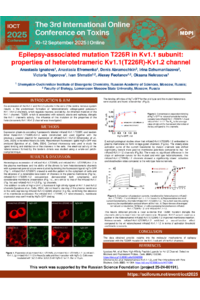
Co-expression of the Kv1.1 and Kv1.2 subunits in the cells of the central nervous system results in the predominant formation of heterotetrameric voltage-gated potassium Kv1.1/Kv1.2 channels, which regulate neuronal excitability. An inherited mutation of the Kv1.1 channel, T226R, which is associated with episodic ataxia and epilepsy, disrupts the Kv1.1 channel's activity. The influence of this mutation on the properties of the heterotetrameric Kv1.1/Kv1.2 channel needs to be investigated.
Methods
Expression plasmids encoding fluorescently labeled mKate2-Kv1.1(T226R) and tandem dimers mKate2-Kv1.1-Kv1.2 and mKate2-Kv1.1(T226R)-Kv1.2 were constructed and used to transfect Neuro-2a cells. Recombinant peptide toxins and the fluorescent ligand HgTx-GFP were produced. Confocal microscopy was used to study the ligand binding and distribution of the channels in the cells. The electrical activity of the heterotetrameric channels formed by the tandem dimers was studied using a whole-cell patch-clamp technique.
Results
The expression of mKate2-Kv1.1(T226R) and mKate2-Kv1.1(T226R)-Kv1.2 in the plasma membrane and the ability of the dimers to form heterotetrameric channels with a preserved pore structure were studied by binding the fluorescent ligand HgTx-GFP. The binding affinities of peptide blockers for the wild type and the mutant heteromers were studied in a competitive assay. The activation and deactivation constants, as well as the voltage dependence, were measured for the heteromeric channels formed by the Kv1.1(T226R)-Kv1.2 and Kv1.1-Kv1.2 dimers. The essential differences that were identified in these studies are discussed.
Conclusions
The data obtained provide insights into the molecular mechanisms of epilepsy associated with the T226R mutation in the Kv1.1 subunit of the Kv1 channels.
Acknowledgements. This work was supported by the Russian Science Foundation (project 25-24-00191).
Keywords
Kv1.1 channel
mutant
T226R
epilepsy
heteromeric channels
peptide blocker
fluorescent confocal microscopy
whole-cell patch-clamp
Poster
Ignatova Poster-IOCT2025.pdf
Effects of heterodimeric phospholipase A2 from the venom of Vipera nikolskii on rat cardiomyocytes
Physiological and biochemical effects of toxigenic Aspergillus flavus on maize (Zea mays)