Event submissions
Published
This submission belongs to the session S1. Plant, Animal, Insect and Microbial Toxins: New Developments of the event The 3rd International Online Conference on Toxins
Published date
08 Sep, 2025
Academic Editor
'%3e%3cpath%20d='M12.6657%2010.9104C12.4185%2010.325%2012.0599%209.79327%2011.6097%209.34482C11.1609%208.89508%2010.6293%208.5365%2010.0442%208.28888C10.0389%208.28626%2010.0337%208.28495%2010.0285%208.28233C10.8446%207.69279%2011.3752%206.73249%2011.3752%205.64904C11.3752%203.8542%209.92103%202.39999%208.1262%202.39999C6.33136%202.39999%204.87715%203.8542%204.87715%205.64904C4.87715%206.73249%205.40774%207.69279%206.22393%208.28364C6.21869%208.28626%206.21345%208.28757%206.20821%208.29019C5.62129%208.5378%205.09463%208.89284%204.64265%209.34613C4.1929%209.79493%203.83432%2010.3266%203.58671%2010.9117C3.34345%2011.4845%203.21226%2012.0987%203.20023%2012.7209C3.19988%2012.7349%203.20233%2012.7488%203.20744%2012.7619C3.21255%2012.7749%203.22022%2012.7867%203.22998%2012.7968C3.23975%2012.8068%203.25142%2012.8147%203.26431%2012.8202C3.2772%2012.8256%203.29105%2012.8284%203.30504%2012.8284H4.09109C4.14874%2012.8284%204.19459%2012.7825%204.1959%2012.7262C4.2221%2011.7148%204.62823%2010.7676%205.34617%2010.0497C6.08899%209.30683%207.0755%208.89808%208.1262%208.89808C9.17689%208.89808%2010.1634%209.30683%2010.9062%2010.0497C11.6242%2010.7676%2012.0303%2011.7148%2012.0565%2012.7262C12.0578%2012.7838%2012.1037%2012.8284%2012.1613%2012.8284H12.9474C12.9613%2012.8284%2012.9752%2012.8256%2012.9881%2012.8202C13.001%2012.8147%2013.0126%2012.8068%2013.0224%2012.7968C13.0322%2012.7867%2013.0398%2012.7749%2013.0449%2012.7619C13.0501%2012.7488%2013.0525%2012.7349%2013.0522%2012.7209C13.0391%2012.0947%2012.9094%2011.4855%2012.6657%2010.9104ZM8.1262%207.9024C7.52486%207.9024%206.9589%207.6679%206.53312%207.24211C6.10733%206.81633%205.87283%206.25037%205.87283%205.64904C5.87283%205.0477%206.10733%204.48174%206.53312%204.05596C6.9589%203.63018%207.52486%203.39567%208.1262%203.39567C8.72753%203.39567%209.29349%203.63018%209.71927%204.05596C10.1451%204.48174%2010.3796%205.0477%2010.3796%205.64904C10.3796%206.25037%2010.1451%206.81633%209.71927%207.24211C9.29349%207.6679%208.72753%207.9024%208.1262%207.9024Z'%20fill='%235D1EE1'/%3e%3c/g%3e%3c/svg%3e) Joseph Barbieri
Joseph BarbieriCitation
Camila Rojo, José María Niz, Germán Ariel Dalinger, Leila Melina Ortiz, Augusto Salas, Diego Herman Sauka, Exploring the biocidal properties of Bacillus thuringiensis INTA Mo1-10 through genomic and phenotypic analysis, in Proceedings of The 3rd International Online Conference on Toxins, 10 September–12 September 2025, MDPI: Basel, Switzerland
Share
Email
Facebook
Twitter
LinkedIn
Exploring the biocidal properties of Bacillus thuringiensis INTA Mo1-10 through genomic and phenotypic analysis
'%3e%3cpath%20d='M12.6647%2010.9104C12.4176%2010.325%2012.0589%209.7933%2011.6088%209.34485C11.16%208.89511%2010.6283%208.53653%2010.0432%208.28891C10.038%208.28629%2010.0327%208.28498%2010.0275%208.28236C10.8437%207.69282%2011.3743%206.73252%2011.3743%205.64907C11.3743%203.85423%209.92005%202.40002%208.12522%202.40002C6.33038%202.40002%204.87618%203.85423%204.87618%205.64907C4.87618%206.73252%205.40677%207.69282%206.22296%208.28367C6.21772%208.28629%206.21248%208.2876%206.20724%208.29022C5.62031%208.53783%205.09365%208.89287%204.64167%209.34616C4.19192%209.79496%203.83334%2010.3266%203.58573%2010.9117C3.34247%2011.4846%203.21128%2012.0987%203.19925%2012.721C3.1989%2012.735%203.20135%2012.7489%203.20646%2012.7619C3.21157%2012.7749%203.21924%2012.7868%203.22901%2012.7968C3.23877%2012.8068%203.25045%2012.8148%203.26334%2012.8202C3.27623%2012.8256%203.29007%2012.8284%203.30406%2012.8284H4.09012C4.14776%2012.8284%204.19362%2012.7825%204.19493%2012.7262C4.22113%2011.7148%204.62726%2010.7676%205.34519%2010.0497C6.08802%209.30686%207.07452%208.89811%208.12522%208.89811C9.17592%208.89811%2010.1624%209.30686%2010.9052%2010.0497C11.6232%2010.7676%2012.0293%2011.7148%2012.0555%2012.7262C12.0568%2012.7839%2012.1027%2012.8284%2012.1603%2012.8284H12.9464C12.9604%2012.8284%2012.9742%2012.8256%2012.9871%2012.8202C13%2012.8148%2013.0117%2012.8068%2013.0214%2012.7968C13.0312%2012.7868%2013.0389%2012.7749%2013.044%2012.7619C13.0491%2012.7489%2013.0515%2012.735%2013.0512%2012.721C13.0381%2012.0947%2012.9084%2011.4856%2012.6647%2010.9104ZM8.12522%207.90243C7.52388%207.90243%206.95792%207.66793%206.53214%207.24215C6.10636%206.81636%205.87185%206.2504%205.87185%205.64907C5.87185%205.04773%206.10636%204.48177%206.53214%204.05599C6.95792%203.63021%207.52388%203.3957%208.12522%203.3957C8.72655%203.3957%209.29252%203.63021%209.7183%204.05599C10.1441%204.48177%2010.3786%205.04773%2010.3786%205.64907C10.3786%206.2504%2010.1441%206.81636%209.7183%207.24215C9.29252%207.66793%208.72655%207.90243%208.12522%207.90243Z'%20fill='%235D1EE1'/%3e%3c/g%3e%3c/svg%3e)
Camila Rojo 1
José María Niz 1
Germán Ariel Dalinger 1
Leila Melina Ortiz 1

Augusto Salas 1,2

Diego Herman Sauka 1,2
1. Instituto Nacional de Tecnología Agropecuaria (INTA), Instituto de Microbiología y Zoología Agrícola (IMYZA), Hurlingham, Buenos Aires, Argentina
2. Consejo Nacional de Investigaciones Científicas y Técnicas (CONICET), Argentina.
Abstract
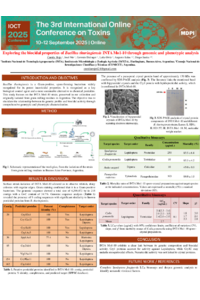
Bacillus thuringiensis is a Gram-positive, spore-forming bacterium widely recognized for its potent insecticidal properties. It is recognized as a key biological control agent and a more sustainable alternative to chemical pesticides. This study focuses on the INTA Mo1-10 strain, preserved in our collection and originally isolated from grain milling residues in Argentina. The objective was to elucidate the relationship between its genetic profile and biocidal activity through comprehensive genotypic and phenotypic characterization. Genomic DNA analysis, performed via Illumina sequencing, identified nine insecticidal protein genes: cry1Aa, cry1Ab1, cry1Ca, cry1Da, cry1Ia, cry2Ab, cry9Ea, vip3Aa, and spp1Aa. Also, the amino acid sequence identities ranged from 77% to 100%. Microscopic analyses revealed that sporulated cultures had bipyramidal crystals that were fully separated from spores, as observed using phase contrast and scanning electron microscopy. The presence of a parasporal crystal protein band of approximately 130 kDa was further confirmed via SDS-PAGE analysis. Bioassays demonstrated the strain's broad-spectrum biocidal activity, achieving over 83% efficacy against Cydia pomonella (Lepidoptera: Tortricidae) and Spodoptera frugiperda (Lepidoptera: Noctuidae) when incorporated into insect diets. For Panagrellus redivivus (Tylenchida: Panagrolaimidae), the strain was grown as a lawn on TSA agar plates before nematode inoculation, which resulted in comparably high mortality. Furthermore, the strain exhibited 45% larvicidal activity against Aedes aegypti (Diptera: Culicidae) when applied to water-filled containers. All bioassays utilized spore/crystal complexes at appropriately high doses to ensure effectiveness. The findings establish a clear correlation between the strain's genetic makeup and its biocidal efficacy. Notably, the insecticidal protein gene profile of INTA Mo1-10 closely aligns with that of other B. thuringiensis serovar galleriae strains. These results underscore the considerable potential of INTA Mo1-10 as an effective and versatile biocontrol agent, contributing to sustainable pest control strategies.
Keywords
Bacillus thuringiensis
entomopathogenic bacteria
invertebrate pests
pesticidal proteins
Poster
POSTER IOCT 2025 INTA Mo1-10.pdf
Time- and Dose-dependent Intracellular Proteome Alterations by Cobra Venom Cytotoxin: System Toxicology and Mechanistic Perspectives
First Insight into the Binding of Microcystin-LR and Cylindrospermopsin to Estrogen and Androgen Receptors via In Silico Molecular Docking