Event submissions
Published
This submission belongs to the session S3. Use of Toxins as Tools for Research, Drug Discovery, and Therapeutics of the event The 3rd International Online Conference on Toxins
Published date
08 Sep, 2025
Academic Editor
'%3e%3cpath%20d='M12.6657%2010.9104C12.4185%2010.325%2012.0599%209.79327%2011.6097%209.34482C11.1609%208.89508%2010.6293%208.5365%2010.0442%208.28888C10.0389%208.28626%2010.0337%208.28495%2010.0285%208.28233C10.8446%207.69279%2011.3752%206.73249%2011.3752%205.64904C11.3752%203.8542%209.92103%202.39999%208.1262%202.39999C6.33136%202.39999%204.87715%203.8542%204.87715%205.64904C4.87715%206.73249%205.40774%207.69279%206.22393%208.28364C6.21869%208.28626%206.21345%208.28757%206.20821%208.29019C5.62129%208.5378%205.09463%208.89284%204.64265%209.34613C4.1929%209.79493%203.83432%2010.3266%203.58671%2010.9117C3.34345%2011.4845%203.21226%2012.0987%203.20023%2012.7209C3.19988%2012.7349%203.20233%2012.7488%203.20744%2012.7619C3.21255%2012.7749%203.22022%2012.7867%203.22998%2012.7968C3.23975%2012.8068%203.25142%2012.8147%203.26431%2012.8202C3.2772%2012.8256%203.29105%2012.8284%203.30504%2012.8284H4.09109C4.14874%2012.8284%204.19459%2012.7825%204.1959%2012.7262C4.2221%2011.7148%204.62823%2010.7676%205.34617%2010.0497C6.08899%209.30683%207.0755%208.89808%208.1262%208.89808C9.17689%208.89808%2010.1634%209.30683%2010.9062%2010.0497C11.6242%2010.7676%2012.0303%2011.7148%2012.0565%2012.7262C12.0578%2012.7838%2012.1037%2012.8284%2012.1613%2012.8284H12.9474C12.9613%2012.8284%2012.9752%2012.8256%2012.9881%2012.8202C13.001%2012.8147%2013.0126%2012.8068%2013.0224%2012.7968C13.0322%2012.7867%2013.0398%2012.7749%2013.0449%2012.7619C13.0501%2012.7488%2013.0525%2012.7349%2013.0522%2012.7209C13.0391%2012.0947%2012.9094%2011.4855%2012.6657%2010.9104ZM8.1262%207.9024C7.52486%207.9024%206.9589%207.6679%206.53312%207.24211C6.10733%206.81633%205.87283%206.25037%205.87283%205.64904C5.87283%205.0477%206.10733%204.48174%206.53312%204.05596C6.9589%203.63018%207.52486%203.39567%208.1262%203.39567C8.72753%203.39567%209.29349%203.63018%209.71927%204.05596C10.1451%204.48174%2010.3796%205.0477%2010.3796%205.64904C10.3796%206.25037%2010.1451%206.81633%209.71927%207.24211C9.29349%207.6679%208.72753%207.9024%208.1262%207.9024Z'%20fill='%235D1EE1'/%3e%3c/g%3e%3c/svg%3e) Nilgun E. Tumer
Nilgun E. TumerCitation
Oksana V. Nekrasova, Nikita A. Orlov, Anastasia A. Ignatova, Elena V. Kryukova, Anastasia V. Efremenko, Oleg V. Kazakov, Valery N. Novoseletsky, Mikhail P. Kirpichnikov, Alexey V. Feofanov, New analytical cellular systems: a study of Kv1 channels, their fluorescent ligands, and peptide blockers, in Proceedings of The 3rd International Online Conference on Toxins, 10 September–12 September 2025, MDPI: Basel, Switzerland
Share
Email
Facebook
Twitter
LinkedIn
New analytical cellular systems: a study of Kv1 channels, their fluorescent ligands, and peptide blockers
'%3e%3cpath%20d='M12.6647%2010.9104C12.4176%2010.325%2012.0589%209.7933%2011.6088%209.34485C11.16%208.89511%2010.6283%208.53653%2010.0432%208.28891C10.038%208.28629%2010.0327%208.28498%2010.0275%208.28236C10.8437%207.69282%2011.3743%206.73252%2011.3743%205.64907C11.3743%203.85423%209.92005%202.40002%208.12522%202.40002C6.33038%202.40002%204.87618%203.85423%204.87618%205.64907C4.87618%206.73252%205.40677%207.69282%206.22296%208.28367C6.21772%208.28629%206.21248%208.2876%206.20724%208.29022C5.62031%208.53783%205.09365%208.89287%204.64167%209.34616C4.19192%209.79496%203.83334%2010.3266%203.58573%2010.9117C3.34247%2011.4846%203.21128%2012.0987%203.19925%2012.721C3.1989%2012.735%203.20135%2012.7489%203.20646%2012.7619C3.21157%2012.7749%203.21924%2012.7868%203.22901%2012.7968C3.23877%2012.8068%203.25045%2012.8148%203.26334%2012.8202C3.27623%2012.8256%203.29007%2012.8284%203.30406%2012.8284H4.09012C4.14776%2012.8284%204.19362%2012.7825%204.19493%2012.7262C4.22113%2011.7148%204.62726%2010.7676%205.34519%2010.0497C6.08802%209.30686%207.07452%208.89811%208.12522%208.89811C9.17592%208.89811%2010.1624%209.30686%2010.9052%2010.0497C11.6232%2010.7676%2012.0293%2011.7148%2012.0555%2012.7262C12.0568%2012.7839%2012.1027%2012.8284%2012.1603%2012.8284H12.9464C12.9604%2012.8284%2012.9742%2012.8256%2012.9871%2012.8202C13%2012.8148%2013.0117%2012.8068%2013.0214%2012.7968C13.0312%2012.7868%2013.0389%2012.7749%2013.044%2012.7619C13.0491%2012.7489%2013.0515%2012.735%2013.0512%2012.721C13.0381%2012.0947%2012.9084%2011.4856%2012.6647%2010.9104ZM8.12522%207.90243C7.52388%207.90243%206.95792%207.66793%206.53214%207.24215C6.10636%206.81636%205.87185%206.2504%205.87185%205.64907C5.87185%205.04773%206.10636%204.48177%206.53214%204.05599C6.95792%203.63021%207.52388%203.3957%208.12522%203.3957C8.72655%203.3957%209.29252%203.63021%209.7183%204.05599C10.1441%204.48177%2010.3786%205.04773%2010.3786%205.64907C10.3786%206.2504%2010.1441%206.81636%209.7183%207.24215C9.29252%207.66793%208.72655%207.90243%208.12522%207.90243Z'%20fill='%235D1EE1'/%3e%3c/g%3e%3c/svg%3e)
Oksana V. Nekrasova 1
Nikita A. Orlov 1
Anastasia A. Ignatova 1
Elena V. Kryukova 1
Anastasia V. Efremenko 1
Oleg V. Kazakov 1
Valery N. Novoseletsky 2
Mikhail P. Kirpichnikov 1,2

Alexey V. Feofanov 1,2
1. Shemyakin-Ovchinnikov Institute of Boorganic Chemistry, Russian Academy of Sciences, Moscow 117997, Russia
2. Faculty of Biology, Lomonosov Moscow State University, Moscow 119234, Russia
Abstract
Introduction:
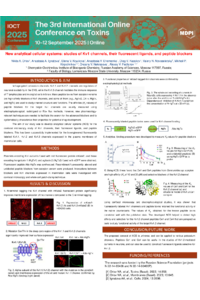
Voltage-gated potassium channels Kv1.1 and Kv1.2 are key players of neuronal excitability. The Kv1.3 channel mediates the immune response of T lymphocytes. Many peptide toxins are blockers of Kv1 channels and help to study channel functioning under normal and pathological conditions. New pharmacology-relevant techniques are needed to search for advanced blockers and to characterize their properties for potential drug development.
Methods:
Plasmids encoding Kv1 subunits fused with the fluorescent protein mKate2 and those encoding hongotoxin 1 (HgTx1) and agitoxin 2 (AgTx2) fused with GFP were obtained. Recombinant fluorescently labeled and unlabeled peptide blockers including Ce-peptides from Centruroides elegans scorpion venom were produced. Interactions between blockers and Kv1 channels expressed in mammalian cells were investigated with confocal microscopy and the whole-cell patch clamp technique.
Results:
The concept of creating analytical cellular systems (ACSs) for the study of Kv1.1, Kv1.2, and Kv1.3 channels, their fluorescent ligands, and peptide blockers using confocal microscopy has been successfully implemented. Point mutations that enhanced the membrane expression of fully functional channels were introduced.
High-affinity fluorescent ligands (synthetic Atto488-HgTx1 and recombinant HgTx1-GFP and AgTx2-GFP) were developed. Using competitive binding of labeled and unlabeled ligands, the apparent dissociation constants of complexes between unlabeled blockers and Kv1 channels were determined. Peptides Ce1 and Ce4 were found to be the most selective and potent peptide blockers of the Kv1.2 channel compared to channels Kv1.1 and Kv1.3.
Conclusions:
The proposed concept of ACSs is universal and can be applied to various potassium channels. Peptides Ce1 and Ce4 can be useful in the study of Kv1.2-mediated currents in neurons, and they can also be used to construct fluorescent ligands selective for Kv1.2.
Acknowledgements: The work was supported by the Russian Science Foundation (project 22-14-00406).
Keywords
voltage-gated potassium channels
peptide blockers
binding
fluorescent confocal microscopy
selectivity
Poster
Poster-IOCT2025-Nekrasova OV.pdf
Identification of potential metabolites of Cylindrospermopsin and Microcystin-LR and effects on brain oxidative stress biomarkers in rats after oral exposure to their mixture
Transition metal doping for improving the fluorescence response of paralytic shellfish poisoning toxins upon pre-chromatographic oxidation