Event submissions
Published
This submission belongs to the session S1. Plant, Animal, Insect and Microbial Toxins: New Developments of the event The 3rd International Online Conference on Toxins
Published date
08 Sep, 2025
Academic Editor
'%3e%3cpath%20d='M12.6657%2010.9104C12.4185%2010.325%2012.0599%209.79327%2011.6097%209.34482C11.1609%208.89508%2010.6293%208.5365%2010.0442%208.28888C10.0389%208.28626%2010.0337%208.28495%2010.0285%208.28233C10.8446%207.69279%2011.3752%206.73249%2011.3752%205.64904C11.3752%203.8542%209.92103%202.39999%208.1262%202.39999C6.33136%202.39999%204.87715%203.8542%204.87715%205.64904C4.87715%206.73249%205.40774%207.69279%206.22393%208.28364C6.21869%208.28626%206.21345%208.28757%206.20821%208.29019C5.62129%208.5378%205.09463%208.89284%204.64265%209.34613C4.1929%209.79493%203.83432%2010.3266%203.58671%2010.9117C3.34345%2011.4845%203.21226%2012.0987%203.20023%2012.7209C3.19988%2012.7349%203.20233%2012.7488%203.20744%2012.7619C3.21255%2012.7749%203.22022%2012.7867%203.22998%2012.7968C3.23975%2012.8068%203.25142%2012.8147%203.26431%2012.8202C3.2772%2012.8256%203.29105%2012.8284%203.30504%2012.8284H4.09109C4.14874%2012.8284%204.19459%2012.7825%204.1959%2012.7262C4.2221%2011.7148%204.62823%2010.7676%205.34617%2010.0497C6.08899%209.30683%207.0755%208.89808%208.1262%208.89808C9.17689%208.89808%2010.1634%209.30683%2010.9062%2010.0497C11.6242%2010.7676%2012.0303%2011.7148%2012.0565%2012.7262C12.0578%2012.7838%2012.1037%2012.8284%2012.1613%2012.8284H12.9474C12.9613%2012.8284%2012.9752%2012.8256%2012.9881%2012.8202C13.001%2012.8147%2013.0126%2012.8068%2013.0224%2012.7968C13.0322%2012.7867%2013.0398%2012.7749%2013.0449%2012.7619C13.0501%2012.7488%2013.0525%2012.7349%2013.0522%2012.7209C13.0391%2012.0947%2012.9094%2011.4855%2012.6657%2010.9104ZM8.1262%207.9024C7.52486%207.9024%206.9589%207.6679%206.53312%207.24211C6.10733%206.81633%205.87283%206.25037%205.87283%205.64904C5.87283%205.0477%206.10733%204.48174%206.53312%204.05596C6.9589%203.63018%207.52486%203.39567%208.1262%203.39567C8.72753%203.39567%209.29349%203.63018%209.71927%204.05596C10.1451%204.48174%2010.3796%205.0477%2010.3796%205.64904C10.3796%206.25037%2010.1451%206.81633%209.71927%207.24211C9.29349%207.6679%208.72753%207.9024%208.1262%207.9024Z'%20fill='%235D1EE1'/%3e%3c/g%3e%3c/svg%3e) Joseph Barbieri
Joseph BarbieriCitation
Paulo Vale, Transition metal doping for improving the fluorescence response of paralytic shellfish poisoning toxins upon pre-chromatographic oxidation, in Proceedings of The 3rd International Online Conference on Toxins, 10 September–12 September 2025, MDPI: Basel, Switzerland
Share
Email
Facebook
Twitter
LinkedIn
Transition metal doping for improving the fluorescence response of paralytic shellfish poisoning toxins upon pre-chromatographic oxidation
'%3e%3cpath%20d='M12.6647%2010.9104C12.4176%2010.325%2012.0589%209.7933%2011.6088%209.34485C11.16%208.89511%2010.6283%208.53653%2010.0432%208.28891C10.038%208.28629%2010.0327%208.28498%2010.0275%208.28236C10.8437%207.69282%2011.3743%206.73252%2011.3743%205.64907C11.3743%203.85423%209.92005%202.40002%208.12522%202.40002C6.33038%202.40002%204.87618%203.85423%204.87618%205.64907C4.87618%206.73252%205.40677%207.69282%206.22296%208.28367C6.21772%208.28629%206.21248%208.2876%206.20724%208.29022C5.62031%208.53783%205.09365%208.89287%204.64167%209.34616C4.19192%209.79496%203.83334%2010.3266%203.58573%2010.9117C3.34247%2011.4846%203.21128%2012.0987%203.19925%2012.721C3.1989%2012.735%203.20135%2012.7489%203.20646%2012.7619C3.21157%2012.7749%203.21924%2012.7868%203.22901%2012.7968C3.23877%2012.8068%203.25045%2012.8148%203.26334%2012.8202C3.27623%2012.8256%203.29007%2012.8284%203.30406%2012.8284H4.09012C4.14776%2012.8284%204.19362%2012.7825%204.19493%2012.7262C4.22113%2011.7148%204.62726%2010.7676%205.34519%2010.0497C6.08802%209.30686%207.07452%208.89811%208.12522%208.89811C9.17592%208.89811%2010.1624%209.30686%2010.9052%2010.0497C11.6232%2010.7676%2012.0293%2011.7148%2012.0555%2012.7262C12.0568%2012.7839%2012.1027%2012.8284%2012.1603%2012.8284H12.9464C12.9604%2012.8284%2012.9742%2012.8256%2012.9871%2012.8202C13%2012.8148%2013.0117%2012.8068%2013.0214%2012.7968C13.0312%2012.7868%2013.0389%2012.7749%2013.044%2012.7619C13.0491%2012.7489%2013.0515%2012.735%2013.0512%2012.721C13.0381%2012.0947%2012.9084%2011.4856%2012.6647%2010.9104ZM8.12522%207.90243C7.52388%207.90243%206.95792%207.66793%206.53214%207.24215C6.10636%206.81636%205.87185%206.2504%205.87185%205.64907C5.87185%205.04773%206.10636%204.48177%206.53214%204.05599C6.95792%203.63021%207.52388%203.3957%208.12522%203.3957C8.72655%203.3957%209.29252%203.63021%209.7183%204.05599C10.1441%204.48177%2010.3786%205.04773%2010.3786%205.64907C10.3786%206.2504%2010.1441%206.81636%209.7183%207.24215C9.29252%207.66793%208.72655%207.90243%208.12522%207.90243Z'%20fill='%235D1EE1'/%3e%3c/g%3e%3c/svg%3e)
Paulo Vale 1
1. Instituto Português do Mar e da Atmosfera, Av. Alfredo Magalhães Ramalho 6, 1495-165 Algés, Portugal
Abstract
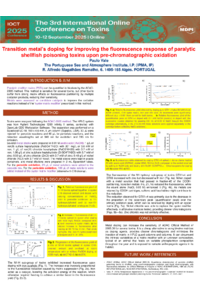
Paralytic shellfish toxins can be quantified in bivalve molluscs by the AOAC-2005 method. This method is quite sensitive for some toxins, while other toxins suffer from strong matrix effects or fluorescence partitioning by multiple oxidation products, reducing their sensitivity. Metals were assessed as candidate catalysts to improve the oxidation reactions instead of the oyster matrix modifier preconized in this method. The N1-H sub-group of toxins exhibited increased fluorescence upon doping with iron sulphate. The increase was inversely proportional to the fluorescence reduction caused by matrix suppression. Iron acted as a catalyst, lowering the activation energy of the reaction, which otherwise required heating to achieve a similar boost in fluorescence yield.
The fluorescence of the N1-hydroxyl sub-group of toxins GTX1+4 and GTX6 increased with zinc but decreased with iron. When doped with a metal solution that had passed in fraction 2 of the carboxylic acid partitioning, both metals reduced the fluorescence, while the eluent of fraction 2 (NaCL 0.5 M) enhanced it. As metals are retained by COOH cartridges, sulfonic acid leachables might contribute to this reduction. The reduction observed for GTX1+4 was primarily due to the decrease in the proportion of the secondary peak over the primary oxidation peak, which can be reversed by doping with an oyster matrix. Nickel chloride was able to replace the oyster modifier effectively in all five bivalve matrices tested, while zinc chloride was not similarly effective. For dcNEO spiked in several bivalve matrices, adding an oyster modifier derived from Magallana gigas caused a 16-19% reduction in fluorescence. Doping with several metals (Ni, Zn, alkaline, and alkaline earth metals) could not achieve the same fluorescence as doping with 0.1 mM acetic acid. In this case, the matrix modifier preconized in the method was not adequate.
Keywords
saxitoxins
prechromatographic oxidation
transition metals
paralytic shellfish poisoning
matrix suppression
Poster
LAWRENCE METHOD metals_poster PAULO VALE.pdf
New analytical cellular systems: a study of Kv1 channels, their fluorescent ligands, and peptide blockers
Dietary Exposure to Aflatoxin B1 and Its Precursor Sterigmatocystin from Traditional Meat Products in Croatia