Event submissions
Published
This submission belongs to the session S3. Bioinspired Materials—Structures, Surfaces and Interfaces of the event The 2nd International Online Conference on Biomimetics
Published date
15 Sep, 2025
Academic Editor
'%3e%3cpath%20d='M12.6657%2010.9104C12.4185%2010.325%2012.0599%209.79327%2011.6097%209.34482C11.1609%208.89508%2010.6293%208.5365%2010.0442%208.28888C10.0389%208.28626%2010.0337%208.28495%2010.0285%208.28233C10.8446%207.69279%2011.3752%206.73249%2011.3752%205.64904C11.3752%203.8542%209.92103%202.39999%208.1262%202.39999C6.33136%202.39999%204.87715%203.8542%204.87715%205.64904C4.87715%206.73249%205.40774%207.69279%206.22393%208.28364C6.21869%208.28626%206.21345%208.28757%206.20821%208.29019C5.62129%208.5378%205.09463%208.89284%204.64265%209.34613C4.1929%209.79493%203.83432%2010.3266%203.58671%2010.9117C3.34345%2011.4845%203.21226%2012.0987%203.20023%2012.7209C3.19988%2012.7349%203.20233%2012.7488%203.20744%2012.7619C3.21255%2012.7749%203.22022%2012.7867%203.22998%2012.7968C3.23975%2012.8068%203.25142%2012.8147%203.26431%2012.8202C3.2772%2012.8256%203.29105%2012.8284%203.30504%2012.8284H4.09109C4.14874%2012.8284%204.19459%2012.7825%204.1959%2012.7262C4.2221%2011.7148%204.62823%2010.7676%205.34617%2010.0497C6.08899%209.30683%207.0755%208.89808%208.1262%208.89808C9.17689%208.89808%2010.1634%209.30683%2010.9062%2010.0497C11.6242%2010.7676%2012.0303%2011.7148%2012.0565%2012.7262C12.0578%2012.7838%2012.1037%2012.8284%2012.1613%2012.8284H12.9474C12.9613%2012.8284%2012.9752%2012.8256%2012.9881%2012.8202C13.001%2012.8147%2013.0126%2012.8068%2013.0224%2012.7968C13.0322%2012.7867%2013.0398%2012.7749%2013.0449%2012.7619C13.0501%2012.7488%2013.0525%2012.7349%2013.0522%2012.7209C13.0391%2012.0947%2012.9094%2011.4855%2012.6657%2010.9104ZM8.1262%207.9024C7.52486%207.9024%206.9589%207.6679%206.53312%207.24211C6.10733%206.81633%205.87283%206.25037%205.87283%205.64904C5.87283%205.0477%206.10733%204.48174%206.53312%204.05596C6.9589%203.63018%207.52486%203.39567%208.1262%203.39567C8.72753%203.39567%209.29349%203.63018%209.71927%204.05596C10.1451%204.48174%2010.3796%205.0477%2010.3796%205.64904C10.3796%206.25037%2010.1451%206.81633%209.71927%207.24211C9.29349%207.6679%208.72753%207.9024%208.1262%207.9024Z'%20fill='%235D1EE1'/%3e%3c/g%3e%3c/svg%3e) Victor Erokhin
Victor ErokhinCitation
Jeong-Mo Yang, Fractal Architecture as a Foundational Design Principle in Biomimetic Material Engineering, in Proceedings of The 2nd International Online Conference on Biomimetics, 16 September–18 September 2025, MDPI: Basel, Switzerland
Share
Email
Facebook
Twitter
LinkedIn
Fractal Architecture as a Foundational Design Principle in Biomimetic Material Engineering
'%3e%3cpath%20d='M12.6647%2010.9104C12.4176%2010.325%2012.0589%209.7933%2011.6088%209.34485C11.16%208.89511%2010.6283%208.53653%2010.0432%208.28891C10.038%208.28629%2010.0327%208.28498%2010.0275%208.28236C10.8437%207.69282%2011.3743%206.73252%2011.3743%205.64907C11.3743%203.85423%209.92005%202.40002%208.12522%202.40002C6.33038%202.40002%204.87618%203.85423%204.87618%205.64907C4.87618%206.73252%205.40677%207.69282%206.22296%208.28367C6.21772%208.28629%206.21248%208.2876%206.20724%208.29022C5.62031%208.53783%205.09365%208.89287%204.64167%209.34616C4.19192%209.79496%203.83334%2010.3266%203.58573%2010.9117C3.34247%2011.4846%203.21128%2012.0987%203.19925%2012.721C3.1989%2012.735%203.20135%2012.7489%203.20646%2012.7619C3.21157%2012.7749%203.21924%2012.7868%203.22901%2012.7968C3.23877%2012.8068%203.25045%2012.8148%203.26334%2012.8202C3.27623%2012.8256%203.29007%2012.8284%203.30406%2012.8284H4.09012C4.14776%2012.8284%204.19362%2012.7825%204.19493%2012.7262C4.22113%2011.7148%204.62726%2010.7676%205.34519%2010.0497C6.08802%209.30686%207.07452%208.89811%208.12522%208.89811C9.17592%208.89811%2010.1624%209.30686%2010.9052%2010.0497C11.6232%2010.7676%2012.0293%2011.7148%2012.0555%2012.7262C12.0568%2012.7839%2012.1027%2012.8284%2012.1603%2012.8284H12.9464C12.9604%2012.8284%2012.9742%2012.8256%2012.9871%2012.8202C13%2012.8148%2013.0117%2012.8068%2013.0214%2012.7968C13.0312%2012.7868%2013.0389%2012.7749%2013.044%2012.7619C13.0491%2012.7489%2013.0515%2012.735%2013.0512%2012.721C13.0381%2012.0947%2012.9084%2011.4856%2012.6647%2010.9104ZM8.12522%207.90243C7.52388%207.90243%206.95792%207.66793%206.53214%207.24215C6.10636%206.81636%205.87185%206.2504%205.87185%205.64907C5.87185%205.04773%206.10636%204.48177%206.53214%204.05599C6.95792%203.63021%207.52388%203.3957%208.12522%203.3957C8.72655%203.3957%209.29252%203.63021%209.7183%204.05599C10.1441%204.48177%2010.3786%205.04773%2010.3786%205.64907C10.3786%206.2504%2010.1441%206.81636%209.7183%207.24215C9.29252%207.66793%208.72655%207.90243%208.12522%207.90243Z'%20fill='%235D1EE1'/%3e%3c/g%3e%3c/svg%3e)
Jeong-Mo Yang 1
1. Department of material engineering, Dongguk university, Seoul, 04620, South Korea
Abstract
Fractal structures are fundamental patterns that repeatedly emerge across biological systems—from alveoli and dendritic trees to vascular networks and neural circuits—supporting highly efficient, resilient, and scalable architectures. Yet, many biomimetic designs mimic biological shapes rather than the structural principles underlying their efficiency. This work proposes a new paradigm in bioinspired engineering by introducing a mathematical framework that reveals function-specific optimal fractal dimensions (e.g., D = 1.7, 2.1, 2.5, 2.9), derived from quadratic performance curves. Each dimension is tailored to a distinct functional goal such as exploration, absorption, circulation, or structural robustness. Unlike heuristic or purely empirical approaches, our model quantifies the fractal design landscape and enables predictive optimization. By mapping dimensionality to system functions, we demonstrate how generalizable design laws can emerge in soft materials, nanostructures, and bio-hybrid interfaces. This framework also offers insights into why fractal architectures naturally evolve in biological systems and how they can be reverse-engineered for high-efficiency human-made systems. The study further connects fractal geometry with multiscale optimization theory and network resilience, drawing from interdisciplinary fields including neuroscience, AI architecture, and materials science. The resulting model provides a modular and scalable blueprint for next-generation biomimetic materials that are energy-efficient, functionally adaptive, and evolutionarily robust. Originating from an undergraduate thesis, this preprint lays the foundation for a broader theoretical framework to unify fractal principles in both natural and artificial systems. It has already been published on ResearchGate with a DOI (10.13140/RG.2.2.29404.91520) and is now submitted as an abstract to further broaden visibility and scholarly feedback. We believe this proposal may stimulate new discussions across bioinspired engineering, network theory, and intelligent material design.
Keywords
Fractals
Bioinspired Materials
Hierarchical Design
Optimization
Nanostructure
Multiscale Architecture
Functional Topology
Poster
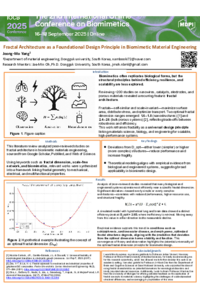
Jeogn-Mo Yang sciforum-123239.pdf
Lotus-Effect Hydrophobic Coatings on Engineered Wood: Toward Self-Cleaning Building Envelopes in Humid Climates
Bioinspired Sn-Substituted Hydroxyapatite for Dental Desensitization: Structural Insights and Synthesis Optimization