Event submissions
Published
This submission belongs to the session S3. Bioinspired Materials—Structures, Surfaces and Interfaces of the event The 2nd International Online Conference on Biomimetics
Published date
15 Sep, 2025
Academic Editor
'%3e%3cpath%20d='M12.6657%2010.9104C12.4185%2010.325%2012.0599%209.79327%2011.6097%209.34482C11.1609%208.89508%2010.6293%208.5365%2010.0442%208.28888C10.0389%208.28626%2010.0337%208.28495%2010.0285%208.28233C10.8446%207.69279%2011.3752%206.73249%2011.3752%205.64904C11.3752%203.8542%209.92103%202.39999%208.1262%202.39999C6.33136%202.39999%204.87715%203.8542%204.87715%205.64904C4.87715%206.73249%205.40774%207.69279%206.22393%208.28364C6.21869%208.28626%206.21345%208.28757%206.20821%208.29019C5.62129%208.5378%205.09463%208.89284%204.64265%209.34613C4.1929%209.79493%203.83432%2010.3266%203.58671%2010.9117C3.34345%2011.4845%203.21226%2012.0987%203.20023%2012.7209C3.19988%2012.7349%203.20233%2012.7488%203.20744%2012.7619C3.21255%2012.7749%203.22022%2012.7867%203.22998%2012.7968C3.23975%2012.8068%203.25142%2012.8147%203.26431%2012.8202C3.2772%2012.8256%203.29105%2012.8284%203.30504%2012.8284H4.09109C4.14874%2012.8284%204.19459%2012.7825%204.1959%2012.7262C4.2221%2011.7148%204.62823%2010.7676%205.34617%2010.0497C6.08899%209.30683%207.0755%208.89808%208.1262%208.89808C9.17689%208.89808%2010.1634%209.30683%2010.9062%2010.0497C11.6242%2010.7676%2012.0303%2011.7148%2012.0565%2012.7262C12.0578%2012.7838%2012.1037%2012.8284%2012.1613%2012.8284H12.9474C12.9613%2012.8284%2012.9752%2012.8256%2012.9881%2012.8202C13.001%2012.8147%2013.0126%2012.8068%2013.0224%2012.7968C13.0322%2012.7867%2013.0398%2012.7749%2013.0449%2012.7619C13.0501%2012.7488%2013.0525%2012.7349%2013.0522%2012.7209C13.0391%2012.0947%2012.9094%2011.4855%2012.6657%2010.9104ZM8.1262%207.9024C7.52486%207.9024%206.9589%207.6679%206.53312%207.24211C6.10733%206.81633%205.87283%206.25037%205.87283%205.64904C5.87283%205.0477%206.10733%204.48174%206.53312%204.05596C6.9589%203.63018%207.52486%203.39567%208.1262%203.39567C8.72753%203.39567%209.29349%203.63018%209.71927%204.05596C10.1451%204.48174%2010.3796%205.0477%2010.3796%205.64904C10.3796%206.25037%2010.1451%206.81633%209.71927%207.24211C9.29349%207.6679%208.72753%207.9024%208.1262%207.9024Z'%20fill='%235D1EE1'/%3e%3c/g%3e%3c/svg%3e) Andrew Adamatzky
Andrew AdamatzkyCitation
Jovana Aćimović, Darija Obradović, Pavle Spasojević, Aleksandar Popović, Saša Lazović, Tijana Milićević, In Silico Assessment of Natural Biodegradable Polymers for Dermal Drug Delivery Systems, in Proceedings of The 2nd International Online Conference on Biomimetics, 16 September–18 September 2025, MDPI: Basel, Switzerland
Share
Email
Facebook
Twitter
LinkedIn
In Silico Assessment of Natural Biodegradable Polymers for Dermal Drug Delivery Systems
'%3e%3cpath%20d='M12.6647%2010.9104C12.4176%2010.325%2012.0589%209.7933%2011.6088%209.34485C11.16%208.89511%2010.6283%208.53653%2010.0432%208.28891C10.038%208.28629%2010.0327%208.28498%2010.0275%208.28236C10.8437%207.69282%2011.3743%206.73252%2011.3743%205.64907C11.3743%203.85423%209.92005%202.40002%208.12522%202.40002C6.33038%202.40002%204.87618%203.85423%204.87618%205.64907C4.87618%206.73252%205.40677%207.69282%206.22296%208.28367C6.21772%208.28629%206.21248%208.2876%206.20724%208.29022C5.62031%208.53783%205.09365%208.89287%204.64167%209.34616C4.19192%209.79496%203.83334%2010.3266%203.58573%2010.9117C3.34247%2011.4846%203.21128%2012.0987%203.19925%2012.721C3.1989%2012.735%203.20135%2012.7489%203.20646%2012.7619C3.21157%2012.7749%203.21924%2012.7868%203.22901%2012.7968C3.23877%2012.8068%203.25045%2012.8148%203.26334%2012.8202C3.27623%2012.8256%203.29007%2012.8284%203.30406%2012.8284H4.09012C4.14776%2012.8284%204.19362%2012.7825%204.19493%2012.7262C4.22113%2011.7148%204.62726%2010.7676%205.34519%2010.0497C6.08802%209.30686%207.07452%208.89811%208.12522%208.89811C9.17592%208.89811%2010.1624%209.30686%2010.9052%2010.0497C11.6232%2010.7676%2012.0293%2011.7148%2012.0555%2012.7262C12.0568%2012.7839%2012.1027%2012.8284%2012.1603%2012.8284H12.9464C12.9604%2012.8284%2012.9742%2012.8256%2012.9871%2012.8202C13%2012.8148%2013.0117%2012.8068%2013.0214%2012.7968C13.0312%2012.7868%2013.0389%2012.7749%2013.044%2012.7619C13.0491%2012.7489%2013.0515%2012.735%2013.0512%2012.721C13.0381%2012.0947%2012.9084%2011.4856%2012.6647%2010.9104ZM8.12522%207.90243C7.52388%207.90243%206.95792%207.66793%206.53214%207.24215C6.10636%206.81636%205.87185%206.2504%205.87185%205.64907C5.87185%205.04773%206.10636%204.48177%206.53214%204.05599C6.95792%203.63021%207.52388%203.3957%208.12522%203.3957C8.72655%203.3957%209.29252%203.63021%209.7183%204.05599C10.1441%204.48177%2010.3786%205.04773%2010.3786%205.64907C10.3786%206.2504%2010.1441%206.81636%209.7183%207.24215C9.29252%207.66793%208.72655%207.90243%208.12522%207.90243Z'%20fill='%235D1EE1'/%3e%3c/g%3e%3c/svg%3e)
Jovana Aćimović 1
Darija Obradović 2
Pavle Spasojević 3,4
Aleksandar Popović 5
Saša Lazović 2
Tijana Milićević 1
1. University of Belgrade - Environmental Physics Laboratory, Institute of Physics Belgrade, National Institute of the Republic of Serbia, Belgrade, Serbia
2. University of Belgrade, Institute of Physics Belgrade, National Institute of the Republic of Serbia, Belgrade, Serbia
3. Innovation Center of Faculty of Technology and Metallurgy, Belgrade, Serbia
4. Faculty of Technical Sciences, University of Kragujevac, Čacak, Serbia
5. Faculty of Chemistry, University of Belgrade, Belgrade, Serbia
Abstract
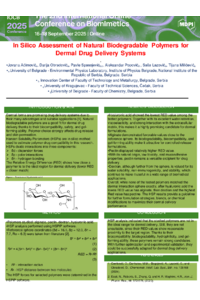
Biodegradable polymers derived from natural sources are gaining attention as components in dermal drug delivery formulations due to their low toxicity, compatibility with biological systems, and biodegradability. Their physicochemical traits can significantly influence their ability to serve as carriers in topical drug delivery. Hansen’s three-dimensional solubility (HSP) concept can be used to preliminarily assess the compatibility of tested polymers as drug carriers and determine their potential for effective drug delivery [1]. In this study, the HSP approach was employed to analyze the suitability of alginate, pectin, dextran, and hyaluronic acid for drug delivery through the skin. All of these polymers are widely used natural polymers known for their non-toxicity, hydrophilicity, and ability to form stable gels, making them attractive for various pharmaceutical and biomedical applications. A sphere with (ẟd, ẟp, ẟh) coordinates is experimentally defined (ẟd =16.5, ẟp =12, ẟh = 7.7, Ro (the radius of interaction sphere) = 6.3), representing the region with the desired polymer characteristics [2]. Compounds located within the defined HSP sphere (RED < 1) are considered to have appropriate drug delivery profile. The HSP values for the selected polymers were determined using the HSPiP software (https://www.hansen-solubility.com/). Among the materials tested (hyaluronic acid, alginate, pectin, and dextran), hyaluronic acid exhibited the lowest RED value, suggesting that it is the most promising of the four polymers for dermal drug delivery.
References
- Cvetković, D., Dankulov, M.M., Bogojević, A., Lazović, S., and Obradović, D., Intell. Lab. Syst., 251, no. 105168 (2024).
- Ezati, N., Roberts, S., Zhang, Q, and H. R. Moghimi, H.R., J. Pharm. Res., 19, 572–578, (2020).
Keywords
polymer
biodegradable
natural
dermal drug delivery
Poster
In Silico Assessment of Natural Biodegradable Polymers for Dermal Drug Delivery Systems.pdf
Bioinspired Sn-Substituted Hydroxyapatite for Dental Desensitization: Structural Insights and Synthesis Optimization
Preparation and characterization of alginate/hyaluronate hydrogel incorporating zoledronic acid-loaded chitosan microparticles for osteoarthritis therapy