Event submissions
Published
This submission belongs to the session S3. Bioinspired Materials—Structures, Surfaces and Interfaces of the event The 2nd International Online Conference on Biomimetics
Published date
15 Sep, 2025
Academic Editor
'%3e%3cpath%20d='M12.6657%2010.9104C12.4185%2010.325%2012.0599%209.79327%2011.6097%209.34482C11.1609%208.89508%2010.6293%208.5365%2010.0442%208.28888C10.0389%208.28626%2010.0337%208.28495%2010.0285%208.28233C10.8446%207.69279%2011.3752%206.73249%2011.3752%205.64904C11.3752%203.8542%209.92103%202.39999%208.1262%202.39999C6.33136%202.39999%204.87715%203.8542%204.87715%205.64904C4.87715%206.73249%205.40774%207.69279%206.22393%208.28364C6.21869%208.28626%206.21345%208.28757%206.20821%208.29019C5.62129%208.5378%205.09463%208.89284%204.64265%209.34613C4.1929%209.79493%203.83432%2010.3266%203.58671%2010.9117C3.34345%2011.4845%203.21226%2012.0987%203.20023%2012.7209C3.19988%2012.7349%203.20233%2012.7488%203.20744%2012.7619C3.21255%2012.7749%203.22022%2012.7867%203.22998%2012.7968C3.23975%2012.8068%203.25142%2012.8147%203.26431%2012.8202C3.2772%2012.8256%203.29105%2012.8284%203.30504%2012.8284H4.09109C4.14874%2012.8284%204.19459%2012.7825%204.1959%2012.7262C4.2221%2011.7148%204.62823%2010.7676%205.34617%2010.0497C6.08899%209.30683%207.0755%208.89808%208.1262%208.89808C9.17689%208.89808%2010.1634%209.30683%2010.9062%2010.0497C11.6242%2010.7676%2012.0303%2011.7148%2012.0565%2012.7262C12.0578%2012.7838%2012.1037%2012.8284%2012.1613%2012.8284H12.9474C12.9613%2012.8284%2012.9752%2012.8256%2012.9881%2012.8202C13.001%2012.8147%2013.0126%2012.8068%2013.0224%2012.7968C13.0322%2012.7867%2013.0398%2012.7749%2013.0449%2012.7619C13.0501%2012.7488%2013.0525%2012.7349%2013.0522%2012.7209C13.0391%2012.0947%2012.9094%2011.4855%2012.6657%2010.9104ZM8.1262%207.9024C7.52486%207.9024%206.9589%207.6679%206.53312%207.24211C6.10733%206.81633%205.87283%206.25037%205.87283%205.64904C5.87283%205.0477%206.10733%204.48174%206.53312%204.05596C6.9589%203.63018%207.52486%203.39567%208.1262%203.39567C8.72753%203.39567%209.29349%203.63018%209.71927%204.05596C10.1451%204.48174%2010.3796%205.0477%2010.3796%205.64904C10.3796%206.25037%2010.1451%206.81633%209.71927%207.24211C9.29349%207.6679%208.72753%207.9024%208.1262%207.9024Z'%20fill='%235D1EE1'/%3e%3c/g%3e%3c/svg%3e) Victor Erokhin
Victor ErokhinCitation
ELIZAVETA LANTSOVA, Denis Kolykhalov, The use of chloropropyltriethoxysilane in combination with biotemplates for the formation of a functionalized organosilicon material, in Proceedings of The 2nd International Online Conference on Biomimetics, 16 September–18 September 2025, MDPI: Basel, Switzerland
Share
Email
Facebook
Twitter
LinkedIn
The use of chloropropyltriethoxysilane in combination with biotemplates for the formation of a functionalized organosilicon material
'%3e%3cpath%20d='M12.6647%2010.9104C12.4176%2010.325%2012.0589%209.7933%2011.6088%209.34485C11.16%208.89511%2010.6283%208.53653%2010.0432%208.28891C10.038%208.28629%2010.0327%208.28498%2010.0275%208.28236C10.8437%207.69282%2011.3743%206.73252%2011.3743%205.64907C11.3743%203.85423%209.92005%202.40002%208.12522%202.40002C6.33038%202.40002%204.87618%203.85423%204.87618%205.64907C4.87618%206.73252%205.40677%207.69282%206.22296%208.28367C6.21772%208.28629%206.21248%208.2876%206.20724%208.29022C5.62031%208.53783%205.09365%208.89287%204.64167%209.34616C4.19192%209.79496%203.83334%2010.3266%203.58573%2010.9117C3.34247%2011.4846%203.21128%2012.0987%203.19925%2012.721C3.1989%2012.735%203.20135%2012.7489%203.20646%2012.7619C3.21157%2012.7749%203.21924%2012.7868%203.22901%2012.7968C3.23877%2012.8068%203.25045%2012.8148%203.26334%2012.8202C3.27623%2012.8256%203.29007%2012.8284%203.30406%2012.8284H4.09012C4.14776%2012.8284%204.19362%2012.7825%204.19493%2012.7262C4.22113%2011.7148%204.62726%2010.7676%205.34519%2010.0497C6.08802%209.30686%207.07452%208.89811%208.12522%208.89811C9.17592%208.89811%2010.1624%209.30686%2010.9052%2010.0497C11.6232%2010.7676%2012.0293%2011.7148%2012.0555%2012.7262C12.0568%2012.7839%2012.1027%2012.8284%2012.1603%2012.8284H12.9464C12.9604%2012.8284%2012.9742%2012.8256%2012.9871%2012.8202C13%2012.8148%2013.0117%2012.8068%2013.0214%2012.7968C13.0312%2012.7868%2013.0389%2012.7749%2013.044%2012.7619C13.0491%2012.7489%2013.0515%2012.735%2013.0512%2012.721C13.0381%2012.0947%2012.9084%2011.4856%2012.6647%2010.9104ZM8.12522%207.90243C7.52388%207.90243%206.95792%207.66793%206.53214%207.24215C6.10636%206.81636%205.87185%206.2504%205.87185%205.64907C5.87185%205.04773%206.10636%204.48177%206.53214%204.05599C6.95792%203.63021%207.52388%203.3957%208.12522%203.3957C8.72655%203.3957%209.29252%203.63021%209.7183%204.05599C10.1441%204.48177%2010.3786%205.04773%2010.3786%205.64907C10.3786%206.2504%2010.1441%206.81636%209.7183%207.24215C9.29252%207.66793%208.72655%207.90243%208.12522%207.90243Z'%20fill='%235D1EE1'/%3e%3c/g%3e%3c/svg%3e)
ELIZAVETA LANTSOVA 1
Denis Kolykhalov 1
1. BioChemTech Center, Tula State University, Tula, 300012
Abstract
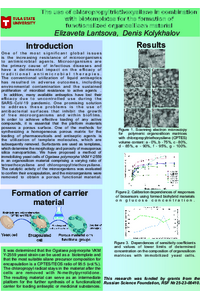
The utilization of biomimetic mineralization methodologies by researchers has given rise to the development of various composites that exhibit exceptional chemical and physical properties, controllable structures, and desirable biocompatibility. Sol--gel technology is regarded as one of the simplest and most promising methods for creating modern biocatalysts and porous carrier materials. The utilization of living microbial cells in combination with sol--gel technology allows for the production of hybrid biomaterials. A material containing functional groups can be created using chloropropyltriethoxysilane (CPTES), which contains a chloropropyl radical. The addition of further quaternary ammonium compounds or triazoles leads to the formation of an antimicrobial material with a contact-killing surface. A porous silicon-containing material with a sufficiently large specific surface area can be created using microorganism cells. This makes it possible to obtain a promising, two-in-one antibacterial material that releases the active substance and destroys microorganisms upon contact.
In this study, the yeast strain Ogataea polymorpha BKM Y-2559 was immobilized in organosilicon biomimetic shells with varying volume ratios of chloropropyltriethoxysilane (CPTES) and tetraethoxysilane (TEOS). The formation of polymeric organosilicon matrices was confirmed by infrared spectroscopy. The architecture and elemental distribution on the surface of the obtained materials were established by scanning electron microscopy and energy-dispersive spectroscopy. Immobilization efficiency was determined by measuring the sensitivity characteristics of the biosensor, for which encapsulated yeast cells were used as the biomaterial.
It was determined that the Ogataea polymorpha BKM Y-2559 yeast strain can be used as a biotemplate, and that the most suitable silane precursor composition for encapsulation is a CPTES/TEOS ratio of 95:5 (vol.%). The chloropropyl radical stays in the material after the cells have been removed with N-methylpyrrolidone.
The resulting material can serve as an intermediate platform for the further synthesis of a functionalized carrier for loading antiseptic or medicinal substances.
Keywords
sol-gel
functionalized organosilicon material
chloropropyltriethoxysilane
biotemplate
Ogataea polymorpha
Poster
Poster.pdf
Characteristics of Iridophore Crystals in Anolis carolinensis
Simultaneous Targeted Isolation and Controlled release of Circulating Tumor Cells (CTCs) using a photothermal scaffold-embedded microfluidics system