Event submissions
Published
This submission belongs to the session S3. Bioinspired Materials—Structures, Surfaces and Interfaces of the event The 2nd International Online Conference on Biomimetics
Published date
15 Sep, 2025
Academic Editor
'%3e%3cpath%20d='M12.6657%2010.9104C12.4185%2010.325%2012.0599%209.79327%2011.6097%209.34482C11.1609%208.89508%2010.6293%208.5365%2010.0442%208.28888C10.0389%208.28626%2010.0337%208.28495%2010.0285%208.28233C10.8446%207.69279%2011.3752%206.73249%2011.3752%205.64904C11.3752%203.8542%209.92103%202.39999%208.1262%202.39999C6.33136%202.39999%204.87715%203.8542%204.87715%205.64904C4.87715%206.73249%205.40774%207.69279%206.22393%208.28364C6.21869%208.28626%206.21345%208.28757%206.20821%208.29019C5.62129%208.5378%205.09463%208.89284%204.64265%209.34613C4.1929%209.79493%203.83432%2010.3266%203.58671%2010.9117C3.34345%2011.4845%203.21226%2012.0987%203.20023%2012.7209C3.19988%2012.7349%203.20233%2012.7488%203.20744%2012.7619C3.21255%2012.7749%203.22022%2012.7867%203.22998%2012.7968C3.23975%2012.8068%203.25142%2012.8147%203.26431%2012.8202C3.2772%2012.8256%203.29105%2012.8284%203.30504%2012.8284H4.09109C4.14874%2012.8284%204.19459%2012.7825%204.1959%2012.7262C4.2221%2011.7148%204.62823%2010.7676%205.34617%2010.0497C6.08899%209.30683%207.0755%208.89808%208.1262%208.89808C9.17689%208.89808%2010.1634%209.30683%2010.9062%2010.0497C11.6242%2010.7676%2012.0303%2011.7148%2012.0565%2012.7262C12.0578%2012.7838%2012.1037%2012.8284%2012.1613%2012.8284H12.9474C12.9613%2012.8284%2012.9752%2012.8256%2012.9881%2012.8202C13.001%2012.8147%2013.0126%2012.8068%2013.0224%2012.7968C13.0322%2012.7867%2013.0398%2012.7749%2013.0449%2012.7619C13.0501%2012.7488%2013.0525%2012.7349%2013.0522%2012.7209C13.0391%2012.0947%2012.9094%2011.4855%2012.6657%2010.9104ZM8.1262%207.9024C7.52486%207.9024%206.9589%207.6679%206.53312%207.24211C6.10733%206.81633%205.87283%206.25037%205.87283%205.64904C5.87283%205.0477%206.10733%204.48174%206.53312%204.05596C6.9589%203.63018%207.52486%203.39567%208.1262%203.39567C8.72753%203.39567%209.29349%203.63018%209.71927%204.05596C10.1451%204.48174%2010.3796%205.0477%2010.3796%205.64904C10.3796%206.25037%2010.1451%206.81633%209.71927%207.24211C9.29349%207.6679%208.72753%207.9024%208.1262%207.9024Z'%20fill='%235D1EE1'/%3e%3c/g%3e%3c/svg%3e) Andrew Adamatzky
Andrew AdamatzkyCitation
Nutan Rakeshkumar Shukla, Simultaneous Targeted Isolation and Controlled release of Circulating Tumor Cells (CTCs) using a photothermal scaffold-embedded microfluidics system, in Proceedings of The 2nd International Online Conference on Biomimetics, 16 September–18 September 2025, MDPI: Basel, Switzerland
Share
Email
Facebook
Twitter
LinkedIn
Simultaneous Targeted Isolation and Controlled release of Circulating Tumor Cells (CTCs) using a photothermal scaffold-embedded microfluidics system

Nutan Rakeshkumar Shukla 1
1. Southern Federal University
Abstract
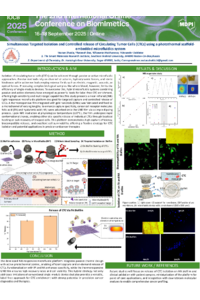
The isolation of a diverse sample of circulating tumor cells (CTCs) can be achieved either in an active or passive manner. While passive approaches manage cells via channel architectures, intrinsic hydrodynamic forces, and steric hindrances, active methods use external fields like electric, magnetic, acoustic, and optical forces to separate cells. However, processing complex biological materials, such as whole blood with unusual cells, makes separation with a single-module microfluidic device difficult. In recent years, hybrid microfluidic devices with both passive and active components have gained popularity as a method for the label-free enrichment of circulating tumor cells due to their many advantages, such as high sensitivity, high efficiency, and multi-target cell processing. The goal of this study was to create a near-infrared (NIR) light-responsive substrate by combining a thermos-responsive film with microchannels of varying lengths in order to accomplish an extremely efficient targeted capture and biocompatible site-release of CTCs. Pre-synthesized photothermal agent gold nanorods (GNRs) were integrated into biodegradable scaffolds. Later, a nano-film was fixed onto a chip. To improve the capture efficiency of receptors, molecule folic acid (FA) and haluronic acid (HA) targeting cancer cells were respectively adsorbed using a straightforward dipping technique for a GNR film. Temperature-responsive films quickly change their conformation upon NIR irradiation at 37°C or higher, enabling either site-specific release of individual CTCs through NIR-mediated photothermal activation of embedded GNRs, or the bulk recovery of trapped CTCs at a physiological temperature. This hybrid microfluidic NIR-responsive platform not only provides a robust and flexible route toward tailored anticancer therapies, but it also excels in the collection and site-release of CTCs with excellent survivability.
Keywords
hybrid microfluidics
Nano film
CTC
gold nanorods(GNRs)
Near infrared irradiation(NIR)
targeted
Poster
IOCB Poster 17th September.pdf
The use of chloropropyltriethoxysilane in combination with biotemplates for the formation of a functionalized organosilicon material
Phage-formed liquid crystal fiber biotemplates for material synthesis