Event submissions
Published
This submission belongs to the session S3. Bioinspired Materials—Structures, Surfaces and Interfaces of the event The 2nd International Online Conference on Biomimetics
Published date
15 Sep, 2025
Academic Editor
'%3e%3cpath%20d='M12.6657%2010.9104C12.4185%2010.325%2012.0599%209.79327%2011.6097%209.34482C11.1609%208.89508%2010.6293%208.5365%2010.0442%208.28888C10.0389%208.28626%2010.0337%208.28495%2010.0285%208.28233C10.8446%207.69279%2011.3752%206.73249%2011.3752%205.64904C11.3752%203.8542%209.92103%202.39999%208.1262%202.39999C6.33136%202.39999%204.87715%203.8542%204.87715%205.64904C4.87715%206.73249%205.40774%207.69279%206.22393%208.28364C6.21869%208.28626%206.21345%208.28757%206.20821%208.29019C5.62129%208.5378%205.09463%208.89284%204.64265%209.34613C4.1929%209.79493%203.83432%2010.3266%203.58671%2010.9117C3.34345%2011.4845%203.21226%2012.0987%203.20023%2012.7209C3.19988%2012.7349%203.20233%2012.7488%203.20744%2012.7619C3.21255%2012.7749%203.22022%2012.7867%203.22998%2012.7968C3.23975%2012.8068%203.25142%2012.8147%203.26431%2012.8202C3.2772%2012.8256%203.29105%2012.8284%203.30504%2012.8284H4.09109C4.14874%2012.8284%204.19459%2012.7825%204.1959%2012.7262C4.2221%2011.7148%204.62823%2010.7676%205.34617%2010.0497C6.08899%209.30683%207.0755%208.89808%208.1262%208.89808C9.17689%208.89808%2010.1634%209.30683%2010.9062%2010.0497C11.6242%2010.7676%2012.0303%2011.7148%2012.0565%2012.7262C12.0578%2012.7838%2012.1037%2012.8284%2012.1613%2012.8284H12.9474C12.9613%2012.8284%2012.9752%2012.8256%2012.9881%2012.8202C13.001%2012.8147%2013.0126%2012.8068%2013.0224%2012.7968C13.0322%2012.7867%2013.0398%2012.7749%2013.0449%2012.7619C13.0501%2012.7488%2013.0525%2012.7349%2013.0522%2012.7209C13.0391%2012.0947%2012.9094%2011.4855%2012.6657%2010.9104ZM8.1262%207.9024C7.52486%207.9024%206.9589%207.6679%206.53312%207.24211C6.10733%206.81633%205.87283%206.25037%205.87283%205.64904C5.87283%205.0477%206.10733%204.48174%206.53312%204.05596C6.9589%203.63018%207.52486%203.39567%208.1262%203.39567C8.72753%203.39567%209.29349%203.63018%209.71927%204.05596C10.1451%204.48174%2010.3796%205.0477%2010.3796%205.64904C10.3796%206.25037%2010.1451%206.81633%209.71927%207.24211C9.29349%207.6679%208.72753%207.9024%208.1262%207.9024Z'%20fill='%235D1EE1'/%3e%3c/g%3e%3c/svg%3e) Andrew Adamatzky
Andrew AdamatzkyCitation
Olga A. Kamanina, Pavel V. Rybochkin, Vitaliy N. Soromotin, Elizaveta A. Lantsova, The biosynthesis of palladium nanoparticles by microorganisms and their relationship with biomimetic structures, in Proceedings of The 2nd International Online Conference on Biomimetics, 16 September–18 September 2025, MDPI: Basel, Switzerland
Share
Email
Facebook
Twitter
LinkedIn
The biosynthesis of palladium nanoparticles by microorganisms and their relationship with biomimetic structures
'%3e%3cpath%20d='M12.6647%2010.9104C12.4176%2010.325%2012.0589%209.7933%2011.6088%209.34485C11.16%208.89511%2010.6283%208.53653%2010.0432%208.28891C10.038%208.28629%2010.0327%208.28498%2010.0275%208.28236C10.8437%207.69282%2011.3743%206.73252%2011.3743%205.64907C11.3743%203.85423%209.92005%202.40002%208.12522%202.40002C6.33038%202.40002%204.87618%203.85423%204.87618%205.64907C4.87618%206.73252%205.40677%207.69282%206.22296%208.28367C6.21772%208.28629%206.21248%208.2876%206.20724%208.29022C5.62031%208.53783%205.09365%208.89287%204.64167%209.34616C4.19192%209.79496%203.83334%2010.3266%203.58573%2010.9117C3.34247%2011.4846%203.21128%2012.0987%203.19925%2012.721C3.1989%2012.735%203.20135%2012.7489%203.20646%2012.7619C3.21157%2012.7749%203.21924%2012.7868%203.22901%2012.7968C3.23877%2012.8068%203.25045%2012.8148%203.26334%2012.8202C3.27623%2012.8256%203.29007%2012.8284%203.30406%2012.8284H4.09012C4.14776%2012.8284%204.19362%2012.7825%204.19493%2012.7262C4.22113%2011.7148%204.62726%2010.7676%205.34519%2010.0497C6.08802%209.30686%207.07452%208.89811%208.12522%208.89811C9.17592%208.89811%2010.1624%209.30686%2010.9052%2010.0497C11.6232%2010.7676%2012.0293%2011.7148%2012.0555%2012.7262C12.0568%2012.7839%2012.1027%2012.8284%2012.1603%2012.8284H12.9464C12.9604%2012.8284%2012.9742%2012.8256%2012.9871%2012.8202C13%2012.8148%2013.0117%2012.8068%2013.0214%2012.7968C13.0312%2012.7868%2013.0389%2012.7749%2013.044%2012.7619C13.0491%2012.7489%2013.0515%2012.735%2013.0512%2012.721C13.0381%2012.0947%2012.9084%2011.4856%2012.6647%2010.9104ZM8.12522%207.90243C7.52388%207.90243%206.95792%207.66793%206.53214%207.24215C6.10636%206.81636%205.87185%206.2504%205.87185%205.64907C5.87185%205.04773%206.10636%204.48177%206.53214%204.05599C6.95792%203.63021%207.52388%203.3957%208.12522%203.3957C8.72655%203.3957%209.29252%203.63021%209.7183%204.05599C10.1441%204.48177%2010.3786%205.04773%2010.3786%205.64907C10.3786%206.2504%2010.1441%206.81636%209.7183%207.24215C9.29252%207.66793%208.72655%207.90243%208.12522%207.90243Z'%20fill='%235D1EE1'/%3e%3c/g%3e%3c/svg%3e)
Olga A. Kamanina 1
Pavel V. Rybochkin 1
Vitaliy N. Soromotin 1

Elizaveta A. Lantsova 1
1. Research group, Tula state university, Tula, 300012, Russia
Abstract
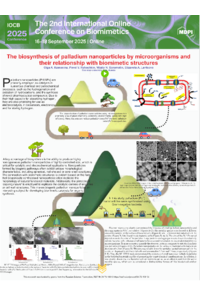
The bioproduction of palladium nanoparticles using microorganisms is a promising area of green chemistry, combining environmental safety with high efficiency. Many bacteria can reduce palladium ions (Pd²⁺) to form palladium metal (Pd⁰) nanoparticles. This process is often driven by enzymatic activity and/or bacterial surface structures. A key advantage of biosynthesis is the ability to produce highly homogeneous palladium nanoparticles of tightly controlled size, which is critical for catalytic and electrochemical applications. Nanoparticles formed by biogenic pathways often exhibit unique morphological characteristics, including spherical, rod-shaped or core–shell structures. The connection with biomimetic structures is evident based on the fact that biogenically synthesised nanoparticles often replicate the morphology of natural functional materials. Additionally, the principle of 'copying nature' is employed to replicate the catalytic centres of enzymes or cell wall structures. This makes biogenic palladium nanoparticles an interesting subject for developing biomimetic catalysts for organic synthesis. Therefore, the microbiological production of palladium nanoparticles offers a sustainable, environmentally friendly alternative to traditional synthesis methods, reducing toxicity and energy costs. Integrating knowledge from microbiology, materials science, and biomimetics paves the way for creating new functional nanomaterials that are highly efficient and compatible with living systems. In this study, palladium (Pd°) nanoparticles were synthesised using Gram-negative bacteria. As a result of the biosynthesis process, stable nanoparticles with a narrow size distribution were produced. The morphology and size of the resulting palladium nanoparticles were examined using scanning electron microscopy (SEM) and transmission electron microscopy (TEM). The particles were found to be located both on the cell wall surface and in the periplasmic space. A model cross-coupling reaction was then performed to evaluate the catalytic activity of the synthesised nanoparticles. The results confirmed the feasibility of using a biogenic palladium catalyst in organic synthesis reactions. This suggests potential for the further development of biogenic palladium-based catalysts for sustainable, environmentally friendly catalysis in organic chemistry.
This research was funded by grants from the Russian Science Foundation, RSF № 24-73-10013 https://rscf.ru/en/project/24-73-10013/.
Keywords
palladium nanoparticles
microorganisms
biomimetic
Poster
Kamanina.pdf
Phage-formed liquid crystal fiber biotemplates for material synthesis
Integration of 3D Bioprinting in Bone Tissue Engineering Using Chitosan Hydrogels: Preliminary Experiments Based on Formulation and Characterization of Three Chitosan Hydrogels