Event submissions
Published
This submission belongs to the session S4. Modeling and Simulation of Nanostructures and Nanodevices of the event The 5th International Online Conference on Nanomaterials
Published date
18 Sep, 2025
Academic Editor
'%3e%3cpath%20d='M12.6657%2010.9104C12.4185%2010.325%2012.0599%209.79327%2011.6097%209.34482C11.1609%208.89508%2010.6293%208.5365%2010.0442%208.28888C10.0389%208.28626%2010.0337%208.28495%2010.0285%208.28233C10.8446%207.69279%2011.3752%206.73249%2011.3752%205.64904C11.3752%203.8542%209.92103%202.39999%208.1262%202.39999C6.33136%202.39999%204.87715%203.8542%204.87715%205.64904C4.87715%206.73249%205.40774%207.69279%206.22393%208.28364C6.21869%208.28626%206.21345%208.28757%206.20821%208.29019C5.62129%208.5378%205.09463%208.89284%204.64265%209.34613C4.1929%209.79493%203.83432%2010.3266%203.58671%2010.9117C3.34345%2011.4845%203.21226%2012.0987%203.20023%2012.7209C3.19988%2012.7349%203.20233%2012.7488%203.20744%2012.7619C3.21255%2012.7749%203.22022%2012.7867%203.22998%2012.7968C3.23975%2012.8068%203.25142%2012.8147%203.26431%2012.8202C3.2772%2012.8256%203.29105%2012.8284%203.30504%2012.8284H4.09109C4.14874%2012.8284%204.19459%2012.7825%204.1959%2012.7262C4.2221%2011.7148%204.62823%2010.7676%205.34617%2010.0497C6.08899%209.30683%207.0755%208.89808%208.1262%208.89808C9.17689%208.89808%2010.1634%209.30683%2010.9062%2010.0497C11.6242%2010.7676%2012.0303%2011.7148%2012.0565%2012.7262C12.0578%2012.7838%2012.1037%2012.8284%2012.1613%2012.8284H12.9474C12.9613%2012.8284%2012.9752%2012.8256%2012.9881%2012.8202C13.001%2012.8147%2013.0126%2012.8068%2013.0224%2012.7968C13.0322%2012.7867%2013.0398%2012.7749%2013.0449%2012.7619C13.0501%2012.7488%2013.0525%2012.7349%2013.0522%2012.7209C13.0391%2012.0947%2012.9094%2011.4855%2012.6657%2010.9104ZM8.1262%207.9024C7.52486%207.9024%206.9589%207.6679%206.53312%207.24211C6.10733%206.81633%205.87283%206.25037%205.87283%205.64904C5.87283%205.0477%206.10733%204.48174%206.53312%204.05596C6.9589%203.63018%207.52486%203.39567%208.1262%203.39567C8.72753%203.39567%209.29349%203.63018%209.71927%204.05596C10.1451%204.48174%2010.3796%205.0477%2010.3796%205.64904C10.3796%206.25037%2010.1451%206.81633%209.71927%207.24211C9.29349%207.6679%208.72753%207.9024%208.1262%207.9024Z'%20fill='%235D1EE1'/%3e%3c/g%3e%3c/svg%3e) Sotirios Baskoutas
Sotirios BaskoutasCitation
Marco Antonio Pérez-Castillo, Rubén Caro-Briones, Mariangely López-González, Gabriela Martínez-Mejía, Mónica de la Luz Corea-Tellez, Lázaro Ruíz-Vírgen, Solubility-Driven Prediction of Electrospun Nanofibers' Diameters via Generalized Linear Models, in Proceedings of The 5th International Online Conference on Nanomaterials, 22 September–24 September 2025, MDPI: Basel, Switzerland
Share
Email
Facebook
Twitter
LinkedIn
Solubility-Driven Prediction of Electrospun Nanofibers' Diameters via Generalized Linear Models
'%3e%3cpath%20d='M12.6647%2010.9104C12.4176%2010.325%2012.0589%209.7933%2011.6088%209.34485C11.16%208.89511%2010.6283%208.53653%2010.0432%208.28891C10.038%208.28629%2010.0327%208.28498%2010.0275%208.28236C10.8437%207.69282%2011.3743%206.73252%2011.3743%205.64907C11.3743%203.85423%209.92005%202.40002%208.12522%202.40002C6.33038%202.40002%204.87618%203.85423%204.87618%205.64907C4.87618%206.73252%205.40677%207.69282%206.22296%208.28367C6.21772%208.28629%206.21248%208.2876%206.20724%208.29022C5.62031%208.53783%205.09365%208.89287%204.64167%209.34616C4.19192%209.79496%203.83334%2010.3266%203.58573%2010.9117C3.34247%2011.4846%203.21128%2012.0987%203.19925%2012.721C3.1989%2012.735%203.20135%2012.7489%203.20646%2012.7619C3.21157%2012.7749%203.21924%2012.7868%203.22901%2012.7968C3.23877%2012.8068%203.25045%2012.8148%203.26334%2012.8202C3.27623%2012.8256%203.29007%2012.8284%203.30406%2012.8284H4.09012C4.14776%2012.8284%204.19362%2012.7825%204.19493%2012.7262C4.22113%2011.7148%204.62726%2010.7676%205.34519%2010.0497C6.08802%209.30686%207.07452%208.89811%208.12522%208.89811C9.17592%208.89811%2010.1624%209.30686%2010.9052%2010.0497C11.6232%2010.7676%2012.0293%2011.7148%2012.0555%2012.7262C12.0568%2012.7839%2012.1027%2012.8284%2012.1603%2012.8284H12.9464C12.9604%2012.8284%2012.9742%2012.8256%2012.9871%2012.8202C13%2012.8148%2013.0117%2012.8068%2013.0214%2012.7968C13.0312%2012.7868%2013.0389%2012.7749%2013.044%2012.7619C13.0491%2012.7489%2013.0515%2012.735%2013.0512%2012.721C13.0381%2012.0947%2012.9084%2011.4856%2012.6647%2010.9104ZM8.12522%207.90243C7.52388%207.90243%206.95792%207.66793%206.53214%207.24215C6.10636%206.81636%205.87185%206.2504%205.87185%205.64907C5.87185%205.04773%206.10636%204.48177%206.53214%204.05599C6.95792%203.63021%207.52388%203.3957%208.12522%203.3957C8.72655%203.3957%209.29252%203.63021%209.7183%204.05599C10.1441%204.48177%2010.3786%205.04773%2010.3786%205.64907C10.3786%206.2504%2010.1441%206.81636%209.7183%207.24215C9.29252%207.66793%208.72655%207.90243%208.12522%207.90243Z'%20fill='%235D1EE1'/%3e%3c/g%3e%3c/svg%3e)
Marco Antonio Pérez-Castillo 1

Rubén Caro-Briones 1
Mariangely López-González 2
Gabriela Martínez-Mejía 1
Mónica de la Luz Corea-Tellez 1
Lázaro Ruíz-Vírgen 1
1. Department of Industrial Chemical Engineering, Higher School of Chemical Engineering and Extractive Industries (ESIQIE-IPN) , Adolfo López Mateos Campus, National Polytechnic Institute, Mexico City, 07738, Mexico
2. Department of Mathematics, Faculty of Sciences, University City Campus, National, Autonomous University of Mexico, Mexico City, 04510, Mexico
Abstract
This work presents a predictive model for nanofiber diameters based on solution and process parameters in the electrospinning technique. The study emphasizes polymer–solvent interactions, characterized through cohesive energy parameters such as Hansen, Hildebrand, and Flory–Huggins, which describe molecular compatibility. These parameters were used to train seven Generalized Linear Models (GLMs) across three continuous distribution families: Gaussian, Gamma, and Inverse Gaussian—each fitted with identity, log, or reciprocal link functions.
Model performance was evaluated using Akaike (AIC) and Bayesian (BIC) information criteria, deviance, and AIC weights. These metrics guided the selection of individual models and supported the construction of a mean AIC-weighted model, optimizing both accuracy and parsimony. While several models exhibited robust predictive capabilities, the AIC-weighted average model provided slightly enhanced performance, aligning with previous findings that model averaging can reduce selection bias and improve generalization. Among the top-performing models, the Gaussian distribution with a log-link function demonstrated strong goodness-of-fit and parameter stability.
The dataset comprised electrospinning conditions for various natural and synthetic polymers, including cellulose acetate (AC), polyvinyl alcohol (PVA), polyvinylpyrrolidone (PVP), polycaprolactone (PCL), polyvinyl chloride (PVC), and polymethyl methacrylate (PMMA). Polymer–solvent compatibility was assessed by calculating Flory–Huggins interaction parameters and Relative Energy Difference (RED) values via Hansen solubility distance (Ra), compared against the interaction radius (R₀).
Key statistical indicators such as standardized deviance residuals, coefficient significance, and Pearson correlation were used to identify the most influential predictors. The Flory–Huggins parameter and Hansen solubility components emerged as the most significant, followed by process variables such as needle diameter and solution flow rate. Experimental validation with electrospun PVA fibers confirmed the model’s reliability for guiding nanoscale fiber design.
Keywords
Electrospinning
Nanofiber diameter prediction
Generalized Linear Models
GLM
Hansen parameters
Hildebrand parameter
Flory-Huggins solubility interaction parameter
Poster
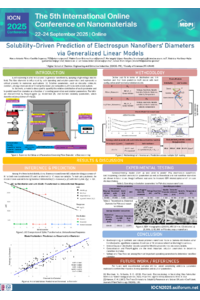
IOCN-2025-Poster-Solubility-Driven-Prediction.pdf
YIG-Supported Spin Waves as Information Carriers in Molecular Neuromorphic Networks
Modeling Ion Transport and Hysteresis Phenomena in Perovskite Solar Cells Using Drift-Diffusion Simulation