Event submissions
Published
This submission belongs to the session S4. Modeling and Simulation of Nanostructures and Nanodevices of the event The 5th International Online Conference on Nanomaterials
Published date
18 Sep, 2025
Academic Editor
'%3e%3cpath%20d='M12.6657%2010.9104C12.4185%2010.325%2012.0599%209.79327%2011.6097%209.34482C11.1609%208.89508%2010.6293%208.5365%2010.0442%208.28888C10.0389%208.28626%2010.0337%208.28495%2010.0285%208.28233C10.8446%207.69279%2011.3752%206.73249%2011.3752%205.64904C11.3752%203.8542%209.92103%202.39999%208.1262%202.39999C6.33136%202.39999%204.87715%203.8542%204.87715%205.64904C4.87715%206.73249%205.40774%207.69279%206.22393%208.28364C6.21869%208.28626%206.21345%208.28757%206.20821%208.29019C5.62129%208.5378%205.09463%208.89284%204.64265%209.34613C4.1929%209.79493%203.83432%2010.3266%203.58671%2010.9117C3.34345%2011.4845%203.21226%2012.0987%203.20023%2012.7209C3.19988%2012.7349%203.20233%2012.7488%203.20744%2012.7619C3.21255%2012.7749%203.22022%2012.7867%203.22998%2012.7968C3.23975%2012.8068%203.25142%2012.8147%203.26431%2012.8202C3.2772%2012.8256%203.29105%2012.8284%203.30504%2012.8284H4.09109C4.14874%2012.8284%204.19459%2012.7825%204.1959%2012.7262C4.2221%2011.7148%204.62823%2010.7676%205.34617%2010.0497C6.08899%209.30683%207.0755%208.89808%208.1262%208.89808C9.17689%208.89808%2010.1634%209.30683%2010.9062%2010.0497C11.6242%2010.7676%2012.0303%2011.7148%2012.0565%2012.7262C12.0578%2012.7838%2012.1037%2012.8284%2012.1613%2012.8284H12.9474C12.9613%2012.8284%2012.9752%2012.8256%2012.9881%2012.8202C13.001%2012.8147%2013.0126%2012.8068%2013.0224%2012.7968C13.0322%2012.7867%2013.0398%2012.7749%2013.0449%2012.7619C13.0501%2012.7488%2013.0525%2012.7349%2013.0522%2012.7209C13.0391%2012.0947%2012.9094%2011.4855%2012.6657%2010.9104ZM8.1262%207.9024C7.52486%207.9024%206.9589%207.6679%206.53312%207.24211C6.10733%206.81633%205.87283%206.25037%205.87283%205.64904C5.87283%205.0477%206.10733%204.48174%206.53312%204.05596C6.9589%203.63018%207.52486%203.39567%208.1262%203.39567C8.72753%203.39567%209.29349%203.63018%209.71927%204.05596C10.1451%204.48174%2010.3796%205.0477%2010.3796%205.64904C10.3796%206.25037%2010.1451%206.81633%209.71927%207.24211C9.29349%207.6679%208.72753%207.9024%208.1262%207.9024Z'%20fill='%235D1EE1'/%3e%3c/g%3e%3c/svg%3e) Sotirios Baskoutas
Sotirios BaskoutasCitation
Zhansaya Omarova, Ayazhan Dossymbekova, Yeldos Seitkozhanov, Erik Shalenov, Modeling Ion Transport and Hysteresis Phenomena in Perovskite Solar Cells Using Drift-Diffusion Simulation, in Proceedings of The 5th International Online Conference on Nanomaterials, 22 September–24 September 2025, MDPI: Basel, Switzerland
Share
Email
Facebook
Twitter
LinkedIn
Modeling Ion Transport and Hysteresis Phenomena in Perovskite Solar Cells Using Drift-Diffusion Simulation
'%3e%3cpath%20d='M12.6647%2010.9104C12.4176%2010.325%2012.0589%209.7933%2011.6088%209.34485C11.16%208.89511%2010.6283%208.53653%2010.0432%208.28891C10.038%208.28629%2010.0327%208.28498%2010.0275%208.28236C10.8437%207.69282%2011.3743%206.73252%2011.3743%205.64907C11.3743%203.85423%209.92005%202.40002%208.12522%202.40002C6.33038%202.40002%204.87618%203.85423%204.87618%205.64907C4.87618%206.73252%205.40677%207.69282%206.22296%208.28367C6.21772%208.28629%206.21248%208.2876%206.20724%208.29022C5.62031%208.53783%205.09365%208.89287%204.64167%209.34616C4.19192%209.79496%203.83334%2010.3266%203.58573%2010.9117C3.34247%2011.4846%203.21128%2012.0987%203.19925%2012.721C3.1989%2012.735%203.20135%2012.7489%203.20646%2012.7619C3.21157%2012.7749%203.21924%2012.7868%203.22901%2012.7968C3.23877%2012.8068%203.25045%2012.8148%203.26334%2012.8202C3.27623%2012.8256%203.29007%2012.8284%203.30406%2012.8284H4.09012C4.14776%2012.8284%204.19362%2012.7825%204.19493%2012.7262C4.22113%2011.7148%204.62726%2010.7676%205.34519%2010.0497C6.08802%209.30686%207.07452%208.89811%208.12522%208.89811C9.17592%208.89811%2010.1624%209.30686%2010.9052%2010.0497C11.6232%2010.7676%2012.0293%2011.7148%2012.0555%2012.7262C12.0568%2012.7839%2012.1027%2012.8284%2012.1603%2012.8284H12.9464C12.9604%2012.8284%2012.9742%2012.8256%2012.9871%2012.8202C13%2012.8148%2013.0117%2012.8068%2013.0214%2012.7968C13.0312%2012.7868%2013.0389%2012.7749%2013.044%2012.7619C13.0491%2012.7489%2013.0515%2012.735%2013.0512%2012.721C13.0381%2012.0947%2012.9084%2011.4856%2012.6647%2010.9104ZM8.12522%207.90243C7.52388%207.90243%206.95792%207.66793%206.53214%207.24215C6.10636%206.81636%205.87185%206.2504%205.87185%205.64907C5.87185%205.04773%206.10636%204.48177%206.53214%204.05599C6.95792%203.63021%207.52388%203.3957%208.12522%203.3957C8.72655%203.3957%209.29252%203.63021%209.7183%204.05599C10.1441%204.48177%2010.3786%205.04773%2010.3786%205.64907C10.3786%206.2504%2010.1441%206.81636%209.7183%207.24215C9.29252%207.66793%208.72655%207.90243%208.12522%207.90243Z'%20fill='%235D1EE1'/%3e%3c/g%3e%3c/svg%3e)
Zhansaya Omarova 1
Ayazhan Dossymbekova 1
Yeldos Seitkozhanov 2,3
Erik Shalenov 1
1. Department of Materials Science, Nanotechnology and Engineering Physics, Mining and metallurgical institute named after O.A.Baikonurov Satbayev University Almaty, 050013
2. Department of General Physics, Satbayev University, Almaty 050013, Kazakhstan,
3. Department of Plasma Physics, Nanotechnology and Computer Physics, Al-Farabi Kazakh National University, Almaty 050040, Kazakhstan
Abstract
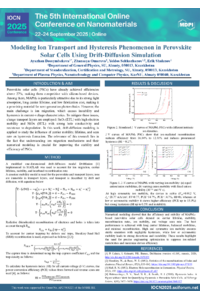
Hybrid organic–inorganic perovskites, particularly methylammonium lead iodide (MAPbI₃), have attracted considerable interest due to their exceptional photoelectric properties, making them promising candidates for next-generation solar cells [1,2]. However, despite these advantages, MAPbI₃-based perovskites are susceptible to ion migration, during which dissociation into methylammonium (MA⁺) and iodide (I⁻) ions occurs [3]. This phenomenon leads to instability in device performance, including the emergence of hysteresis in current–voltage (J–V) characteristics.
In this study, drift-diffusion modeling is employed to analyze these effects. This approach enables a detailed investigation of hysteresis behavior and allows for the assessment of how scan rate, carrier lifetime, and charge carrier mobility influence the shape of the J–V curves in perovskite solar cells [4].
The mobilities of cations and anions are equal (μₐ = μc). At high mobility (10⁻⁸ cm²/V·s), the J–V curve appears symmetric with minimal hysteresis, indicating rapid ion redistribution and efficient compensation of the internal electric field. In contrast, the results show in which cation mobility is fixed at 10⁻¹² cm²/V·s, while anion mobility varies from 10⁻⁸ to 10⁻¹² cm²/V·s. As anion mobility decreases, hysteresis progressively intensifies: at the lowest value (μₐ = 10⁻¹² cm²/V·s), the reverse J–V curve exhibits a pronounced shift, indicating significant distortion in charge transport processes.
This work was supported by Grant No. AP27508227 of the Ministry of Science and Higher Education of the Republic of Kazakhstan.
Keywords
perovskite solar cells
drift-diffusion model
ion migration
hysteresis effects
Poster
IOCN 2025 Poster Dossymbekova A.pdf
Solubility-Driven Prediction of Electrospun Nanofibers' Diameters via Generalized Linear Models
Modeling and Performance Optimization of CH₃NH₃SnI₃-Based Lead-Free Perovskite Solar Cells