Event submissions
Published
This submission belongs to the session S4. Modeling and Simulation of Nanostructures and Nanodevices of the event The 5th International Online Conference on Nanomaterials
Published date
18 Sep, 2025
Academic Editor
'%3e%3cpath%20d='M12.6657%2010.9104C12.4185%2010.325%2012.0599%209.79327%2011.6097%209.34482C11.1609%208.89508%2010.6293%208.5365%2010.0442%208.28888C10.0389%208.28626%2010.0337%208.28495%2010.0285%208.28233C10.8446%207.69279%2011.3752%206.73249%2011.3752%205.64904C11.3752%203.8542%209.92103%202.39999%208.1262%202.39999C6.33136%202.39999%204.87715%203.8542%204.87715%205.64904C4.87715%206.73249%205.40774%207.69279%206.22393%208.28364C6.21869%208.28626%206.21345%208.28757%206.20821%208.29019C5.62129%208.5378%205.09463%208.89284%204.64265%209.34613C4.1929%209.79493%203.83432%2010.3266%203.58671%2010.9117C3.34345%2011.4845%203.21226%2012.0987%203.20023%2012.7209C3.19988%2012.7349%203.20233%2012.7488%203.20744%2012.7619C3.21255%2012.7749%203.22022%2012.7867%203.22998%2012.7968C3.23975%2012.8068%203.25142%2012.8147%203.26431%2012.8202C3.2772%2012.8256%203.29105%2012.8284%203.30504%2012.8284H4.09109C4.14874%2012.8284%204.19459%2012.7825%204.1959%2012.7262C4.2221%2011.7148%204.62823%2010.7676%205.34617%2010.0497C6.08899%209.30683%207.0755%208.89808%208.1262%208.89808C9.17689%208.89808%2010.1634%209.30683%2010.9062%2010.0497C11.6242%2010.7676%2012.0303%2011.7148%2012.0565%2012.7262C12.0578%2012.7838%2012.1037%2012.8284%2012.1613%2012.8284H12.9474C12.9613%2012.8284%2012.9752%2012.8256%2012.9881%2012.8202C13.001%2012.8147%2013.0126%2012.8068%2013.0224%2012.7968C13.0322%2012.7867%2013.0398%2012.7749%2013.0449%2012.7619C13.0501%2012.7488%2013.0525%2012.7349%2013.0522%2012.7209C13.0391%2012.0947%2012.9094%2011.4855%2012.6657%2010.9104ZM8.1262%207.9024C7.52486%207.9024%206.9589%207.6679%206.53312%207.24211C6.10733%206.81633%205.87283%206.25037%205.87283%205.64904C5.87283%205.0477%206.10733%204.48174%206.53312%204.05596C6.9589%203.63018%207.52486%203.39567%208.1262%203.39567C8.72753%203.39567%209.29349%203.63018%209.71927%204.05596C10.1451%204.48174%2010.3796%205.0477%2010.3796%205.64904C10.3796%206.25037%2010.1451%206.81633%209.71927%207.24211C9.29349%207.6679%208.72753%207.9024%208.1262%207.9024Z'%20fill='%235D1EE1'/%3e%3c/g%3e%3c/svg%3e) Sotirios Baskoutas
Sotirios BaskoutasCitation
Zhansaya Omarova, Aina Shaikhmeddenova, Erik Shalenov, Ayazhan Dossymbekova, Modeling and Performance Optimization of CH₃NH₃SnI₃-Based Lead-Free Perovskite Solar Cells, in Proceedings of The 5th International Online Conference on Nanomaterials, 22 September–24 September 2025, MDPI: Basel, Switzerland
Share
Email
Facebook
Twitter
LinkedIn
Modeling and Performance Optimization of CH₃NH₃SnI₃-Based Lead-Free Perovskite Solar Cells
'%3e%3cpath%20d='M12.6647%2010.9104C12.4176%2010.325%2012.0589%209.7933%2011.6088%209.34485C11.16%208.89511%2010.6283%208.53653%2010.0432%208.28891C10.038%208.28629%2010.0327%208.28498%2010.0275%208.28236C10.8437%207.69282%2011.3743%206.73252%2011.3743%205.64907C11.3743%203.85423%209.92005%202.40002%208.12522%202.40002C6.33038%202.40002%204.87618%203.85423%204.87618%205.64907C4.87618%206.73252%205.40677%207.69282%206.22296%208.28367C6.21772%208.28629%206.21248%208.2876%206.20724%208.29022C5.62031%208.53783%205.09365%208.89287%204.64167%209.34616C4.19192%209.79496%203.83334%2010.3266%203.58573%2010.9117C3.34247%2011.4846%203.21128%2012.0987%203.19925%2012.721C3.1989%2012.735%203.20135%2012.7489%203.20646%2012.7619C3.21157%2012.7749%203.21924%2012.7868%203.22901%2012.7968C3.23877%2012.8068%203.25045%2012.8148%203.26334%2012.8202C3.27623%2012.8256%203.29007%2012.8284%203.30406%2012.8284H4.09012C4.14776%2012.8284%204.19362%2012.7825%204.19493%2012.7262C4.22113%2011.7148%204.62726%2010.7676%205.34519%2010.0497C6.08802%209.30686%207.07452%208.89811%208.12522%208.89811C9.17592%208.89811%2010.1624%209.30686%2010.9052%2010.0497C11.6232%2010.7676%2012.0293%2011.7148%2012.0555%2012.7262C12.0568%2012.7839%2012.1027%2012.8284%2012.1603%2012.8284H12.9464C12.9604%2012.8284%2012.9742%2012.8256%2012.9871%2012.8202C13%2012.8148%2013.0117%2012.8068%2013.0214%2012.7968C13.0312%2012.7868%2013.0389%2012.7749%2013.044%2012.7619C13.0491%2012.7489%2013.0515%2012.735%2013.0512%2012.721C13.0381%2012.0947%2012.9084%2011.4856%2012.6647%2010.9104ZM8.12522%207.90243C7.52388%207.90243%206.95792%207.66793%206.53214%207.24215C6.10636%206.81636%205.87185%206.2504%205.87185%205.64907C5.87185%205.04773%206.10636%204.48177%206.53214%204.05599C6.95792%203.63021%207.52388%203.3957%208.12522%203.3957C8.72655%203.3957%209.29252%203.63021%209.7183%204.05599C10.1441%204.48177%2010.3786%205.04773%2010.3786%205.64907C10.3786%206.2504%2010.1441%206.81636%209.7183%207.24215C9.29252%207.66793%208.72655%207.90243%208.12522%207.90243Z'%20fill='%235D1EE1'/%3e%3c/g%3e%3c/svg%3e)
Zhansaya Omarova 1
Aina Shaikhmeddenova 1
Erik Shalenov 1
Ayazhan Dossymbekova 1
1. Department of Standardization, Certification and Metrology, Institute of Energy and Mechanical Engineering named after A. Burkitbayev, Satbayev University, Almaty, 050013, Kazakhstan
Abstract
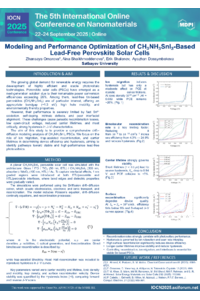
Methylammonium tin iodide (CH₃NH₃SnI₃) has attracted significant attention in recent years as a promising lead-free material for perovskite solar cells (PSCs), offering an environmentally friendly alternative to traditional lead-based compounds. With a direct band gap of approximately 1.3 eV, high hole mobility, and favorable charge transport properties, CH₃NH₃SnI₃ possesses strong theoretical potential for high-efficiency solar energy conversion [1-3].
However, further development of devices based on this material is limited by several fundamental challenges, most notably the pronounced hysteresis in current–voltage (J–V) characteristics. This behavior is associated with slow internal dynamic processes, including ion migration and interfacial charge relaxation [4].
In this study, numerical simulations based on the drift-diffusion model were conducted to investigate the role of ion-mediated recombination and ionic mobility in the formation of hysteresis in CH₃NH₃SnI₃-based devices. Particular attention was paid to the influence of carrier lifetime (τ), a key parameter governing the efficiency of photogenerated carrier generation, transport, and extraction. The simulation results show that increasing τ significantly reduces bulk and interfacial recombination losses, minimizes the hysteresis index (HI), enhances the short-circuit current density (Jsc = 31.62 mA/cm²), and improves the operational stability of the device under both forward and reverse scan directions. Analysis of the J–V characteristics as a function of carrier lifetime confirmed that longer lifetimes lead to improved photovoltaic performance, reduced impact of ion migration, and enhanced output stability. Thus, this study highlights the critical importance of precise control over carrier lifetime and ionic mobility in improving the efficiency and long-term stability of CH₃NH₃SnI₃-based PSCs. It also demonstrates the potential of numerical modeling as an effective tool for the engineering optimization of perovskite photovoltaic devices.
This work was supported by the Grant No. AP19174728 of the Ministry of Science and Higher Education of the Republic of Kazakhstan.
Keywords
perovskite solar cells
drift-diffusion model
carrier lifetime
hysteresis index
Poster
IOCN 2025 Poster Omarova.pdf
Modeling Ion Transport and Hysteresis Phenomena in Perovskite Solar Cells Using Drift-Diffusion Simulation
Investigation of mechanical properties of BaTiO3/PVDF nanocomposites: molecular dynamics simulations