Event submissions
Published
This submission belongs to the session S6. Synthesis, Characterization, and Properties of Nanomaterials of the event The 5th International Online Conference on Nanomaterials
Published date
19 Sep, 2025
Academic Editor
'%3e%3cpath%20d='M12.6657%2010.9104C12.4185%2010.325%2012.0599%209.79327%2011.6097%209.34482C11.1609%208.89508%2010.6293%208.5365%2010.0442%208.28888C10.0389%208.28626%2010.0337%208.28495%2010.0285%208.28233C10.8446%207.69279%2011.3752%206.73249%2011.3752%205.64904C11.3752%203.8542%209.92103%202.39999%208.1262%202.39999C6.33136%202.39999%204.87715%203.8542%204.87715%205.64904C4.87715%206.73249%205.40774%207.69279%206.22393%208.28364C6.21869%208.28626%206.21345%208.28757%206.20821%208.29019C5.62129%208.5378%205.09463%208.89284%204.64265%209.34613C4.1929%209.79493%203.83432%2010.3266%203.58671%2010.9117C3.34345%2011.4845%203.21226%2012.0987%203.20023%2012.7209C3.19988%2012.7349%203.20233%2012.7488%203.20744%2012.7619C3.21255%2012.7749%203.22022%2012.7867%203.22998%2012.7968C3.23975%2012.8068%203.25142%2012.8147%203.26431%2012.8202C3.2772%2012.8256%203.29105%2012.8284%203.30504%2012.8284H4.09109C4.14874%2012.8284%204.19459%2012.7825%204.1959%2012.7262C4.2221%2011.7148%204.62823%2010.7676%205.34617%2010.0497C6.08899%209.30683%207.0755%208.89808%208.1262%208.89808C9.17689%208.89808%2010.1634%209.30683%2010.9062%2010.0497C11.6242%2010.7676%2012.0303%2011.7148%2012.0565%2012.7262C12.0578%2012.7838%2012.1037%2012.8284%2012.1613%2012.8284H12.9474C12.9613%2012.8284%2012.9752%2012.8256%2012.9881%2012.8202C13.001%2012.8147%2013.0126%2012.8068%2013.0224%2012.7968C13.0322%2012.7867%2013.0398%2012.7749%2013.0449%2012.7619C13.0501%2012.7488%2013.0525%2012.7349%2013.0522%2012.7209C13.0391%2012.0947%2012.9094%2011.4855%2012.6657%2010.9104ZM8.1262%207.9024C7.52486%207.9024%206.9589%207.6679%206.53312%207.24211C6.10733%206.81633%205.87283%206.25037%205.87283%205.64904C5.87283%205.0477%206.10733%204.48174%206.53312%204.05596C6.9589%203.63018%207.52486%203.39567%208.1262%203.39567C8.72753%203.39567%209.29349%203.63018%209.71927%204.05596C10.1451%204.48174%2010.3796%205.0477%2010.3796%205.64904C10.3796%206.25037%2010.1451%206.81633%209.71927%207.24211C9.29349%207.6679%208.72753%207.9024%208.1262%207.9024Z'%20fill='%235D1EE1'/%3e%3c/g%3e%3c/svg%3e) José Luis Arias Mediano
José Luis Arias MedianoCitation
Danielle do Rocio Laskowski, Vinicius Pereira dos Anjos, Sido Feilstrecker Junior, Kevin Siqueira Costa, Thiago Neves Machado, Jorge Alberto Lenz, Emilson Ribeiro Viana, Rafael Eleodoro de Góes, Wido Herwig Schreiner, Arandi Ginane Bezerra Jr, MAGNETO-PLASMONIC AU-FE (OXIDE) HYBRID NANOPARTICLES: FROM SYNTHESIS TO SERS APPLICATIONS, in Proceedings of The 5th International Online Conference on Nanomaterials, 22 September–24 September 2025, MDPI: Basel, Switzerland
Share
Email
Facebook
Twitter
LinkedIn
MAGNETO-PLASMONIC AU-FE (OXIDE) HYBRID NANOPARTICLES: FROM SYNTHESIS TO SERS APPLICATIONS

Danielle do Rocio Laskowski 1

Vinicius Pereira dos Anjos 2
'%3e%3cpath%20d='M12.6647%2010.9104C12.4176%2010.325%2012.0589%209.7933%2011.6088%209.34485C11.16%208.89511%2010.6283%208.53653%2010.0432%208.28891C10.038%208.28629%2010.0327%208.28498%2010.0275%208.28236C10.8437%207.69282%2011.3743%206.73252%2011.3743%205.64907C11.3743%203.85423%209.92005%202.40002%208.12522%202.40002C6.33038%202.40002%204.87618%203.85423%204.87618%205.64907C4.87618%206.73252%205.40677%207.69282%206.22296%208.28367C6.21772%208.28629%206.21248%208.2876%206.20724%208.29022C5.62031%208.53783%205.09365%208.89287%204.64167%209.34616C4.19192%209.79496%203.83334%2010.3266%203.58573%2010.9117C3.34247%2011.4846%203.21128%2012.0987%203.19925%2012.721C3.1989%2012.735%203.20135%2012.7489%203.20646%2012.7619C3.21157%2012.7749%203.21924%2012.7868%203.22901%2012.7968C3.23877%2012.8068%203.25045%2012.8148%203.26334%2012.8202C3.27623%2012.8256%203.29007%2012.8284%203.30406%2012.8284H4.09012C4.14776%2012.8284%204.19362%2012.7825%204.19493%2012.7262C4.22113%2011.7148%204.62726%2010.7676%205.34519%2010.0497C6.08802%209.30686%207.07452%208.89811%208.12522%208.89811C9.17592%208.89811%2010.1624%209.30686%2010.9052%2010.0497C11.6232%2010.7676%2012.0293%2011.7148%2012.0555%2012.7262C12.0568%2012.7839%2012.1027%2012.8284%2012.1603%2012.8284H12.9464C12.9604%2012.8284%2012.9742%2012.8256%2012.9871%2012.8202C13%2012.8148%2013.0117%2012.8068%2013.0214%2012.7968C13.0312%2012.7868%2013.0389%2012.7749%2013.044%2012.7619C13.0491%2012.7489%2013.0515%2012.735%2013.0512%2012.721C13.0381%2012.0947%2012.9084%2011.4856%2012.6647%2010.9104ZM8.12522%207.90243C7.52388%207.90243%206.95792%207.66793%206.53214%207.24215C6.10636%206.81636%205.87185%206.2504%205.87185%205.64907C5.87185%205.04773%206.10636%204.48177%206.53214%204.05599C6.95792%203.63021%207.52388%203.3957%208.12522%203.3957C8.72655%203.3957%209.29252%203.63021%209.7183%204.05599C10.1441%204.48177%2010.3786%205.04773%2010.3786%205.64907C10.3786%206.2504%2010.1441%206.81636%209.7183%207.24215C9.29252%207.66793%208.72655%207.90243%208.12522%207.90243Z'%20fill='%235D1EE1'/%3e%3c/g%3e%3c/svg%3e)
Sido Feilstrecker Junior 1
Kevin Siqueira Costa 3
Thiago Neves Machado 1
Jorge Alberto Lenz 4
Emilson Ribeiro Viana 5
Rafael Eleodoro de Góes 1
Wido Herwig Schreiner 1
Arandi Ginane Bezerra Jr 1
1. Postgraduate Program in Physics and Astronomy (PPGFA), Federal University of Technology – Paraná , Curitiba, 80230-901, Brazil
2. Graduate Program in Physics and Astronomy , University of São Paulo, São Paulo, Brazil
3. Degree in Physics, Federal University of Technology – Paraná , Curitiba, 80230-901, Brazil
4. Academic Department of Physics (DAFIS), Federal University of Technology – Paraná , Curitiba, 80230-901, Brazil.
5. Department of Physics, Federal University of Technology – Paraná , Curitiba, 80230-901, Brazil.
Abstract
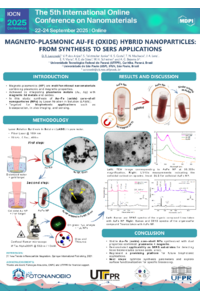
Magneto-plasmonics (MP) refers to multifunctional nanomaterials that exhibit both plasmonic and magnetic properties concurrently. This integration of magnetism and photonics at the nanoscale is typically accomplished by combining plasmonic materials, such as Au and Ag, with magnetic substances, including 3D metals and their oxides. In this study, we present experimental findings on the laser ablation synthesis in solution (LASiS) of Au-Fe (oxide) core–shell nanoparticles (NP) in water. Our approach consists of two steps: first, a gold target is subjected to 1064 nm (400 ns; 0.5 mJ) pulses from a fiber laser at 50 kHz, resulting in pure Au. A colloidal solution with an optical density (OD) of 1 at 520 nm—corresponding to ~0.1 mg/mL of Au—was obtained in this step and was used as the medium for the second step, involving the ablation of an iron target under identical laser conditions. Various LASiS configurations were explored, with different Au0 and Fe-target ablation durations. Consequently, optimal Au and Fe colloidal concentrations were established to synthesize very stable hybrid Au-Fe (oxide) nanoparticle solutions. NP characterization using UV-Vis spectrometry reveals a surface plasmon band centered at 530 nm, which corresponds to the solution's vibrant purple color; additionally, DLS and TEM analyses indicate spherical NPs with an average size of 10 nm. Characterization of the NP structure through EDS and XPS confirms the presence of iron oxide, which explains why a small neodymium magnet placed at the bottom of a test tube filled with the colloidal solution can attract all the NPs to the bottom in under 5 minutes. These core–shell Au-Fe (oxide) NPs represent promising materials for biophotonic applications, including bioseparation, in vivo imaging, and sensing. As a proof-of-concept experiment, we effectively utilized our Au-Fe (oxide) NPs as substrates in Surface-Enhanced Raman Spectroscopy (SERS) tests to detect trace amounts of biological molecules, such as amino acids and urea, in aqueous solutions.
Keywords
magneto-plasmonics
nanoparticles
laser ablation
SERS
biophotonics
Poster
Poster+IOCN25.pdf
Development and Application of Metal–Organic Frameworks (MOFs) for Flame Retardancy to Improve the Safety of Cotton Fabrics
Elucidating the chemical depth profile of laser-induced graphene electrodes