Event submissions
Published
This submission belongs to the session S6. Synthesis, Characterization, and Properties of Nanomaterials of the event The 5th International Online Conference on Nanomaterials
Published date
19 Sep, 2025
Academic Editor
'%3e%3cpath%20d='M12.6657%2010.9104C12.4185%2010.325%2012.0599%209.79327%2011.6097%209.34482C11.1609%208.89508%2010.6293%208.5365%2010.0442%208.28888C10.0389%208.28626%2010.0337%208.28495%2010.0285%208.28233C10.8446%207.69279%2011.3752%206.73249%2011.3752%205.64904C11.3752%203.8542%209.92103%202.39999%208.1262%202.39999C6.33136%202.39999%204.87715%203.8542%204.87715%205.64904C4.87715%206.73249%205.40774%207.69279%206.22393%208.28364C6.21869%208.28626%206.21345%208.28757%206.20821%208.29019C5.62129%208.5378%205.09463%208.89284%204.64265%209.34613C4.1929%209.79493%203.83432%2010.3266%203.58671%2010.9117C3.34345%2011.4845%203.21226%2012.0987%203.20023%2012.7209C3.19988%2012.7349%203.20233%2012.7488%203.20744%2012.7619C3.21255%2012.7749%203.22022%2012.7867%203.22998%2012.7968C3.23975%2012.8068%203.25142%2012.8147%203.26431%2012.8202C3.2772%2012.8256%203.29105%2012.8284%203.30504%2012.8284H4.09109C4.14874%2012.8284%204.19459%2012.7825%204.1959%2012.7262C4.2221%2011.7148%204.62823%2010.7676%205.34617%2010.0497C6.08899%209.30683%207.0755%208.89808%208.1262%208.89808C9.17689%208.89808%2010.1634%209.30683%2010.9062%2010.0497C11.6242%2010.7676%2012.0303%2011.7148%2012.0565%2012.7262C12.0578%2012.7838%2012.1037%2012.8284%2012.1613%2012.8284H12.9474C12.9613%2012.8284%2012.9752%2012.8256%2012.9881%2012.8202C13.001%2012.8147%2013.0126%2012.8068%2013.0224%2012.7968C13.0322%2012.7867%2013.0398%2012.7749%2013.0449%2012.7619C13.0501%2012.7488%2013.0525%2012.7349%2013.0522%2012.7209C13.0391%2012.0947%2012.9094%2011.4855%2012.6657%2010.9104ZM8.1262%207.9024C7.52486%207.9024%206.9589%207.6679%206.53312%207.24211C6.10733%206.81633%205.87283%206.25037%205.87283%205.64904C5.87283%205.0477%206.10733%204.48174%206.53312%204.05596C6.9589%203.63018%207.52486%203.39567%208.1262%203.39567C8.72753%203.39567%209.29349%203.63018%209.71927%204.05596C10.1451%204.48174%2010.3796%205.0477%2010.3796%205.64904C10.3796%206.25037%2010.1451%206.81633%209.71927%207.24211C9.29349%207.6679%208.72753%207.9024%208.1262%207.9024Z'%20fill='%235D1EE1'/%3e%3c/g%3e%3c/svg%3e) José Luis Arias Mediano
José Luis Arias MedianoCitation
Muhammad Khan Khattak, Asif Jamil, Thiago Soares, Giovanna Machado, Marcus Vinicius Castegnaro, Lara Loguercio, Anderson Thesing, Nickel-Modified Carbon Nitride for Enhanced Photocatalysis, in Proceedings of The 5th International Online Conference on Nanomaterials, 22 September–24 September 2025, MDPI: Basel, Switzerland
Share
Email
Facebook
Twitter
LinkedIn
Nickel-Modified Carbon Nitride for Enhanced Photocatalysis
'%3e%3cpath%20d='M12.6647%2010.9104C12.4176%2010.325%2012.0589%209.7933%2011.6088%209.34485C11.16%208.89511%2010.6283%208.53653%2010.0432%208.28891C10.038%208.28629%2010.0327%208.28498%2010.0275%208.28236C10.8437%207.69282%2011.3743%206.73252%2011.3743%205.64907C11.3743%203.85423%209.92005%202.40002%208.12522%202.40002C6.33038%202.40002%204.87618%203.85423%204.87618%205.64907C4.87618%206.73252%205.40677%207.69282%206.22296%208.28367C6.21772%208.28629%206.21248%208.2876%206.20724%208.29022C5.62031%208.53783%205.09365%208.89287%204.64167%209.34616C4.19192%209.79496%203.83334%2010.3266%203.58573%2010.9117C3.34247%2011.4846%203.21128%2012.0987%203.19925%2012.721C3.1989%2012.735%203.20135%2012.7489%203.20646%2012.7619C3.21157%2012.7749%203.21924%2012.7868%203.22901%2012.7968C3.23877%2012.8068%203.25045%2012.8148%203.26334%2012.8202C3.27623%2012.8256%203.29007%2012.8284%203.30406%2012.8284H4.09012C4.14776%2012.8284%204.19362%2012.7825%204.19493%2012.7262C4.22113%2011.7148%204.62726%2010.7676%205.34519%2010.0497C6.08802%209.30686%207.07452%208.89811%208.12522%208.89811C9.17592%208.89811%2010.1624%209.30686%2010.9052%2010.0497C11.6232%2010.7676%2012.0293%2011.7148%2012.0555%2012.7262C12.0568%2012.7839%2012.1027%2012.8284%2012.1603%2012.8284H12.9464C12.9604%2012.8284%2012.9742%2012.8256%2012.9871%2012.8202C13%2012.8148%2013.0117%2012.8068%2013.0214%2012.7968C13.0312%2012.7868%2013.0389%2012.7749%2013.044%2012.7619C13.0491%2012.7489%2013.0515%2012.735%2013.0512%2012.721C13.0381%2012.0947%2012.9084%2011.4856%2012.6647%2010.9104ZM8.12522%207.90243C7.52388%207.90243%206.95792%207.66793%206.53214%207.24215C6.10636%206.81636%205.87185%206.2504%205.87185%205.64907C5.87185%205.04773%206.10636%204.48177%206.53214%204.05599C6.95792%203.63021%207.52388%203.3957%208.12522%203.3957C8.72655%203.3957%209.29252%203.63021%209.7183%204.05599C10.1441%204.48177%2010.3786%205.04773%2010.3786%205.64907C10.3786%206.2504%2010.1441%206.81636%209.7183%207.24215C9.29252%207.66793%208.72655%207.90243%208.12522%207.90243Z'%20fill='%235D1EE1'/%3e%3c/g%3e%3c/svg%3e)
Muhammad Khan Khattak 1
Asif Jamil 1
Thiago Soares 2
Giovanna Machado 2
Marcus Vinicius Castegnaro 1
Lara Loguercio 3
Anderson Thesing 1
1. Institute of Physics, Federal University of Rio Grande do Sul, Porto Alegre, Brazil
2. Nanotechnology, Centro de Tecnologias Estratégicas do Nordeste, Recife, Brazil
3. Institute of Chemistry, Federal University of Rio Grande do Sul, Porto Alegre, Brazil
Abstract
The development of efficient artificial photocatalysts is a promising strategy for addressing global energy and environmental challenges. Polymeric carbon nitride (CN) has emerged as a strong candidate for photocatalytic hydrogen (H2) evolution due to its favorable electronic structure and ease of synthesis. However, its performance is limited by the rapid recombination of photogenerated charge carriers. To overcome this limitation, CN was synthesized through the thermal polycondensation of melamine and subsequently modified with nickel (Ni) cocatalysts through magnetron sputtering. The Ni loading was precisely tuned by adjusting the deposition time, reaching up to 0.11 wt%. A range of characterization techniques, including UV-Vis spectroscopy, FTIR, XRD, SEM, XPS, and XAS, was used to evaluate the structural and electronic properties of the CN-Ni materials. The results confirmed the presence of Ni²⁺ species, primarily as NiOx and Ni(OH)x, which contributed to the improved charge separation by acting as hole and electron scavengers. Additionally, the incorporation of Ni led to modifications in the nitrogen bonding states without altering the bulk structure of the CN. These changes correlate with enhanced photocatalytic activity, supporting a proposed mechanism based on the interaction between CN and different Ni species. This study provides meaningful insights into the design of non-noble-metal-based photocatalysts for sustainable hydrogen production.
Keywords
Photocatalysis
Melamine
Ni Cocatalyst
Hydrogen production
Poster
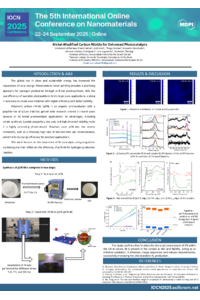
Poster for nanomaterial MDPI_AT.pdf
Elucidating the chemical depth profile of laser-induced graphene electrodes
Developing Nanomaterials to Improve Crop Resilience Under Drought, Salinity, and Extreme Temperature