Event submissions
Published
This submission belongs to the session S6. Synthesis, Characterization, and Properties of Nanomaterials of the event The 5th International Online Conference on Nanomaterials
Published date
19 Sep, 2025
Academic Editor
'%3e%3cpath%20d='M12.6657%2010.9104C12.4185%2010.325%2012.0599%209.79327%2011.6097%209.34482C11.1609%208.89508%2010.6293%208.5365%2010.0442%208.28888C10.0389%208.28626%2010.0337%208.28495%2010.0285%208.28233C10.8446%207.69279%2011.3752%206.73249%2011.3752%205.64904C11.3752%203.8542%209.92103%202.39999%208.1262%202.39999C6.33136%202.39999%204.87715%203.8542%204.87715%205.64904C4.87715%206.73249%205.40774%207.69279%206.22393%208.28364C6.21869%208.28626%206.21345%208.28757%206.20821%208.29019C5.62129%208.5378%205.09463%208.89284%204.64265%209.34613C4.1929%209.79493%203.83432%2010.3266%203.58671%2010.9117C3.34345%2011.4845%203.21226%2012.0987%203.20023%2012.7209C3.19988%2012.7349%203.20233%2012.7488%203.20744%2012.7619C3.21255%2012.7749%203.22022%2012.7867%203.22998%2012.7968C3.23975%2012.8068%203.25142%2012.8147%203.26431%2012.8202C3.2772%2012.8256%203.29105%2012.8284%203.30504%2012.8284H4.09109C4.14874%2012.8284%204.19459%2012.7825%204.1959%2012.7262C4.2221%2011.7148%204.62823%2010.7676%205.34617%2010.0497C6.08899%209.30683%207.0755%208.89808%208.1262%208.89808C9.17689%208.89808%2010.1634%209.30683%2010.9062%2010.0497C11.6242%2010.7676%2012.0303%2011.7148%2012.0565%2012.7262C12.0578%2012.7838%2012.1037%2012.8284%2012.1613%2012.8284H12.9474C12.9613%2012.8284%2012.9752%2012.8256%2012.9881%2012.8202C13.001%2012.8147%2013.0126%2012.8068%2013.0224%2012.7968C13.0322%2012.7867%2013.0398%2012.7749%2013.0449%2012.7619C13.0501%2012.7488%2013.0525%2012.7349%2013.0522%2012.7209C13.0391%2012.0947%2012.9094%2011.4855%2012.6657%2010.9104ZM8.1262%207.9024C7.52486%207.9024%206.9589%207.6679%206.53312%207.24211C6.10733%206.81633%205.87283%206.25037%205.87283%205.64904C5.87283%205.0477%206.10733%204.48174%206.53312%204.05596C6.9589%203.63018%207.52486%203.39567%208.1262%203.39567C8.72753%203.39567%209.29349%203.63018%209.71927%204.05596C10.1451%204.48174%2010.3796%205.0477%2010.3796%205.64904C10.3796%206.25037%2010.1451%206.81633%209.71927%207.24211C9.29349%207.6679%208.72753%207.9024%208.1262%207.9024Z'%20fill='%235D1EE1'/%3e%3c/g%3e%3c/svg%3e) José Luis Arias Mediano
José Luis Arias MedianoCitation
Abhishek Sharma, Vir Singh Rangra, Strain- and Defect-Engineered Modulation of Structural, Morphological, Optical, and Magnetic Properties in Ho³⁺-Doped β-Ga₂O₃ Nanoparticles, in Proceedings of The 5th International Online Conference on Nanomaterials, 22 September–24 September 2025, MDPI: Basel, Switzerland
Share
Email
Facebook
Twitter
LinkedIn
Strain- and Defect-Engineered Modulation of Structural, Morphological, Optical, and Magnetic Properties in Ho³⁺-Doped β-Ga₂O₃ Nanoparticles
'%3e%3cpath%20d='M12.6647%2010.9104C12.4176%2010.325%2012.0589%209.7933%2011.6088%209.34485C11.16%208.89511%2010.6283%208.53653%2010.0432%208.28891C10.038%208.28629%2010.0327%208.28498%2010.0275%208.28236C10.8437%207.69282%2011.3743%206.73252%2011.3743%205.64907C11.3743%203.85423%209.92005%202.40002%208.12522%202.40002C6.33038%202.40002%204.87618%203.85423%204.87618%205.64907C4.87618%206.73252%205.40677%207.69282%206.22296%208.28367C6.21772%208.28629%206.21248%208.2876%206.20724%208.29022C5.62031%208.53783%205.09365%208.89287%204.64167%209.34616C4.19192%209.79496%203.83334%2010.3266%203.58573%2010.9117C3.34247%2011.4846%203.21128%2012.0987%203.19925%2012.721C3.1989%2012.735%203.20135%2012.7489%203.20646%2012.7619C3.21157%2012.7749%203.21924%2012.7868%203.22901%2012.7968C3.23877%2012.8068%203.25045%2012.8148%203.26334%2012.8202C3.27623%2012.8256%203.29007%2012.8284%203.30406%2012.8284H4.09012C4.14776%2012.8284%204.19362%2012.7825%204.19493%2012.7262C4.22113%2011.7148%204.62726%2010.7676%205.34519%2010.0497C6.08802%209.30686%207.07452%208.89811%208.12522%208.89811C9.17592%208.89811%2010.1624%209.30686%2010.9052%2010.0497C11.6232%2010.7676%2012.0293%2011.7148%2012.0555%2012.7262C12.0568%2012.7839%2012.1027%2012.8284%2012.1603%2012.8284H12.9464C12.9604%2012.8284%2012.9742%2012.8256%2012.9871%2012.8202C13%2012.8148%2013.0117%2012.8068%2013.0214%2012.7968C13.0312%2012.7868%2013.0389%2012.7749%2013.044%2012.7619C13.0491%2012.7489%2013.0515%2012.735%2013.0512%2012.721C13.0381%2012.0947%2012.9084%2011.4856%2012.6647%2010.9104ZM8.12522%207.90243C7.52388%207.90243%206.95792%207.66793%206.53214%207.24215C6.10636%206.81636%205.87185%206.2504%205.87185%205.64907C5.87185%205.04773%206.10636%204.48177%206.53214%204.05599C6.95792%203.63021%207.52388%203.3957%208.12522%203.3957C8.72655%203.3957%209.29252%203.63021%209.7183%204.05599C10.1441%204.48177%2010.3786%205.04773%2010.3786%205.64907C10.3786%206.2504%2010.1441%206.81636%209.7183%207.24215C9.29252%207.66793%208.72655%207.90243%208.12522%207.90243Z'%20fill='%235D1EE1'/%3e%3c/g%3e%3c/svg%3e)
Abhishek Sharma 1
Vir Singh Rangra 1
1. Department of Physics, Himachal Pradesh University-SummerHill, Shimla, India
Abstract
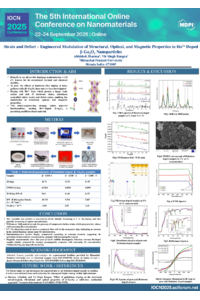
This study presents an investigation into the structural, morphological, vibrational, optical, and magnetic properties of holmium-doped β-Ga₂O₃ nanoparticles synthesized via the solid-state combustion method. X-ray diffraction (XRD) and Williamson–Hall (W–H) analysis confirm the substitution of Ho³⁺ (0.90 Å) for Ga³⁺ (0.62 Å), introducing substantial lattice strain due to the ionic size mismatch. This strain leads to a reduction in crystallite size at 1 wt% doping, while partial strain relaxation at higher concentrations (2–3 wt%) results in moderate grain coarsening. However, the sizes remain below those of the undoped sample. FESEM analysis reveals that grain size follows a similar trend, with morphology characterized by quasi-spherical, polydispersed grains exhibiting agglomeration and non-uniform distribution, reflecting the competing effects of lattice distortion, dopant accommodation, and defect dynamics. Energy-dispersive X-ray spectroscopy (EDS) confirms uniform Ho³⁺ distribution without secondary phase segregation. FTIR spectra exhibit blue-shifted Ga–O vibrational modes, indicating enhanced bond stiffness and structural distortion. UV–Vis diffuse reflectance spectra reveal a doping‑dependent Burstein–Moss shift, corresponding to bandgap widening caused by increased carrier concentration and strain‑altered electronic states. Absorption bands at 361, 419, 454, 487, 643, and 801 nm arise from Ho³⁺ intra‑4f transitions, confirming substitutional incorporation. Photoluminescence (PL) spectra exhibit broad visible emission spanning 400–600 nm, with peaks at 427, 467, and 518 nm, corresponding to the violet, blue, and bluish-green regions. A systematic quenching in PL intensity is observed with increasing Ho³⁺ concentration, attributed to enhanced non-radiative recombination via defect centers. Magnetic measurements using vibrating sample magnetometry (VSM) reveal a transition from intrinsic diamagnetism in undoped β‑Ga₂O₃ to weak ferromagnetism in Ho³⁺‑doped samples, arising from the magnetic moment of Ho³⁺ ions and defect‑mediated exchange interactions. To the best of our knowledge, this is the first report of substitutional Ho³⁺ doping in β‑Ga₂O₃ via solid‑state combustion synthesis. The tunable multifunctionality observed in structural, optical, and magnetic domains highlights the potential of Ho³⁺‑doped β‑Ga₂O₃ for future optoelectronic and spintronic applications.
Keywords
β-Ga₂O₃ nanoparticles
Lattice strain
Defect engineering
Burstein–Moss shift
Photoluminescence quenching
Weak ferromagnetism
Solid-state combustion synthesis.
Poster
134015.pdf
A Review of the Synthesis and Properties of Graphene-TiO2 Nanocomposites for Perovskite Solar Cells
Revised Protocol for Analyzing the Protein Corona on Graphene Oxide