Event submissions
Published
This submission belongs to the session S6. Synthesis, Characterization, and Properties of Nanomaterials of the event The 5th International Online Conference on Nanomaterials
Published date
19 Sep, 2025
Academic Editor
'%3e%3cpath%20d='M12.6657%2010.9104C12.4185%2010.325%2012.0599%209.79327%2011.6097%209.34482C11.1609%208.89508%2010.6293%208.5365%2010.0442%208.28888C10.0389%208.28626%2010.0337%208.28495%2010.0285%208.28233C10.8446%207.69279%2011.3752%206.73249%2011.3752%205.64904C11.3752%203.8542%209.92103%202.39999%208.1262%202.39999C6.33136%202.39999%204.87715%203.8542%204.87715%205.64904C4.87715%206.73249%205.40774%207.69279%206.22393%208.28364C6.21869%208.28626%206.21345%208.28757%206.20821%208.29019C5.62129%208.5378%205.09463%208.89284%204.64265%209.34613C4.1929%209.79493%203.83432%2010.3266%203.58671%2010.9117C3.34345%2011.4845%203.21226%2012.0987%203.20023%2012.7209C3.19988%2012.7349%203.20233%2012.7488%203.20744%2012.7619C3.21255%2012.7749%203.22022%2012.7867%203.22998%2012.7968C3.23975%2012.8068%203.25142%2012.8147%203.26431%2012.8202C3.2772%2012.8256%203.29105%2012.8284%203.30504%2012.8284H4.09109C4.14874%2012.8284%204.19459%2012.7825%204.1959%2012.7262C4.2221%2011.7148%204.62823%2010.7676%205.34617%2010.0497C6.08899%209.30683%207.0755%208.89808%208.1262%208.89808C9.17689%208.89808%2010.1634%209.30683%2010.9062%2010.0497C11.6242%2010.7676%2012.0303%2011.7148%2012.0565%2012.7262C12.0578%2012.7838%2012.1037%2012.8284%2012.1613%2012.8284H12.9474C12.9613%2012.8284%2012.9752%2012.8256%2012.9881%2012.8202C13.001%2012.8147%2013.0126%2012.8068%2013.0224%2012.7968C13.0322%2012.7867%2013.0398%2012.7749%2013.0449%2012.7619C13.0501%2012.7488%2013.0525%2012.7349%2013.0522%2012.7209C13.0391%2012.0947%2012.9094%2011.4855%2012.6657%2010.9104ZM8.1262%207.9024C7.52486%207.9024%206.9589%207.6679%206.53312%207.24211C6.10733%206.81633%205.87283%206.25037%205.87283%205.64904C5.87283%205.0477%206.10733%204.48174%206.53312%204.05596C6.9589%203.63018%207.52486%203.39567%208.1262%203.39567C8.72753%203.39567%209.29349%203.63018%209.71927%204.05596C10.1451%204.48174%2010.3796%205.0477%2010.3796%205.64904C10.3796%206.25037%2010.1451%206.81633%209.71927%207.24211C9.29349%207.6679%208.72753%207.9024%208.1262%207.9024Z'%20fill='%235D1EE1'/%3e%3c/g%3e%3c/svg%3e) José Luis Arias Mediano
José Luis Arias MedianoCitation
Laureline ROFFI, Riccardo Rubino, Fabrizio Messina, Alice Sciortino, Investigation of Luminescent Properties of Carbon Nanodot Superparticles Assembled via Emulsion-Templated Assembly, in Proceedings of The 5th International Online Conference on Nanomaterials, 22 September–24 September 2025, MDPI: Basel, Switzerland
Share
Email
Facebook
Twitter
LinkedIn
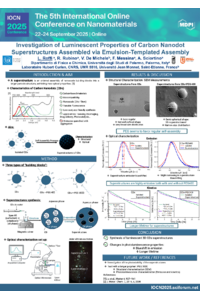
Investigation of Luminescent Properties of Carbon Nanodot Superparticles Assembled via Emulsion-Templated Assembly
'%3e%3cpath%20d='M12.6647%2010.9104C12.4176%2010.325%2012.0589%209.7933%2011.6088%209.34485C11.16%208.89511%2010.6283%208.53653%2010.0432%208.28891C10.038%208.28629%2010.0327%208.28498%2010.0275%208.28236C10.8437%207.69282%2011.3743%206.73252%2011.3743%205.64907C11.3743%203.85423%209.92005%202.40002%208.12522%202.40002C6.33038%202.40002%204.87618%203.85423%204.87618%205.64907C4.87618%206.73252%205.40677%207.69282%206.22296%208.28367C6.21772%208.28629%206.21248%208.2876%206.20724%208.29022C5.62031%208.53783%205.09365%208.89287%204.64167%209.34616C4.19192%209.79496%203.83334%2010.3266%203.58573%2010.9117C3.34247%2011.4846%203.21128%2012.0987%203.19925%2012.721C3.1989%2012.735%203.20135%2012.7489%203.20646%2012.7619C3.21157%2012.7749%203.21924%2012.7868%203.22901%2012.7968C3.23877%2012.8068%203.25045%2012.8148%203.26334%2012.8202C3.27623%2012.8256%203.29007%2012.8284%203.30406%2012.8284H4.09012C4.14776%2012.8284%204.19362%2012.7825%204.19493%2012.7262C4.22113%2011.7148%204.62726%2010.7676%205.34519%2010.0497C6.08802%209.30686%207.07452%208.89811%208.12522%208.89811C9.17592%208.89811%2010.1624%209.30686%2010.9052%2010.0497C11.6232%2010.7676%2012.0293%2011.7148%2012.0555%2012.7262C12.0568%2012.7839%2012.1027%2012.8284%2012.1603%2012.8284H12.9464C12.9604%2012.8284%2012.9742%2012.8256%2012.9871%2012.8202C13%2012.8148%2013.0117%2012.8068%2013.0214%2012.7968C13.0312%2012.7868%2013.0389%2012.7749%2013.044%2012.7619C13.0491%2012.7489%2013.0515%2012.735%2013.0512%2012.721C13.0381%2012.0947%2012.9084%2011.4856%2012.6647%2010.9104ZM8.12522%207.90243C7.52388%207.90243%206.95792%207.66793%206.53214%207.24215C6.10636%206.81636%205.87185%206.2504%205.87185%205.64907C5.87185%205.04773%206.10636%204.48177%206.53214%204.05599C6.95792%203.63021%207.52388%203.3957%208.12522%203.3957C8.72655%203.3957%209.29252%203.63021%209.7183%204.05599C10.1441%204.48177%2010.3786%205.04773%2010.3786%205.64907C10.3786%206.2504%2010.1441%206.81636%209.7183%207.24215C9.29252%207.66793%208.72655%207.90243%208.12522%207.90243Z'%20fill='%235D1EE1'/%3e%3c/g%3e%3c/svg%3e)
Laureline ROFFI 1
Riccardo Rubino 1

Fabrizio Messina 1
Alice Sciortino 1
1. Department of Physics and Chemistry "Emilio Segrè", University of Palermo, Palermo, 90133, Italy
Abstract
Carbon Nanodots (CDs) are a family of carbon-based nanoparticles characterized by intense and tunable absorption–emission in the visible range, which makes them very promising for light-emitting devices, optoelectronics, photocatalysis, and more.
Emulsion-templated assembly has emerged as a scalable approach to fabricate the so-called superparticles (SPs), controlled three-dimensional structures with crystalline or amorphous organization. SPs are obtained by the hierarchical assembly of colloidal nanoparticles, which act as the building blocks, constituting artificial materials with new properties stemming from the crosstalk between individual nanoparticles. Unfortunately, the photophysics governing their optical response remains largely unclear. In particular, little information is available on the dynamics of photoexcited superparticles made from the assembly of CDs.
Here, we report the first synthesis of CD-based SPs by a water-in-oil self-assembly procedure. Before the assembly, CDs were purified by column chromatography to isolate a fraction with narrow size distribution. One type of SP was directly obtained by the spontaneous self-assembly of the purified CDs by a water-in-oil (toluene) procedure. Alternatively, we pegylated (P-CDs) the CDs before self-assembly in order to change the interparticle distance inside the superparticles (P-SPs).
Both SPs are characterized by 1-2 mm diameters, and they display luminescence even in a solid state after dropcasting the sample, which is not common for individual CDs. We have been able to collect the emission and the lifetime from a single SP, demonstrating that the emission depends dramatically on the distance between the CDs inside the superstructure. In fact, when decreasing the distance between CDs, we observed a redshift of the emission band and a shortening of the emission lifetime. This work lays the foundations for the synthesis of new luminescent materials which can be useful in several optoelectronic applications.
Keywords
Emulsion-Templated Assembly
Carbon Nanodots
Superparticles
Photoluminescence
Poster
ROFFI_Carbon Nanodot Superstructures via Emulsion-Templated Assembly.pdf
Confinement of ultrasmall NiO nanoparticles into ordered and non-ordered mesoporous supports for CO2 methanation
Agro-food Waste as a Source for Advanced ORR Catalysts