Event submissions
Published
This submission belongs to the session S2. Nanoenergies and Nanocatalysis of the event The 5th International Online Conference on Nanomaterials
Published date
19 Sep, 2025
Academic Editor
'%3e%3cpath%20d='M12.6657%2010.9104C12.4185%2010.325%2012.0599%209.79327%2011.6097%209.34482C11.1609%208.89508%2010.6293%208.5365%2010.0442%208.28888C10.0389%208.28626%2010.0337%208.28495%2010.0285%208.28233C10.8446%207.69279%2011.3752%206.73249%2011.3752%205.64904C11.3752%203.8542%209.92103%202.39999%208.1262%202.39999C6.33136%202.39999%204.87715%203.8542%204.87715%205.64904C4.87715%206.73249%205.40774%207.69279%206.22393%208.28364C6.21869%208.28626%206.21345%208.28757%206.20821%208.29019C5.62129%208.5378%205.09463%208.89284%204.64265%209.34613C4.1929%209.79493%203.83432%2010.3266%203.58671%2010.9117C3.34345%2011.4845%203.21226%2012.0987%203.20023%2012.7209C3.19988%2012.7349%203.20233%2012.7488%203.20744%2012.7619C3.21255%2012.7749%203.22022%2012.7867%203.22998%2012.7968C3.23975%2012.8068%203.25142%2012.8147%203.26431%2012.8202C3.2772%2012.8256%203.29105%2012.8284%203.30504%2012.8284H4.09109C4.14874%2012.8284%204.19459%2012.7825%204.1959%2012.7262C4.2221%2011.7148%204.62823%2010.7676%205.34617%2010.0497C6.08899%209.30683%207.0755%208.89808%208.1262%208.89808C9.17689%208.89808%2010.1634%209.30683%2010.9062%2010.0497C11.6242%2010.7676%2012.0303%2011.7148%2012.0565%2012.7262C12.0578%2012.7838%2012.1037%2012.8284%2012.1613%2012.8284H12.9474C12.9613%2012.8284%2012.9752%2012.8256%2012.9881%2012.8202C13.001%2012.8147%2013.0126%2012.8068%2013.0224%2012.7968C13.0322%2012.7867%2013.0398%2012.7749%2013.0449%2012.7619C13.0501%2012.7488%2013.0525%2012.7349%2013.0522%2012.7209C13.0391%2012.0947%2012.9094%2011.4855%2012.6657%2010.9104ZM8.1262%207.9024C7.52486%207.9024%206.9589%207.6679%206.53312%207.24211C6.10733%206.81633%205.87283%206.25037%205.87283%205.64904C5.87283%205.0477%206.10733%204.48174%206.53312%204.05596C6.9589%203.63018%207.52486%203.39567%208.1262%203.39567C8.72753%203.39567%209.29349%203.63018%209.71927%204.05596C10.1451%204.48174%2010.3796%205.0477%2010.3796%205.64904C10.3796%206.25037%2010.1451%206.81633%209.71927%207.24211C9.29349%207.6679%208.72753%207.9024%208.1262%207.9024Z'%20fill='%235D1EE1'/%3e%3c/g%3e%3c/svg%3e) Jian-Gan Wang
Jian-Gan WangCitation
Sri Bala Jeya Krishna Sri Paramasivam, Gopu Gopalakrishnan, The role of nano-metal oxides as catalytic membranes in the processes of contaminated water into hydrogen energy: a review, in Proceedings of The 5th International Online Conference on Nanomaterials, 22 September–24 September 2025, MDPI: Basel, Switzerland
Share
Email
Facebook
Twitter
LinkedIn
The role of nano-metal oxides as catalytic membranes in the processes of contaminated water into hydrogen energy: a review
'%3e%3cpath%20d='M12.6647%2010.9104C12.4176%2010.325%2012.0589%209.7933%2011.6088%209.34485C11.16%208.89511%2010.6283%208.53653%2010.0432%208.28891C10.038%208.28629%2010.0327%208.28498%2010.0275%208.28236C10.8437%207.69282%2011.3743%206.73252%2011.3743%205.64907C11.3743%203.85423%209.92005%202.40002%208.12522%202.40002C6.33038%202.40002%204.87618%203.85423%204.87618%205.64907C4.87618%206.73252%205.40677%207.69282%206.22296%208.28367C6.21772%208.28629%206.21248%208.2876%206.20724%208.29022C5.62031%208.53783%205.09365%208.89287%204.64167%209.34616C4.19192%209.79496%203.83334%2010.3266%203.58573%2010.9117C3.34247%2011.4846%203.21128%2012.0987%203.19925%2012.721C3.1989%2012.735%203.20135%2012.7489%203.20646%2012.7619C3.21157%2012.7749%203.21924%2012.7868%203.22901%2012.7968C3.23877%2012.8068%203.25045%2012.8148%203.26334%2012.8202C3.27623%2012.8256%203.29007%2012.8284%203.30406%2012.8284H4.09012C4.14776%2012.8284%204.19362%2012.7825%204.19493%2012.7262C4.22113%2011.7148%204.62726%2010.7676%205.34519%2010.0497C6.08802%209.30686%207.07452%208.89811%208.12522%208.89811C9.17592%208.89811%2010.1624%209.30686%2010.9052%2010.0497C11.6232%2010.7676%2012.0293%2011.7148%2012.0555%2012.7262C12.0568%2012.7839%2012.1027%2012.8284%2012.1603%2012.8284H12.9464C12.9604%2012.8284%2012.9742%2012.8256%2012.9871%2012.8202C13%2012.8148%2013.0117%2012.8068%2013.0214%2012.7968C13.0312%2012.7868%2013.0389%2012.7749%2013.044%2012.7619C13.0491%2012.7489%2013.0515%2012.735%2013.0512%2012.721C13.0381%2012.0947%2012.9084%2011.4856%2012.6647%2010.9104ZM8.12522%207.90243C7.52388%207.90243%206.95792%207.66793%206.53214%207.24215C6.10636%206.81636%205.87185%206.2504%205.87185%205.64907C5.87185%205.04773%206.10636%204.48177%206.53214%204.05599C6.95792%203.63021%207.52388%203.3957%208.12522%203.3957C8.72655%203.3957%209.29252%203.63021%209.7183%204.05599C10.1441%204.48177%2010.3786%205.04773%2010.3786%205.64907C10.3786%206.2504%2010.1441%206.81636%209.7183%207.24215C9.29252%207.66793%208.72655%207.90243%208.12522%207.90243Z'%20fill='%235D1EE1'/%3e%3c/g%3e%3c/svg%3e)
Sri Bala Jeya Krishna Sri Paramasivam 1
Gopu Gopalakrishnan 1
1. School of Chemical Sciences, Department of Industrial Chemistry, Alagappa University, Karaikudi-630003, Tamil Nadu
Abstract
The combination of wastewater treatment with advanced waste-to-energy (WTE) technologies, particularly through membrane-based processes for hydrogen production, represents a promising strategy for sustainable resource management. This paper investigates the application of membrane technologies such as membrane electrolysis, reverse osmosis (RO), forward osmosis (FO), and electrochemical systems in the extraction of hydrogen from wastewater. Membrane electrolysis stands out as a highly efficient method for hydrogen generation, where electrochemical reactions drive the splitting of water into hydrogen and oxygen, utilizing wastewater as a feedstock. By leveraging wastewater’s organic contaminants and high water content, membrane electrolysis can offer a decentralized, scalable, and sustainable solution for clean hydrogen production. Additionally, pressure-driven membrane processes like RO and FO can concentrate waste components in wastewater, improving the recovery of valuable products while facilitating more efficient energy conversion for hydrogen production. The combination of these membrane-based systems with renewable energy sources, such as solar or wind power, enhances the potential for energy-neutral or even energy positive wastewater treatment plants. However, challenges such as membrane fouling, limited long-term operational stability, and energy consumption in membrane separation processes must be addressed to optimize system efficiency and economic viability. Moreover, coupling these technologies with other WTE methods, such as microbial electrolysis cells (MECs) or advanced oxidation processes (AOPs), holds promise for improving overall hydrogen yields and operational efficiency. Life cycle assessments (LCAs) and techno-economic evaluations indicate that while membrane-based hydrogen production from wastewater is still in the experimental phase. This paper highlights the key advances in membrane technology, identifies current research gaps, and proposes directions for future development, emphasizing the potential of hydrogen production as a crucial component in circular economy models, where wastewater treatment and energy recovery work synergistically to promote sustainable water and energy management.
Keywords
Catalysts
Nano metal oxides
Membrane
Hydrogen
Sustainable energy
Poster
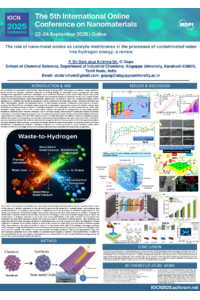
IOCN 2025 Poster.pdf
Agro-food Waste as a Source for Advanced ORR Catalysts
Exfoliated PdSe2 supported on graphene oxide as an electrocatalyst for efficient water splitting