Event submissions
Published
This submission belongs to the session S2. Nanoenergies and Nanocatalysis of the event The 5th International Online Conference on Nanomaterials
Published date
19 Sep, 2025
Academic Editor
'%3e%3cpath%20d='M12.6657%2010.9104C12.4185%2010.325%2012.0599%209.79327%2011.6097%209.34482C11.1609%208.89508%2010.6293%208.5365%2010.0442%208.28888C10.0389%208.28626%2010.0337%208.28495%2010.0285%208.28233C10.8446%207.69279%2011.3752%206.73249%2011.3752%205.64904C11.3752%203.8542%209.92103%202.39999%208.1262%202.39999C6.33136%202.39999%204.87715%203.8542%204.87715%205.64904C4.87715%206.73249%205.40774%207.69279%206.22393%208.28364C6.21869%208.28626%206.21345%208.28757%206.20821%208.29019C5.62129%208.5378%205.09463%208.89284%204.64265%209.34613C4.1929%209.79493%203.83432%2010.3266%203.58671%2010.9117C3.34345%2011.4845%203.21226%2012.0987%203.20023%2012.7209C3.19988%2012.7349%203.20233%2012.7488%203.20744%2012.7619C3.21255%2012.7749%203.22022%2012.7867%203.22998%2012.7968C3.23975%2012.8068%203.25142%2012.8147%203.26431%2012.8202C3.2772%2012.8256%203.29105%2012.8284%203.30504%2012.8284H4.09109C4.14874%2012.8284%204.19459%2012.7825%204.1959%2012.7262C4.2221%2011.7148%204.62823%2010.7676%205.34617%2010.0497C6.08899%209.30683%207.0755%208.89808%208.1262%208.89808C9.17689%208.89808%2010.1634%209.30683%2010.9062%2010.0497C11.6242%2010.7676%2012.0303%2011.7148%2012.0565%2012.7262C12.0578%2012.7838%2012.1037%2012.8284%2012.1613%2012.8284H12.9474C12.9613%2012.8284%2012.9752%2012.8256%2012.9881%2012.8202C13.001%2012.8147%2013.0126%2012.8068%2013.0224%2012.7968C13.0322%2012.7867%2013.0398%2012.7749%2013.0449%2012.7619C13.0501%2012.7488%2013.0525%2012.7349%2013.0522%2012.7209C13.0391%2012.0947%2012.9094%2011.4855%2012.6657%2010.9104ZM8.1262%207.9024C7.52486%207.9024%206.9589%207.6679%206.53312%207.24211C6.10733%206.81633%205.87283%206.25037%205.87283%205.64904C5.87283%205.0477%206.10733%204.48174%206.53312%204.05596C6.9589%203.63018%207.52486%203.39567%208.1262%203.39567C8.72753%203.39567%209.29349%203.63018%209.71927%204.05596C10.1451%204.48174%2010.3796%205.0477%2010.3796%205.64904C10.3796%206.25037%2010.1451%206.81633%209.71927%207.24211C9.29349%207.6679%208.72753%207.9024%208.1262%207.9024Z'%20fill='%235D1EE1'/%3e%3c/g%3e%3c/svg%3e) Jian-Gan Wang
Jian-Gan WangCitation
Lorena Trinidad Pérez-Poyatos, Sergio Morales-Torres, Luisa María Pastrana-Martínez, Francisco José Maldonado-Hódar, Effect of doping on the catalytic activity of materials based on TiO₂ for VOC degradation, in Proceedings of The 5th International Online Conference on Nanomaterials, 22 September–24 September 2025, MDPI: Basel, Switzerland
Share
Email
Facebook
Twitter
LinkedIn
Effect of doping on the catalytic activity of materials based on TiO2 for VOC degradation
'%3e%3cpath%20d='M12.6647%2010.9104C12.4176%2010.325%2012.0589%209.7933%2011.6088%209.34485C11.16%208.89511%2010.6283%208.53653%2010.0432%208.28891C10.038%208.28629%2010.0327%208.28498%2010.0275%208.28236C10.8437%207.69282%2011.3743%206.73252%2011.3743%205.64907C11.3743%203.85423%209.92005%202.40002%208.12522%202.40002C6.33038%202.40002%204.87618%203.85423%204.87618%205.64907C4.87618%206.73252%205.40677%207.69282%206.22296%208.28367C6.21772%208.28629%206.21248%208.2876%206.20724%208.29022C5.62031%208.53783%205.09365%208.89287%204.64167%209.34616C4.19192%209.79496%203.83334%2010.3266%203.58573%2010.9117C3.34247%2011.4846%203.21128%2012.0987%203.19925%2012.721C3.1989%2012.735%203.20135%2012.7489%203.20646%2012.7619C3.21157%2012.7749%203.21924%2012.7868%203.22901%2012.7968C3.23877%2012.8068%203.25045%2012.8148%203.26334%2012.8202C3.27623%2012.8256%203.29007%2012.8284%203.30406%2012.8284H4.09012C4.14776%2012.8284%204.19362%2012.7825%204.19493%2012.7262C4.22113%2011.7148%204.62726%2010.7676%205.34519%2010.0497C6.08802%209.30686%207.07452%208.89811%208.12522%208.89811C9.17592%208.89811%2010.1624%209.30686%2010.9052%2010.0497C11.6232%2010.7676%2012.0293%2011.7148%2012.0555%2012.7262C12.0568%2012.7839%2012.1027%2012.8284%2012.1603%2012.8284H12.9464C12.9604%2012.8284%2012.9742%2012.8256%2012.9871%2012.8202C13%2012.8148%2013.0117%2012.8068%2013.0214%2012.7968C13.0312%2012.7868%2013.0389%2012.7749%2013.044%2012.7619C13.0491%2012.7489%2013.0515%2012.735%2013.0512%2012.721C13.0381%2012.0947%2012.9084%2011.4856%2012.6647%2010.9104ZM8.12522%207.90243C7.52388%207.90243%206.95792%207.66793%206.53214%207.24215C6.10636%206.81636%205.87185%206.2504%205.87185%205.64907C5.87185%205.04773%206.10636%204.48177%206.53214%204.05599C6.95792%203.63021%207.52388%203.3957%208.12522%203.3957C8.72655%203.3957%209.29252%203.63021%209.7183%204.05599C10.1441%204.48177%2010.3786%205.04773%2010.3786%205.64907C10.3786%206.2504%2010.1441%206.81636%209.7183%207.24215C9.29252%207.66793%208.72655%207.90243%208.12522%207.90243Z'%20fill='%235D1EE1'/%3e%3c/g%3e%3c/svg%3e)
Lorena Trinidad Pérez-Poyatos 1

Sergio Morales-Torres 1

Luisa María Pastrana-Martínez 1

Francisco José Maldonado-Hódar 1
1. Department of Inorganic Chemistry, Faculty of Sciences, University of Granada, Granada, 18071, Spain
Abstract
Volatile organic compounds (VOCs), with boiling points below 250 °C, are atmospheric pollutants responsible for adverse effects such as climate change, depletion of the ozone layer and respiratory diseases. Traditional methods for their removal, such as absorption, condensation, membrane separation and thermal oxidation, present some limitations, including high cost, low efficiency or the generation of toxic byproducts. Therefore, more sustainable alternatives are needed, among which adsorption and photocatalytic oxidation stand out.
In this study, photocatalytic materials based on titanium dioxide (TiO2) were synthesized and doped with nitrogen (N), nitrogen and boron (N-B), and nitrogen and sulfur (N-S) using a hydrothermal synthesis method, with the aim of degrading ethylene and toluene as model VOCs. The materials were obtained from a solution of titanium(IV) tert-butoxide and different doping agents, achieving a doping concentration of 2 wt%. After synthesis, the solids were washed, filtered and calcined. In addition, a sample of pure TiO2 and several composites of the best-performing material with carbon xerogels doped with sulfur or nitrogen were also synthesized to enhance the performance.
The materials were characterized using complementary techniques such as SEM, XRD, XPS, DRUV and N2 adsorption. The results showed an anatase crystalline structure with mesoporosity and a specific surface area of approximately 90 m2/g. The introduction of the carbon support increased these values and diminished the bandgap of the composite materials to 2.3 eV due to the formation of bonds between Ti and the heteroatoms. In photocatalytic tests under visible light and dynamic conditions, ethylene was easier to remove than toluene, and co-doped materials exhibited better performance, particularly under dry conditions. Notably, the SN-TiO2 sample showed the highest activity and its combination with S- and N-doped xerogels significantly improved catalytic efficiency even under humid conditions due to an increase in hydrophobicity, achieving notable gains in terms of turnover frequency (TOF).
Keywords
Photocatalysis
titania
VOC degradation
heteroatoms
Poster
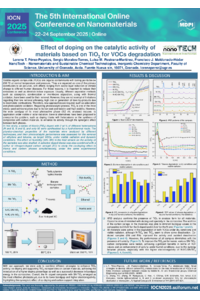
Poster Nanomaterials 2025.pdf
Exfoliated PdSe2 supported on graphene oxide as an electrocatalyst for efficient water splitting
Synthesis of effective carbon-based composite materials as electrocatalysts for electrochemical reactions