Event submissions
Published
This submission belongs to the session S2. Nanoenergies and Nanocatalysis of the event The 5th International Online Conference on Nanomaterials
Published date
19 Sep, 2025
Academic Editor
'%3e%3cpath%20d='M12.6657%2010.9104C12.4185%2010.325%2012.0599%209.79327%2011.6097%209.34482C11.1609%208.89508%2010.6293%208.5365%2010.0442%208.28888C10.0389%208.28626%2010.0337%208.28495%2010.0285%208.28233C10.8446%207.69279%2011.3752%206.73249%2011.3752%205.64904C11.3752%203.8542%209.92103%202.39999%208.1262%202.39999C6.33136%202.39999%204.87715%203.8542%204.87715%205.64904C4.87715%206.73249%205.40774%207.69279%206.22393%208.28364C6.21869%208.28626%206.21345%208.28757%206.20821%208.29019C5.62129%208.5378%205.09463%208.89284%204.64265%209.34613C4.1929%209.79493%203.83432%2010.3266%203.58671%2010.9117C3.34345%2011.4845%203.21226%2012.0987%203.20023%2012.7209C3.19988%2012.7349%203.20233%2012.7488%203.20744%2012.7619C3.21255%2012.7749%203.22022%2012.7867%203.22998%2012.7968C3.23975%2012.8068%203.25142%2012.8147%203.26431%2012.8202C3.2772%2012.8256%203.29105%2012.8284%203.30504%2012.8284H4.09109C4.14874%2012.8284%204.19459%2012.7825%204.1959%2012.7262C4.2221%2011.7148%204.62823%2010.7676%205.34617%2010.0497C6.08899%209.30683%207.0755%208.89808%208.1262%208.89808C9.17689%208.89808%2010.1634%209.30683%2010.9062%2010.0497C11.6242%2010.7676%2012.0303%2011.7148%2012.0565%2012.7262C12.0578%2012.7838%2012.1037%2012.8284%2012.1613%2012.8284H12.9474C12.9613%2012.8284%2012.9752%2012.8256%2012.9881%2012.8202C13.001%2012.8147%2013.0126%2012.8068%2013.0224%2012.7968C13.0322%2012.7867%2013.0398%2012.7749%2013.0449%2012.7619C13.0501%2012.7488%2013.0525%2012.7349%2013.0522%2012.7209C13.0391%2012.0947%2012.9094%2011.4855%2012.6657%2010.9104ZM8.1262%207.9024C7.52486%207.9024%206.9589%207.6679%206.53312%207.24211C6.10733%206.81633%205.87283%206.25037%205.87283%205.64904C5.87283%205.0477%206.10733%204.48174%206.53312%204.05596C6.9589%203.63018%207.52486%203.39567%208.1262%203.39567C8.72753%203.39567%209.29349%203.63018%209.71927%204.05596C10.1451%204.48174%2010.3796%205.0477%2010.3796%205.64904C10.3796%206.25037%2010.1451%206.81633%209.71927%207.24211C9.29349%207.6679%208.72753%207.9024%208.1262%207.9024Z'%20fill='%235D1EE1'/%3e%3c/g%3e%3c/svg%3e) Jian-Gan Wang
Jian-Gan WangCitation
Partha Protim Borthakur, Pranjal Sarmah, Metal Oxide Nanomaterials for Energy Density Improvement in Lithium-Ion and Solid-State Batteries, in Proceedings of The 5th International Online Conference on Nanomaterials, 22 September–24 September 2025, MDPI: Basel, Switzerland
Share
Email
Facebook
Twitter
LinkedIn
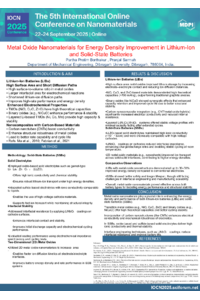
Metal Oxide Nanomaterials for Energy Density Improvement in Lithium-Ion and Solid-State Batteries

Partha Protim Borthakur 1
'%3e%3cpath%20d='M12.6647%2010.9104C12.4176%2010.325%2012.0589%209.7933%2011.6088%209.34485C11.16%208.89511%2010.6283%208.53653%2010.0432%208.28891C10.038%208.28629%2010.0327%208.28498%2010.0275%208.28236C10.8437%207.69282%2011.3743%206.73252%2011.3743%205.64907C11.3743%203.85423%209.92005%202.40002%208.12522%202.40002C6.33038%202.40002%204.87618%203.85423%204.87618%205.64907C4.87618%206.73252%205.40677%207.69282%206.22296%208.28367C6.21772%208.28629%206.21248%208.2876%206.20724%208.29022C5.62031%208.53783%205.09365%208.89287%204.64167%209.34616C4.19192%209.79496%203.83334%2010.3266%203.58573%2010.9117C3.34247%2011.4846%203.21128%2012.0987%203.19925%2012.721C3.1989%2012.735%203.20135%2012.7489%203.20646%2012.7619C3.21157%2012.7749%203.21924%2012.7868%203.22901%2012.7968C3.23877%2012.8068%203.25045%2012.8148%203.26334%2012.8202C3.27623%2012.8256%203.29007%2012.8284%203.30406%2012.8284H4.09012C4.14776%2012.8284%204.19362%2012.7825%204.19493%2012.7262C4.22113%2011.7148%204.62726%2010.7676%205.34519%2010.0497C6.08802%209.30686%207.07452%208.89811%208.12522%208.89811C9.17592%208.89811%2010.1624%209.30686%2010.9052%2010.0497C11.6232%2010.7676%2012.0293%2011.7148%2012.0555%2012.7262C12.0568%2012.7839%2012.1027%2012.8284%2012.1603%2012.8284H12.9464C12.9604%2012.8284%2012.9742%2012.8256%2012.9871%2012.8202C13%2012.8148%2013.0117%2012.8068%2013.0214%2012.7968C13.0312%2012.7868%2013.0389%2012.7749%2013.044%2012.7619C13.0491%2012.7489%2013.0515%2012.735%2013.0512%2012.721C13.0381%2012.0947%2012.9084%2011.4856%2012.6647%2010.9104ZM8.12522%207.90243C7.52388%207.90243%206.95792%207.66793%206.53214%207.24215C6.10636%206.81636%205.87185%206.2504%205.87185%205.64907C5.87185%205.04773%206.10636%204.48177%206.53214%204.05599C6.95792%203.63021%207.52388%203.3957%208.12522%203.3957C8.72655%203.3957%209.29252%203.63021%209.7183%204.05599C10.1441%204.48177%2010.3786%205.04773%2010.3786%205.64907C10.3786%206.2504%2010.1441%206.81636%209.7183%207.24215C9.29252%207.66793%208.72655%207.90243%208.12522%207.90243Z'%20fill='%235D1EE1'/%3e%3c/g%3e%3c/svg%3e)
Pranjal Sarmah 1
1. Department of Mechanical Engineering , Dibrugarh University, Dibrugarh 786004, Assam, India.
Abstract
Metal oxide nanomaterials have emerged as transformative materials in the quest to enhance the energy density and overall performance of lithium-ion batteries (LIBs) and solid-state batteries (SSBs). Their unique properties—high surface areas and short ion diffusion pathways—make them ideal for next-generation energy storage technologies. In LIBs, the high surface-to-volume ratio of metal oxide nanomaterials significantly enlarges the active interfacial area and shortens the lithium-ion diffusion paths, leading to an improved high-rate performance and enhanced energy density. Transition metal oxides (TMOs) such as nickel oxide (NiO), copper oxide (CuO), and zinc oxide (ZnO) have demonstrated high theoretical capacities, while binary systems like NiCuO offer further improvements in the cycling stability and energy output. Additionally, layered lithium-based TMOs, particularly those incorporating nickel, cobalt, and manganese, have shown remarkable promise in achieving high specific capacities and long-term stability. The synergistic integration of metal oxides with carbon-based nanostructures, such as carbon nanotubes (CNTs), enhances the electrical conductivity and structural durability further, leading to a superior electrochemical performance in LIBs. In SSBs, the use of oxide-based solid electrolytes like garnet-type Li₇La₃Zr₂O₁₂ (LLZO) and sulfide-based electrolytes has facilitated the development of high-energy-density systems with excellent ionic conductivity and chemical stability. However, challenges such as high interfacial resistance at the electrode–electrolyte interface persist. Strategies like the application of lithium niobate (LiNbO₃) coatings have been employed to enhance the interfacial stability and maintain electrochemical integrity. Furthermore, two-dimensional (2D) metal oxide nanomaterials, owing to their high active surface areas and rapid ion transport, have demonstrated considerable potential to boost the performance of SSBs. Despite these advancements, several challenges remain. Morphological optimization of nanomaterials, improved interface engineering to reduce the interfacial resistance, and solutions to address dendrite formation and mechanical degradation are critical to achieving the full potential of these materials.
Keywords
Metal Oxide Nanomaterials
Lithium-Ion Batteries
Energy Density Enhancement
Electrode–Electrolyte Interface
Nanostructured Material.
Poster
sciforum-123689.pdf
Optimization of the mechanical properties of biopolymer films by nanofibrous coating
Engineering of Tiny Bi2S3/SnS Heterostructured Nanorods via a Dual Polysulfide Confinement Strategy for Enhanced Alkali Metal-Ion Storage