Event submissions
Published
This submission belongs to the session S2. Nanoenergies and Nanocatalysis of the event The 5th International Online Conference on Nanomaterials
Published date
19 Sep, 2025
Academic Editor
'%3e%3cpath%20d='M12.6657%2010.9104C12.4185%2010.325%2012.0599%209.79327%2011.6097%209.34482C11.1609%208.89508%2010.6293%208.5365%2010.0442%208.28888C10.0389%208.28626%2010.0337%208.28495%2010.0285%208.28233C10.8446%207.69279%2011.3752%206.73249%2011.3752%205.64904C11.3752%203.8542%209.92103%202.39999%208.1262%202.39999C6.33136%202.39999%204.87715%203.8542%204.87715%205.64904C4.87715%206.73249%205.40774%207.69279%206.22393%208.28364C6.21869%208.28626%206.21345%208.28757%206.20821%208.29019C5.62129%208.5378%205.09463%208.89284%204.64265%209.34613C4.1929%209.79493%203.83432%2010.3266%203.58671%2010.9117C3.34345%2011.4845%203.21226%2012.0987%203.20023%2012.7209C3.19988%2012.7349%203.20233%2012.7488%203.20744%2012.7619C3.21255%2012.7749%203.22022%2012.7867%203.22998%2012.7968C3.23975%2012.8068%203.25142%2012.8147%203.26431%2012.8202C3.2772%2012.8256%203.29105%2012.8284%203.30504%2012.8284H4.09109C4.14874%2012.8284%204.19459%2012.7825%204.1959%2012.7262C4.2221%2011.7148%204.62823%2010.7676%205.34617%2010.0497C6.08899%209.30683%207.0755%208.89808%208.1262%208.89808C9.17689%208.89808%2010.1634%209.30683%2010.9062%2010.0497C11.6242%2010.7676%2012.0303%2011.7148%2012.0565%2012.7262C12.0578%2012.7838%2012.1037%2012.8284%2012.1613%2012.8284H12.9474C12.9613%2012.8284%2012.9752%2012.8256%2012.9881%2012.8202C13.001%2012.8147%2013.0126%2012.8068%2013.0224%2012.7968C13.0322%2012.7867%2013.0398%2012.7749%2013.0449%2012.7619C13.0501%2012.7488%2013.0525%2012.7349%2013.0522%2012.7209C13.0391%2012.0947%2012.9094%2011.4855%2012.6657%2010.9104ZM8.1262%207.9024C7.52486%207.9024%206.9589%207.6679%206.53312%207.24211C6.10733%206.81633%205.87283%206.25037%205.87283%205.64904C5.87283%205.0477%206.10733%204.48174%206.53312%204.05596C6.9589%203.63018%207.52486%203.39567%208.1262%203.39567C8.72753%203.39567%209.29349%203.63018%209.71927%204.05596C10.1451%204.48174%2010.3796%205.0477%2010.3796%205.64904C10.3796%206.25037%2010.1451%206.81633%209.71927%207.24211C9.29349%207.6679%208.72753%207.9024%208.1262%207.9024Z'%20fill='%235D1EE1'/%3e%3c/g%3e%3c/svg%3e) Jian-Gan Wang
Jian-Gan WangCitation
Meng Qin, He Lin Wang, Engineering of Tiny Bi₂S₃/SnS Heterostructured Nanorods via a Dual Polysulfide Confinement Strategy for Enhanced Alkali Metal-Ion Storage, in Proceedings of The 5th International Online Conference on Nanomaterials, 22 September–24 September 2025, MDPI: Basel, Switzerland
Share
Email
Facebook
Twitter
LinkedIn
Engineering of Tiny Bi2S3/SnS Heterostructured Nanorods via a Dual Polysulfide Confinement Strategy for Enhanced Alkali Metal-Ion Storage
'%3e%3cpath%20d='M12.6647%2010.9104C12.4176%2010.325%2012.0589%209.7933%2011.6088%209.34485C11.16%208.89511%2010.6283%208.53653%2010.0432%208.28891C10.038%208.28629%2010.0327%208.28498%2010.0275%208.28236C10.8437%207.69282%2011.3743%206.73252%2011.3743%205.64907C11.3743%203.85423%209.92005%202.40002%208.12522%202.40002C6.33038%202.40002%204.87618%203.85423%204.87618%205.64907C4.87618%206.73252%205.40677%207.69282%206.22296%208.28367C6.21772%208.28629%206.21248%208.2876%206.20724%208.29022C5.62031%208.53783%205.09365%208.89287%204.64167%209.34616C4.19192%209.79496%203.83334%2010.3266%203.58573%2010.9117C3.34247%2011.4846%203.21128%2012.0987%203.19925%2012.721C3.1989%2012.735%203.20135%2012.7489%203.20646%2012.7619C3.21157%2012.7749%203.21924%2012.7868%203.22901%2012.7968C3.23877%2012.8068%203.25045%2012.8148%203.26334%2012.8202C3.27623%2012.8256%203.29007%2012.8284%203.30406%2012.8284H4.09012C4.14776%2012.8284%204.19362%2012.7825%204.19493%2012.7262C4.22113%2011.7148%204.62726%2010.7676%205.34519%2010.0497C6.08802%209.30686%207.07452%208.89811%208.12522%208.89811C9.17592%208.89811%2010.1624%209.30686%2010.9052%2010.0497C11.6232%2010.7676%2012.0293%2011.7148%2012.0555%2012.7262C12.0568%2012.7839%2012.1027%2012.8284%2012.1603%2012.8284H12.9464C12.9604%2012.8284%2012.9742%2012.8256%2012.9871%2012.8202C13%2012.8148%2013.0117%2012.8068%2013.0214%2012.7968C13.0312%2012.7868%2013.0389%2012.7749%2013.044%2012.7619C13.0491%2012.7489%2013.0515%2012.735%2013.0512%2012.721C13.0381%2012.0947%2012.9084%2011.4856%2012.6647%2010.9104ZM8.12522%207.90243C7.52388%207.90243%206.95792%207.66793%206.53214%207.24215C6.10636%206.81636%205.87185%206.2504%205.87185%205.64907C5.87185%205.04773%206.10636%204.48177%206.53214%204.05599C6.95792%203.63021%207.52388%203.3957%208.12522%203.3957C8.72655%203.3957%209.29252%203.63021%209.7183%204.05599C10.1441%204.48177%2010.3786%205.04773%2010.3786%205.64907C10.3786%206.2504%2010.1441%206.81636%209.7183%207.24215C9.29252%207.66793%208.72655%207.90243%208.12522%207.90243Z'%20fill='%235D1EE1'/%3e%3c/g%3e%3c/svg%3e)
Meng Qin 1
He Lin Wang 2
1. Hubei Key Laboratory of Energy Storage and Power Battery, School of Mathematics, Physics and Optoelectronic Engineering, Hubei University of Automotive Technology, Shiyan 442002, PR China
2. Hubei Key Laboratory of Energy Storage and Power Battery,School of Optoelectronic Engineering,School of New Energy , Hubei University of Automotive Technology, Shiyan 442002, PR China
Abstract
Potassium-ion batteries, due to their low cost and other advantages, are considered a complementary technology to lithium-ion batteries in the field of large-scale energy storage. In recent years, they have received widespread attention from researchers. Bismuth sulfide has been identified as a promising anode for potassium-ion batteries due to its high theoretical specific capacity and low cost. Nevertheless, the polysulfide shuttle and severe volumetric expansion severely plague its commercial application on a large scale. Herein, using SnCl4 as the Sn source and employing a mixed surfactant of oleylamine/oleic acid with significant spatial steric hindrance, ultra-small Sn-doped Bi2S3 (Bi1.9Sn0.1S3) nanorods were first prepared under hydrothermal conditions. Next, through the polymerization reaction of dopamine, a coating layer of approximately 5 nm thickness was formed on the surface of the nanorods. Finally, by ordered electrostatic self-assembly, PDDA-modified nanorods were combined with MXene to obtain PDA-coated Sn-doped Bi2S3/MXene (BSPM-20) composites for alkali metal-ion storage. The obtained nanocomposite displays a considerable reversible capacity of 599 mAh g−1 at 0.1 A g−1 and impressive cycling stability over 1000 cycles with a capacity decay of 0.007% per cycle. It also delivers a high reversible capacity of 756 mAh g−1 for Li storage and 650 mAh g−1 for Na storage at 0.1 A g−1, respectively. In addition, we have revealed the mechanism of the dual confinement effect of PDA and MXene on Bi1.9Sn0.1S3 through experiments and DFT calculations. At the same time, it has also been clarified through structural characterization and kinetic analysis that oleic acid/oleylamine, as a capping agent, reduces the scale of Bi1.9Sn0.1S3 by inhibiting grain growth, thereby improving the kinetic rate of potassium storage reaction. This work provides ideas for solving the issues of long-term cycles of metal sulfide.
Keywords
absorption
chemical bonding
heterojunction
polysulfides
potassium-ion batteries
Poster
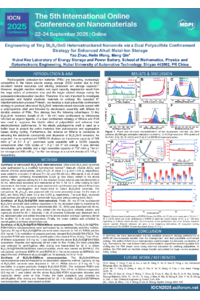
sciforum_121561_S2_slides_Meng_Qin.pdf
Metal Oxide Nanomaterials for Energy Density Improvement in Lithium-Ion and Solid-State Batteries
Utilization of TiO2 Nanoparicles for Methylene Blue Degradation