Event submissions
Published
This submission belongs to the session S2. Nanoenergies and Nanocatalysis of the event The 5th International Online Conference on Nanomaterials
Published date
19 Sep, 2025
Academic Editor
'%3e%3cpath%20d='M12.6657%2010.9104C12.4185%2010.325%2012.0599%209.79327%2011.6097%209.34482C11.1609%208.89508%2010.6293%208.5365%2010.0442%208.28888C10.0389%208.28626%2010.0337%208.28495%2010.0285%208.28233C10.8446%207.69279%2011.3752%206.73249%2011.3752%205.64904C11.3752%203.8542%209.92103%202.39999%208.1262%202.39999C6.33136%202.39999%204.87715%203.8542%204.87715%205.64904C4.87715%206.73249%205.40774%207.69279%206.22393%208.28364C6.21869%208.28626%206.21345%208.28757%206.20821%208.29019C5.62129%208.5378%205.09463%208.89284%204.64265%209.34613C4.1929%209.79493%203.83432%2010.3266%203.58671%2010.9117C3.34345%2011.4845%203.21226%2012.0987%203.20023%2012.7209C3.19988%2012.7349%203.20233%2012.7488%203.20744%2012.7619C3.21255%2012.7749%203.22022%2012.7867%203.22998%2012.7968C3.23975%2012.8068%203.25142%2012.8147%203.26431%2012.8202C3.2772%2012.8256%203.29105%2012.8284%203.30504%2012.8284H4.09109C4.14874%2012.8284%204.19459%2012.7825%204.1959%2012.7262C4.2221%2011.7148%204.62823%2010.7676%205.34617%2010.0497C6.08899%209.30683%207.0755%208.89808%208.1262%208.89808C9.17689%208.89808%2010.1634%209.30683%2010.9062%2010.0497C11.6242%2010.7676%2012.0303%2011.7148%2012.0565%2012.7262C12.0578%2012.7838%2012.1037%2012.8284%2012.1613%2012.8284H12.9474C12.9613%2012.8284%2012.9752%2012.8256%2012.9881%2012.8202C13.001%2012.8147%2013.0126%2012.8068%2013.0224%2012.7968C13.0322%2012.7867%2013.0398%2012.7749%2013.0449%2012.7619C13.0501%2012.7488%2013.0525%2012.7349%2013.0522%2012.7209C13.0391%2012.0947%2012.9094%2011.4855%2012.6657%2010.9104ZM8.1262%207.9024C7.52486%207.9024%206.9589%207.6679%206.53312%207.24211C6.10733%206.81633%205.87283%206.25037%205.87283%205.64904C5.87283%205.0477%206.10733%204.48174%206.53312%204.05596C6.9589%203.63018%207.52486%203.39567%208.1262%203.39567C8.72753%203.39567%209.29349%203.63018%209.71927%204.05596C10.1451%204.48174%2010.3796%205.0477%2010.3796%205.64904C10.3796%206.25037%2010.1451%206.81633%209.71927%207.24211C9.29349%207.6679%208.72753%207.9024%208.1262%207.9024Z'%20fill='%235D1EE1'/%3e%3c/g%3e%3c/svg%3e) Jian-Gan Wang
Jian-Gan WangCitation
Md. Golam Sazid, Asraf Ibna Helal, Harunur Rashid, Md. Redwanur Rashid Nafi, Advances in TiO2 nanoparticles for rhodamine B degradation, in Proceedings of The 5th International Online Conference on Nanomaterials, 22 September–24 September 2025, MDPI: Basel, Switzerland
Share
Email
Facebook
Twitter
LinkedIn
Advances in TiO2 nanoparticles for rhodamine B degradation
'%3e%3cpath%20d='M12.6647%2010.9104C12.4176%2010.325%2012.0589%209.7933%2011.6088%209.34485C11.16%208.89511%2010.6283%208.53653%2010.0432%208.28891C10.038%208.28629%2010.0327%208.28498%2010.0275%208.28236C10.8437%207.69282%2011.3743%206.73252%2011.3743%205.64907C11.3743%203.85423%209.92005%202.40002%208.12522%202.40002C6.33038%202.40002%204.87618%203.85423%204.87618%205.64907C4.87618%206.73252%205.40677%207.69282%206.22296%208.28367C6.21772%208.28629%206.21248%208.2876%206.20724%208.29022C5.62031%208.53783%205.09365%208.89287%204.64167%209.34616C4.19192%209.79496%203.83334%2010.3266%203.58573%2010.9117C3.34247%2011.4846%203.21128%2012.0987%203.19925%2012.721C3.1989%2012.735%203.20135%2012.7489%203.20646%2012.7619C3.21157%2012.7749%203.21924%2012.7868%203.22901%2012.7968C3.23877%2012.8068%203.25045%2012.8148%203.26334%2012.8202C3.27623%2012.8256%203.29007%2012.8284%203.30406%2012.8284H4.09012C4.14776%2012.8284%204.19362%2012.7825%204.19493%2012.7262C4.22113%2011.7148%204.62726%2010.7676%205.34519%2010.0497C6.08802%209.30686%207.07452%208.89811%208.12522%208.89811C9.17592%208.89811%2010.1624%209.30686%2010.9052%2010.0497C11.6232%2010.7676%2012.0293%2011.7148%2012.0555%2012.7262C12.0568%2012.7839%2012.1027%2012.8284%2012.1603%2012.8284H12.9464C12.9604%2012.8284%2012.9742%2012.8256%2012.9871%2012.8202C13%2012.8148%2013.0117%2012.8068%2013.0214%2012.7968C13.0312%2012.7868%2013.0389%2012.7749%2013.044%2012.7619C13.0491%2012.7489%2013.0515%2012.735%2013.0512%2012.721C13.0381%2012.0947%2012.9084%2011.4856%2012.6647%2010.9104ZM8.12522%207.90243C7.52388%207.90243%206.95792%207.66793%206.53214%207.24215C6.10636%206.81636%205.87185%206.2504%205.87185%205.64907C5.87185%205.04773%206.10636%204.48177%206.53214%204.05599C6.95792%203.63021%207.52388%203.3957%208.12522%203.3957C8.72655%203.3957%209.29252%203.63021%209.7183%204.05599C10.1441%204.48177%2010.3786%205.04773%2010.3786%205.64907C10.3786%206.2504%2010.1441%206.81636%209.7183%207.24215C9.29252%207.66793%208.72655%207.90243%208.12522%207.90243Z'%20fill='%235D1EE1'/%3e%3c/g%3e%3c/svg%3e)
Md. Golam Sazid 1

Asraf Ibna Helal 1
Harunur Rashid 1
Md. Redwanur Rashid Nafi 1
1. Department of Environmental Research, Nano Research Centre,
Sylhet, 3114, Bangladesh
Abstract
Titanium dioxide (TiO2) nanoparticles have garnered significant attention as a photocatalyst for degrading organic pollutants, particularly synthetic dyes such as rhodamine B (RhB), methylene blue, methyl orange, and others. The impact of several synthesis methods, including sol–gel, hydrothermal, and CVD techniques, on the electrical and morphological properties of TiO2 nanoparticles has been studied, emphasizing the distinctive physicochemical properties of TiO2 nanoparticles, including their extensive surface area, significant oxidative capacity, and remarkable chemical stability, which are important in addressing recent advancements in their use for RhB degradation. A detailed examination of TiO2's photocatalytic mechanism is based on the generation of reactive oxygen species (ROS) by photoinduced electron–hole pair formation under ultraviolet (UV) light exposure. In wastewater treatment, TiO2 degrades RhB into less harmful byproducts by the generation of electron–hole pairs that initiate redox reactions under sunlight. This study includes a thorough overview of significant factors influencing photocatalytic efficacy. The parameters include particle size, crystal phase (anatase, rutile, and brookite), surface changes, and the incorporation of metal or non-metal dopants to enhance visible light absorption. Researchers continually seek methods to overcome challenges, including restricted visible light responsiveness and rapid electron–hole recombination. The investigated approaches include heterojunction generation, composite development, and co-catalyst insertion. The primary objective of this work is to address the deficiencies in our understanding of TiO2-based photocatalysis for the degradation of RhB and to propose enhancements for these systems to enable more efficient and sustainable wastewater treatment in the future.
Keywords
Titanium Dioxide
ROS
UV radiation
Size
Surface Changes
electron-hole pair
Poster
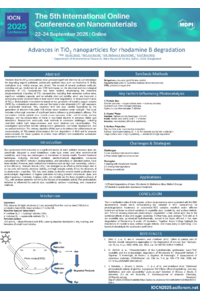
Advances in TiO2 nanoparticles for rhodamine B degradation.pdf
The Impact of Ag Substitution on the Structural and Optoelectronic Properties of Cu₂ZnSnS₄ and Cu₂CdSnS₄ for Photovoltaic Applications
Rational design of efficient catalysts for photothermal CO2 hydrogenation