Event submissions
Published
This submission belongs to the session S6. Synthesis, Characterization, and Properties of Nanomaterials of the event The 5th International Online Conference on Nanomaterials
Published date
19 Sep, 2025
Academic Editor
'%3e%3cpath%20d='M12.6657%2010.9104C12.4185%2010.325%2012.0599%209.79327%2011.6097%209.34482C11.1609%208.89508%2010.6293%208.5365%2010.0442%208.28888C10.0389%208.28626%2010.0337%208.28495%2010.0285%208.28233C10.8446%207.69279%2011.3752%206.73249%2011.3752%205.64904C11.3752%203.8542%209.92103%202.39999%208.1262%202.39999C6.33136%202.39999%204.87715%203.8542%204.87715%205.64904C4.87715%206.73249%205.40774%207.69279%206.22393%208.28364C6.21869%208.28626%206.21345%208.28757%206.20821%208.29019C5.62129%208.5378%205.09463%208.89284%204.64265%209.34613C4.1929%209.79493%203.83432%2010.3266%203.58671%2010.9117C3.34345%2011.4845%203.21226%2012.0987%203.20023%2012.7209C3.19988%2012.7349%203.20233%2012.7488%203.20744%2012.7619C3.21255%2012.7749%203.22022%2012.7867%203.22998%2012.7968C3.23975%2012.8068%203.25142%2012.8147%203.26431%2012.8202C3.2772%2012.8256%203.29105%2012.8284%203.30504%2012.8284H4.09109C4.14874%2012.8284%204.19459%2012.7825%204.1959%2012.7262C4.2221%2011.7148%204.62823%2010.7676%205.34617%2010.0497C6.08899%209.30683%207.0755%208.89808%208.1262%208.89808C9.17689%208.89808%2010.1634%209.30683%2010.9062%2010.0497C11.6242%2010.7676%2012.0303%2011.7148%2012.0565%2012.7262C12.0578%2012.7838%2012.1037%2012.8284%2012.1613%2012.8284H12.9474C12.9613%2012.8284%2012.9752%2012.8256%2012.9881%2012.8202C13.001%2012.8147%2013.0126%2012.8068%2013.0224%2012.7968C13.0322%2012.7867%2013.0398%2012.7749%2013.0449%2012.7619C13.0501%2012.7488%2013.0525%2012.7349%2013.0522%2012.7209C13.0391%2012.0947%2012.9094%2011.4855%2012.6657%2010.9104ZM8.1262%207.9024C7.52486%207.9024%206.9589%207.6679%206.53312%207.24211C6.10733%206.81633%205.87283%206.25037%205.87283%205.64904C5.87283%205.0477%206.10733%204.48174%206.53312%204.05596C6.9589%203.63018%207.52486%203.39567%208.1262%203.39567C8.72753%203.39567%209.29349%203.63018%209.71927%204.05596C10.1451%204.48174%2010.3796%205.0477%2010.3796%205.64904C10.3796%206.25037%2010.1451%206.81633%209.71927%207.24211C9.29349%207.6679%208.72753%207.9024%208.1262%207.9024Z'%20fill='%235D1EE1'/%3e%3c/g%3e%3c/svg%3e) José Luis Arias Mediano
José Luis Arias MedianoCitation
IOANNA TZOUMANI, IOANNIS SMPOUKIS, ZACHAROULA IATRIDI, GEORGIOS BOKIAS, NIKOLAOS BOUROPOULOS, Fabrication and characterization of cross-linked PDMAEMA/PEGMA membranes incorporating ZnO nanoparticles., in Proceedings of The 5th International Online Conference on Nanomaterials, 22 September–24 September 2025, MDPI: Basel, Switzerland
Share
Email
Facebook
Twitter
LinkedIn
Fabrication and characterization of cross-linked PDMAEMA/PEGMA membranes incorporating ZnO nanoparticles.
'%3e%3cpath%20d='M12.6647%2010.9104C12.4176%2010.325%2012.0589%209.7933%2011.6088%209.34485C11.16%208.89511%2010.6283%208.53653%2010.0432%208.28891C10.038%208.28629%2010.0327%208.28498%2010.0275%208.28236C10.8437%207.69282%2011.3743%206.73252%2011.3743%205.64907C11.3743%203.85423%209.92005%202.40002%208.12522%202.40002C6.33038%202.40002%204.87618%203.85423%204.87618%205.64907C4.87618%206.73252%205.40677%207.69282%206.22296%208.28367C6.21772%208.28629%206.21248%208.2876%206.20724%208.29022C5.62031%208.53783%205.09365%208.89287%204.64167%209.34616C4.19192%209.79496%203.83334%2010.3266%203.58573%2010.9117C3.34247%2011.4846%203.21128%2012.0987%203.19925%2012.721C3.1989%2012.735%203.20135%2012.7489%203.20646%2012.7619C3.21157%2012.7749%203.21924%2012.7868%203.22901%2012.7968C3.23877%2012.8068%203.25045%2012.8148%203.26334%2012.8202C3.27623%2012.8256%203.29007%2012.8284%203.30406%2012.8284H4.09012C4.14776%2012.8284%204.19362%2012.7825%204.19493%2012.7262C4.22113%2011.7148%204.62726%2010.7676%205.34519%2010.0497C6.08802%209.30686%207.07452%208.89811%208.12522%208.89811C9.17592%208.89811%2010.1624%209.30686%2010.9052%2010.0497C11.6232%2010.7676%2012.0293%2011.7148%2012.0555%2012.7262C12.0568%2012.7839%2012.1027%2012.8284%2012.1603%2012.8284H12.9464C12.9604%2012.8284%2012.9742%2012.8256%2012.9871%2012.8202C13%2012.8148%2013.0117%2012.8068%2013.0214%2012.7968C13.0312%2012.7868%2013.0389%2012.7749%2013.044%2012.7619C13.0491%2012.7489%2013.0515%2012.735%2013.0512%2012.721C13.0381%2012.0947%2012.9084%2011.4856%2012.6647%2010.9104ZM8.12522%207.90243C7.52388%207.90243%206.95792%207.66793%206.53214%207.24215C6.10636%206.81636%205.87185%206.2504%205.87185%205.64907C5.87185%205.04773%206.10636%204.48177%206.53214%204.05599C6.95792%203.63021%207.52388%203.3957%208.12522%203.3957C8.72655%203.3957%209.29252%203.63021%209.7183%204.05599C10.1441%204.48177%2010.3786%205.04773%2010.3786%205.64907C10.3786%206.2504%2010.1441%206.81636%209.7183%207.24215C9.29252%207.66793%208.72655%207.90243%208.12522%207.90243Z'%20fill='%235D1EE1'/%3e%3c/g%3e%3c/svg%3e)
IOANNA TZOUMANI 1
IOANNIS SMPOUKIS 2

ZACHAROULA IATRIDI 2

GEORGIOS BOKIAS 3,4

NIKOLAOS BOUROPOULOS 4,5
1. Department of Chemistry, University of Patras, Patras , GR-26504 Rio, Achaia, Greece
2. Department of Materials Science, University of Patras, Patras, GR-26504 Rio, Greece
3. Department of Chemistry, University of Patras, Patras , 26504, Greece
4. Foundation for Research and Technology Hellas (FORTH), Institute of Chemical Engineering and High Temperature Chemical Processes, Patras , Greece
5. Department of Materials Science, University of Patras, Patras , 26504, Greece
Abstract
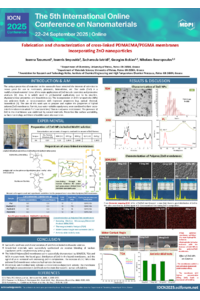
Zinc oxide (ZnO) is widely used in antibacterial applications due to its excellent physicochemical properties and bioactivities. The incorporation of ZnO nanoparticles into polymers leads to the creation of nanocomposites with improved properties (e.g. optical, thermal, and biomedical properties). The aim of this work was to prepare and explore the properties of hybrid polymer/ZnO membranes. Two water-soluble copolymers, poly(N,N-dimethylacrylamide-co-2-(dimethylamino)ethyl methacrylate) (P(DMAM-co-DMAEMAx)) and poly(oligo(ethylene glycol methyl ether methacrylate)-co-glycidyl methacrylate) (P(PEGMA500-co-GMAx)), were synthesized by free-radical copolymerization and subsequently combined to form cross-linked membranes through the reaction between the amine and epoxy groups derived from DMAEMA and GMA units, respectively. The successful cross-linking reaction was confirmed by Attenuated Total Reflection Fourier Transform Infrared Spectroscopy (ATR-FTIR) and the hybrid membranes were examined in terms of their swelling and weight-loss properties. ZnO nanoparticles ~7nm in size (found by Transmission Electron Microscopy) were prepared in boiled methanolic solution. The presence of ZnO in the membranes was confirmed by ATR-FTIR and X-ray diffraction (XRD) while the thermal properties were explored by Thermogravimetric Analysis (TGA) and Differential Scanning Calorimetry (DSC). The surface wettability properties of pure and composite membranes were studied by measuring the contact angle, while their surface morphology was investigated by Scanning Electron Microscopy (SEM). In addition, photoluminescence spectroscopy was employed to compare the optical properties of the polymer/ZnO with the pure ZnO, to assess the possibility of exploiting these materials in optical applications.
Keywords
Zinc oxide (ZnO)
cross-linked membranes
water-soluble copolymers
2-(dimethylamino)ethyl methacrylate
glycidyl methacrylate
oligo(ethylene glycol methyl ether methacrylate
Poster
poster - Iatridi.pdf
Rational design of efficient catalysts for photothermal CO2 hydrogenation
Tailoring Phonon and Electron Transport in GaP and GaN Nanoribbons for Nanoscale Thermoelectric Energy Harvesting