Event submissions
Published
This submission belongs to the session S4. Modeling and Simulation of Nanostructures and Nanodevices of the event The 5th International Online Conference on Nanomaterials
Published date
19 Sep, 2025
Academic Editor
'%3e%3cpath%20d='M12.6657%2010.9104C12.4185%2010.325%2012.0599%209.79327%2011.6097%209.34482C11.1609%208.89508%2010.6293%208.5365%2010.0442%208.28888C10.0389%208.28626%2010.0337%208.28495%2010.0285%208.28233C10.8446%207.69279%2011.3752%206.73249%2011.3752%205.64904C11.3752%203.8542%209.92103%202.39999%208.1262%202.39999C6.33136%202.39999%204.87715%203.8542%204.87715%205.64904C4.87715%206.73249%205.40774%207.69279%206.22393%208.28364C6.21869%208.28626%206.21345%208.28757%206.20821%208.29019C5.62129%208.5378%205.09463%208.89284%204.64265%209.34613C4.1929%209.79493%203.83432%2010.3266%203.58671%2010.9117C3.34345%2011.4845%203.21226%2012.0987%203.20023%2012.7209C3.19988%2012.7349%203.20233%2012.7488%203.20744%2012.7619C3.21255%2012.7749%203.22022%2012.7867%203.22998%2012.7968C3.23975%2012.8068%203.25142%2012.8147%203.26431%2012.8202C3.2772%2012.8256%203.29105%2012.8284%203.30504%2012.8284H4.09109C4.14874%2012.8284%204.19459%2012.7825%204.1959%2012.7262C4.2221%2011.7148%204.62823%2010.7676%205.34617%2010.0497C6.08899%209.30683%207.0755%208.89808%208.1262%208.89808C9.17689%208.89808%2010.1634%209.30683%2010.9062%2010.0497C11.6242%2010.7676%2012.0303%2011.7148%2012.0565%2012.7262C12.0578%2012.7838%2012.1037%2012.8284%2012.1613%2012.8284H12.9474C12.9613%2012.8284%2012.9752%2012.8256%2012.9881%2012.8202C13.001%2012.8147%2013.0126%2012.8068%2013.0224%2012.7968C13.0322%2012.7867%2013.0398%2012.7749%2013.0449%2012.7619C13.0501%2012.7488%2013.0525%2012.7349%2013.0522%2012.7209C13.0391%2012.0947%2012.9094%2011.4855%2012.6657%2010.9104ZM8.1262%207.9024C7.52486%207.9024%206.9589%207.6679%206.53312%207.24211C6.10733%206.81633%205.87283%206.25037%205.87283%205.64904C5.87283%205.0477%206.10733%204.48174%206.53312%204.05596C6.9589%203.63018%207.52486%203.39567%208.1262%203.39567C8.72753%203.39567%209.29349%203.63018%209.71927%204.05596C10.1451%204.48174%2010.3796%205.0477%2010.3796%205.64904C10.3796%206.25037%2010.1451%206.81633%209.71927%207.24211C9.29349%207.6679%208.72753%207.9024%208.1262%207.9024Z'%20fill='%235D1EE1'/%3e%3c/g%3e%3c/svg%3e) Sotirios Baskoutas
Sotirios BaskoutasCitation
Kerolina Sonowal, Partha Protim Borthakur, Modeling and Analysis of Mechanical Behavior in Nanowires, Nanotubes, and Nanopillars, in Proceedings of The 5th International Online Conference on Nanomaterials, 22 September–24 September 2025, MDPI: Basel, Switzerland
Share
Email
Facebook
Twitter
LinkedIn
Modeling and Analysis of Mechanical Behavior in Nanowires, Nanotubes, and Nanopillars
'%3e%3cpath%20d='M12.6647%2010.9104C12.4176%2010.325%2012.0589%209.7933%2011.6088%209.34485C11.16%208.89511%2010.6283%208.53653%2010.0432%208.28891C10.038%208.28629%2010.0327%208.28498%2010.0275%208.28236C10.8437%207.69282%2011.3743%206.73252%2011.3743%205.64907C11.3743%203.85423%209.92005%202.40002%208.12522%202.40002C6.33038%202.40002%204.87618%203.85423%204.87618%205.64907C4.87618%206.73252%205.40677%207.69282%206.22296%208.28367C6.21772%208.28629%206.21248%208.2876%206.20724%208.29022C5.62031%208.53783%205.09365%208.89287%204.64167%209.34616C4.19192%209.79496%203.83334%2010.3266%203.58573%2010.9117C3.34247%2011.4846%203.21128%2012.0987%203.19925%2012.721C3.1989%2012.735%203.20135%2012.7489%203.20646%2012.7619C3.21157%2012.7749%203.21924%2012.7868%203.22901%2012.7968C3.23877%2012.8068%203.25045%2012.8148%203.26334%2012.8202C3.27623%2012.8256%203.29007%2012.8284%203.30406%2012.8284H4.09012C4.14776%2012.8284%204.19362%2012.7825%204.19493%2012.7262C4.22113%2011.7148%204.62726%2010.7676%205.34519%2010.0497C6.08802%209.30686%207.07452%208.89811%208.12522%208.89811C9.17592%208.89811%2010.1624%209.30686%2010.9052%2010.0497C11.6232%2010.7676%2012.0293%2011.7148%2012.0555%2012.7262C12.0568%2012.7839%2012.1027%2012.8284%2012.1603%2012.8284H12.9464C12.9604%2012.8284%2012.9742%2012.8256%2012.9871%2012.8202C13%2012.8148%2013.0117%2012.8068%2013.0214%2012.7968C13.0312%2012.7868%2013.0389%2012.7749%2013.044%2012.7619C13.0491%2012.7489%2013.0515%2012.735%2013.0512%2012.721C13.0381%2012.0947%2012.9084%2011.4856%2012.6647%2010.9104ZM8.12522%207.90243C7.52388%207.90243%206.95792%207.66793%206.53214%207.24215C6.10636%206.81636%205.87185%206.2504%205.87185%205.64907C5.87185%205.04773%206.10636%204.48177%206.53214%204.05599C6.95792%203.63021%207.52388%203.3957%208.12522%203.3957C8.72655%203.3957%209.29252%203.63021%209.7183%204.05599C10.1441%204.48177%2010.3786%205.04773%2010.3786%205.64907C10.3786%206.2504%2010.1441%206.81636%209.7183%207.24215C9.29252%207.66793%208.72655%207.90243%208.12522%207.90243Z'%20fill='%235D1EE1'/%3e%3c/g%3e%3c/svg%3e)
Kerolina Sonowal 1

Partha Protim Borthakur 1
1. Department of Mechanical Engineering, Dibrugarh University, Assam 786004, India.
Abstract
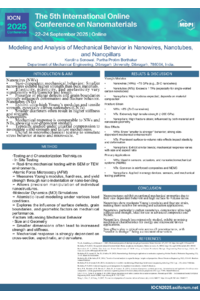
The mechanical behavior of nanowires (NWs), nanotubes (NTs), and nanopillars is critical to advancing nanotechnology and developing nanoelectromechanical systems (NEMS). These nanostructures exhibit mechanical properties that are significantly different from their bulk counterparts due to their reduced dimensions and high surface-to-volume ratios. Nanowires exhibit remarkable elasticity and strength; for example, zinc oxide (ZnO) nanowires have demonstrated a Young’s modulus of approximately 76 GPa and a fracture strain of approximately 8%. The "smaller is stronger" phenomenon is prominent, where reducing nanowire diameters to below 100 nm often leads to strength values exceeding several GPa, compared to the MPa range typical for bulk materials. Carbon nanotubes, particularly single-walled carbon nanotubes (SWNTs), demonstrate extraordinary mechanical properties, with Young’s moduli exceeding 1 TPa and tensile strengths reaching up to 200 GPa. Multi-walled carbon nanotubes (MWNTs) also exhibit superior mechanical robustness, with tensile strengths ranging from 11 to 63 GPa, depending on the number of walls and structural defects. Diameter-dependent behaviors are observed, where nanotubes with diameters under 10 nm generally possess higher stiffness and strength due to minimized defect density and enhanced curvature effects. Nanotubes can also exhibit viscoelasticity under cyclic loading, with energy dissipation characteristics similar to biological tissues. Nanopillars, although less extensively studied, share a similar one-dimensional architecture and exhibit comparable mechanical characteristics. Compression tests on metallic nanopillars have demonstrated yield strengths exceeding 1 GPa, a significant enhancement over their bulk equivalents. Size-dependent strengthening and surface-mediated deformation mechanisms are key features influencing their mechanical responses. Embedding nanowires or nanotubes into polymer matrices can boost composite strength by over 200% compared to pristine polymers.
Keywords
Nanowires
Nanotubes
Nanopillars
Mechanical properties
Nanoelectromechanical systems (NEMS)
Poster
sciforum-123702.pdf
Exploring Nanocomposites through Computational Methods
Theoretical modeling of cluster@MOF catalysts for CO₂ conversion reaction