Event submissions
Published
This submission belongs to the session S4. Modeling and Simulation of Nanostructures and Nanodevices of the event The 5th International Online Conference on Nanomaterials
Published date
19 Sep, 2025
Academic Editor
'%3e%3cpath%20d='M12.6657%2010.9104C12.4185%2010.325%2012.0599%209.79327%2011.6097%209.34482C11.1609%208.89508%2010.6293%208.5365%2010.0442%208.28888C10.0389%208.28626%2010.0337%208.28495%2010.0285%208.28233C10.8446%207.69279%2011.3752%206.73249%2011.3752%205.64904C11.3752%203.8542%209.92103%202.39999%208.1262%202.39999C6.33136%202.39999%204.87715%203.8542%204.87715%205.64904C4.87715%206.73249%205.40774%207.69279%206.22393%208.28364C6.21869%208.28626%206.21345%208.28757%206.20821%208.29019C5.62129%208.5378%205.09463%208.89284%204.64265%209.34613C4.1929%209.79493%203.83432%2010.3266%203.58671%2010.9117C3.34345%2011.4845%203.21226%2012.0987%203.20023%2012.7209C3.19988%2012.7349%203.20233%2012.7488%203.20744%2012.7619C3.21255%2012.7749%203.22022%2012.7867%203.22998%2012.7968C3.23975%2012.8068%203.25142%2012.8147%203.26431%2012.8202C3.2772%2012.8256%203.29105%2012.8284%203.30504%2012.8284H4.09109C4.14874%2012.8284%204.19459%2012.7825%204.1959%2012.7262C4.2221%2011.7148%204.62823%2010.7676%205.34617%2010.0497C6.08899%209.30683%207.0755%208.89808%208.1262%208.89808C9.17689%208.89808%2010.1634%209.30683%2010.9062%2010.0497C11.6242%2010.7676%2012.0303%2011.7148%2012.0565%2012.7262C12.0578%2012.7838%2012.1037%2012.8284%2012.1613%2012.8284H12.9474C12.9613%2012.8284%2012.9752%2012.8256%2012.9881%2012.8202C13.001%2012.8147%2013.0126%2012.8068%2013.0224%2012.7968C13.0322%2012.7867%2013.0398%2012.7749%2013.0449%2012.7619C13.0501%2012.7488%2013.0525%2012.7349%2013.0522%2012.7209C13.0391%2012.0947%2012.9094%2011.4855%2012.6657%2010.9104ZM8.1262%207.9024C7.52486%207.9024%206.9589%207.6679%206.53312%207.24211C6.10733%206.81633%205.87283%206.25037%205.87283%205.64904C5.87283%205.0477%206.10733%204.48174%206.53312%204.05596C6.9589%203.63018%207.52486%203.39567%208.1262%203.39567C8.72753%203.39567%209.29349%203.63018%209.71927%204.05596C10.1451%204.48174%2010.3796%205.0477%2010.3796%205.64904C10.3796%206.25037%2010.1451%206.81633%209.71927%207.24211C9.29349%207.6679%208.72753%207.9024%208.1262%207.9024Z'%20fill='%235D1EE1'/%3e%3c/g%3e%3c/svg%3e) Sotirios Baskoutas
Sotirios BaskoutasCitation
Lina Marcela Bolivar Pineda, Elena V. Basiuk, César Martínez Flores, Vladimir A. Basiuk, Noncovalent dyads of lanthanide nitride cluster fullerenes Ln₃N@C₈₀ and bisphthalocyanines LnPc₂: A DFT Study, in Proceedings of The 5th International Online Conference on Nanomaterials, 22 September–24 September 2025, MDPI: Basel, Switzerland
Share
Email
Facebook
Twitter
LinkedIn
Noncovalent dyads of lanthanide nitride cluster fullerenes Ln3N@C80 and bisphthalocyanines LnPc2: A DFT Study
'%3e%3cpath%20d='M12.6647%2010.9104C12.4176%2010.325%2012.0589%209.7933%2011.6088%209.34485C11.16%208.89511%2010.6283%208.53653%2010.0432%208.28891C10.038%208.28629%2010.0327%208.28498%2010.0275%208.28236C10.8437%207.69282%2011.3743%206.73252%2011.3743%205.64907C11.3743%203.85423%209.92005%202.40002%208.12522%202.40002C6.33038%202.40002%204.87618%203.85423%204.87618%205.64907C4.87618%206.73252%205.40677%207.69282%206.22296%208.28367C6.21772%208.28629%206.21248%208.2876%206.20724%208.29022C5.62031%208.53783%205.09365%208.89287%204.64167%209.34616C4.19192%209.79496%203.83334%2010.3266%203.58573%2010.9117C3.34247%2011.4846%203.21128%2012.0987%203.19925%2012.721C3.1989%2012.735%203.20135%2012.7489%203.20646%2012.7619C3.21157%2012.7749%203.21924%2012.7868%203.22901%2012.7968C3.23877%2012.8068%203.25045%2012.8148%203.26334%2012.8202C3.27623%2012.8256%203.29007%2012.8284%203.30406%2012.8284H4.09012C4.14776%2012.8284%204.19362%2012.7825%204.19493%2012.7262C4.22113%2011.7148%204.62726%2010.7676%205.34519%2010.0497C6.08802%209.30686%207.07452%208.89811%208.12522%208.89811C9.17592%208.89811%2010.1624%209.30686%2010.9052%2010.0497C11.6232%2010.7676%2012.0293%2011.7148%2012.0555%2012.7262C12.0568%2012.7839%2012.1027%2012.8284%2012.1603%2012.8284H12.9464C12.9604%2012.8284%2012.9742%2012.8256%2012.9871%2012.8202C13%2012.8148%2013.0117%2012.8068%2013.0214%2012.7968C13.0312%2012.7868%2013.0389%2012.7749%2013.044%2012.7619C13.0491%2012.7489%2013.0515%2012.735%2013.0512%2012.721C13.0381%2012.0947%2012.9084%2011.4856%2012.6647%2010.9104ZM8.12522%207.90243C7.52388%207.90243%206.95792%207.66793%206.53214%207.24215C6.10636%206.81636%205.87185%206.2504%205.87185%205.64907C5.87185%205.04773%206.10636%204.48177%206.53214%204.05599C6.95792%203.63021%207.52388%203.3957%208.12522%203.3957C8.72655%203.3957%209.29252%203.63021%209.7183%204.05599C10.1441%204.48177%2010.3786%205.04773%2010.3786%205.64907C10.3786%206.2504%2010.1441%206.81636%209.7183%207.24215C9.29252%207.66793%208.72655%207.90243%208.12522%207.90243Z'%20fill='%235D1EE1'/%3e%3c/g%3e%3c/svg%3e)
Lina Marcela Bolivar Pineda 1
Elena V. Basiuk 1
César Martínez Flores 2
Vladimir A. Basiuk 2
1. The Institute for Applied Sciences and Technology (ICAT), National Autonomous University of Mexico (UNAM), Alcaldía Benito Juárez, CP 03100, Mexico
2. Institute of Nuclear Sciences, National Autonomous University of Mexico (UNAM), Alcaldía Benito Juárez, CP 03100, Mexico
Abstract
Diverse systems, including lanthanides (Ln; from La to Lu), are attracting increasing attention, particularly in the research and development of magnetic and luminescent materials. Among versatile lanthanide-based materials, lanthanide nitride cluster fullerenes (Ln3N@C80) and bisphthalocyanines (LnPc2) have emerged as promising candidates for advanced applications such as spintronic devices.
The formation of hybrids or dyads of carbon nanomaterials (graphene and carbon nanotubes) with LnPc2 enhances magnetic properties due to synergy between components. The Ln3N@C80 + LnPc2 dyads remain underexplored. So far, only different macrocycles, such as porphyrins, have been reported to crystallize endohedral fullerenes (EFs). This interaction can alter EFs' structures; however, the extent to which they can achieve this is unclear.
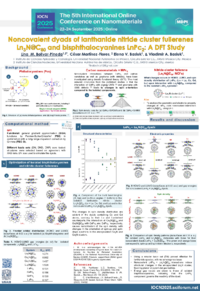
We performed DFT characterization to investigate structural and electronic changes in noncovalently interacting lanthanide (Ln = La, Ce, Gd, Lu) nitride cluster fullerenes and bisphthalocyanines forming Ln3N@C80 + LnPc2 dyads. Optimized geometries, formation and frontier orbital energies, HOMO-LUMO plots, the charge and spin of Ln and N(Ln3N@C80) atoms, and spin density plots were analyzed relative to isolated Ln3N@C80 and LnPc2.
Spin distribution is among the most influenced properties in these interactions. Changes are more evident in dyads with Ce and Gd than their La and Lu counterparts. The interaction of Ce3N@C80 and Gd3N@C80 with CePc2 and GdPc2 redistributes spin density, altering spin-up and spin-down electron orientations in encapsulated Ce3N and Gd3N clusters. This behavior could enable tuning of magnetic properties, enhancing their performance as Single-Molecule Magnets in spintronic and magnetic devices
Keywords
Lanthanides
endohedral fullerenes
bisphthalocyanines
density functional theory
geometries
electronic parameters
Poster
Bolivar_Pineda_IOCN 2025.pdf
Luminescent BIO–NANO hybrids of noble metals for optical sensing and solar conversion
A low-cost thiophene-based hole transport material containing azomethine as a bridge for perovskite solar cells or absorber organic solar cells: a Theoretical study