Event submissions
Published
This submission belongs to the session S3. Nanophotonic, Nanoelectronics, Nanosensors and Devices of the event The 5th International Online Conference on Nanomaterials
Published date
19 Sep, 2025
Academic Editor
'%3e%3cpath%20d='M12.6657%2010.9104C12.4185%2010.325%2012.0599%209.79327%2011.6097%209.34482C11.1609%208.89508%2010.6293%208.5365%2010.0442%208.28888C10.0389%208.28626%2010.0337%208.28495%2010.0285%208.28233C10.8446%207.69279%2011.3752%206.73249%2011.3752%205.64904C11.3752%203.8542%209.92103%202.39999%208.1262%202.39999C6.33136%202.39999%204.87715%203.8542%204.87715%205.64904C4.87715%206.73249%205.40774%207.69279%206.22393%208.28364C6.21869%208.28626%206.21345%208.28757%206.20821%208.29019C5.62129%208.5378%205.09463%208.89284%204.64265%209.34613C4.1929%209.79493%203.83432%2010.3266%203.58671%2010.9117C3.34345%2011.4845%203.21226%2012.0987%203.20023%2012.7209C3.19988%2012.7349%203.20233%2012.7488%203.20744%2012.7619C3.21255%2012.7749%203.22022%2012.7867%203.22998%2012.7968C3.23975%2012.8068%203.25142%2012.8147%203.26431%2012.8202C3.2772%2012.8256%203.29105%2012.8284%203.30504%2012.8284H4.09109C4.14874%2012.8284%204.19459%2012.7825%204.1959%2012.7262C4.2221%2011.7148%204.62823%2010.7676%205.34617%2010.0497C6.08899%209.30683%207.0755%208.89808%208.1262%208.89808C9.17689%208.89808%2010.1634%209.30683%2010.9062%2010.0497C11.6242%2010.7676%2012.0303%2011.7148%2012.0565%2012.7262C12.0578%2012.7838%2012.1037%2012.8284%2012.1613%2012.8284H12.9474C12.9613%2012.8284%2012.9752%2012.8256%2012.9881%2012.8202C13.001%2012.8147%2013.0126%2012.8068%2013.0224%2012.7968C13.0322%2012.7867%2013.0398%2012.7749%2013.0449%2012.7619C13.0501%2012.7488%2013.0525%2012.7349%2013.0522%2012.7209C13.0391%2012.0947%2012.9094%2011.4855%2012.6657%2010.9104ZM8.1262%207.9024C7.52486%207.9024%206.9589%207.6679%206.53312%207.24211C6.10733%206.81633%205.87283%206.25037%205.87283%205.64904C5.87283%205.0477%206.10733%204.48174%206.53312%204.05596C6.9589%203.63018%207.52486%203.39567%208.1262%203.39567C8.72753%203.39567%209.29349%203.63018%209.71927%204.05596C10.1451%204.48174%2010.3796%205.0477%2010.3796%205.64904C10.3796%206.25037%2010.1451%206.81633%209.71927%207.24211C9.29349%207.6679%208.72753%207.9024%208.1262%207.9024Z'%20fill='%235D1EE1'/%3e%3c/g%3e%3c/svg%3e) Huanjun Chen
Huanjun ChenCitation
Abdul Qadeer, Mariya Azam, Basit Abdul, Abdul Rab Asary, Micro-electromagnetic Vibration Energy Harvesters: Analysis and Comparative Assessment, in Proceedings of The 5th International Online Conference on Nanomaterials, 22 September–24 September 2025, MDPI: Basel, Switzerland
Share
Email
Facebook
Twitter
LinkedIn
Micro-electromagnetic Vibration Energy Harvesters: Analysis and Comparative Assessment
'%3e%3cpath%20d='M12.6647%2010.9104C12.4176%2010.325%2012.0589%209.7933%2011.6088%209.34485C11.16%208.89511%2010.6283%208.53653%2010.0432%208.28891C10.038%208.28629%2010.0327%208.28498%2010.0275%208.28236C10.8437%207.69282%2011.3743%206.73252%2011.3743%205.64907C11.3743%203.85423%209.92005%202.40002%208.12522%202.40002C6.33038%202.40002%204.87618%203.85423%204.87618%205.64907C4.87618%206.73252%205.40677%207.69282%206.22296%208.28367C6.21772%208.28629%206.21248%208.2876%206.20724%208.29022C5.62031%208.53783%205.09365%208.89287%204.64167%209.34616C4.19192%209.79496%203.83334%2010.3266%203.58573%2010.9117C3.34247%2011.4846%203.21128%2012.0987%203.19925%2012.721C3.1989%2012.735%203.20135%2012.7489%203.20646%2012.7619C3.21157%2012.7749%203.21924%2012.7868%203.22901%2012.7968C3.23877%2012.8068%203.25045%2012.8148%203.26334%2012.8202C3.27623%2012.8256%203.29007%2012.8284%203.30406%2012.8284H4.09012C4.14776%2012.8284%204.19362%2012.7825%204.19493%2012.7262C4.22113%2011.7148%204.62726%2010.7676%205.34519%2010.0497C6.08802%209.30686%207.07452%208.89811%208.12522%208.89811C9.17592%208.89811%2010.1624%209.30686%2010.9052%2010.0497C11.6232%2010.7676%2012.0293%2011.7148%2012.0555%2012.7262C12.0568%2012.7839%2012.1027%2012.8284%2012.1603%2012.8284H12.9464C12.9604%2012.8284%2012.9742%2012.8256%2012.9871%2012.8202C13%2012.8148%2013.0117%2012.8068%2013.0214%2012.7968C13.0312%2012.7868%2013.0389%2012.7749%2013.044%2012.7619C13.0491%2012.7489%2013.0515%2012.735%2013.0512%2012.721C13.0381%2012.0947%2012.9084%2011.4856%2012.6647%2010.9104ZM8.12522%207.90243C7.52388%207.90243%206.95792%207.66793%206.53214%207.24215C6.10636%206.81636%205.87185%206.2504%205.87185%205.64907C5.87185%205.04773%206.10636%204.48177%206.53214%204.05599C6.95792%203.63021%207.52388%203.3957%208.12522%203.3957C8.72655%203.3957%209.29252%203.63021%209.7183%204.05599C10.1441%204.48177%2010.3786%205.04773%2010.3786%205.64907C10.3786%206.2504%2010.1441%206.81636%209.7183%207.24215C9.29252%207.66793%208.72655%207.90243%208.12522%207.90243Z'%20fill='%235D1EE1'/%3e%3c/g%3e%3c/svg%3e)
Abdul Qadeer 1
Mariya Azam 1
Basit Abdul 2
Abdul Rab Asary 3
1. Institute of Molecular Biology and Biotechnology,
The University of Lahore,
1 KM Defence Road Campus, Lahore 54792, Pakistan
2. Interdisciplinary Institute for Technological Innovation Université de Sherbrooke, 3000 Université Blvd (Innovation Park, P2), Sherbrooke (Québec), J1K 0A5, Canada
3. Fluid Engineering and Energy Systems Laboratory - LIFSE, Arts et Métiers Institute of Technology Paris, 151 Boulevard de l’Hôpital, 75013 Paris, France
Abstract
Micro-electro-magnetic Vibration Energy Harvesters: Analysis and Comparative Assessment
Abstract
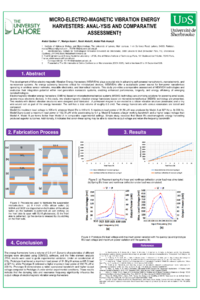
The development of micro-electromagnetic vibration energy harvesters (MEMVEHs) plays a crucial role in advancing self-powered nanophotonic, nanoelectronic, and nanosensor systems. As energy autonomy becomes critical for miniaturized devices, MEMVEHs offer a sustainable power source for low-power nanodevices operating in wireless sensor networks, wearable electronics, and biomedical implants. This study provides a comparative assessment of MEMVEH technologies and evaluates their integration potential within next-generation nanoscale systems, enabling enhanced performance, longevity, and energy efficiency of emerging nanotechnologies.
Electromagnetic vibration energy harvesters (EMEHs) based on microelectromechanical systems (MEMS) technology are promising solutions for powering small-scale, autonomous electronic devices. In this study, two electromagnetic vibration energy harvesters based on microelectromechanical (MEMS) technology are presented. Two models with distinct vibration structures were designed and fabricated . A permanent magnet is connected to a silicon vibration structure (resonator) and a tiny wire-wound coil as part of the energy harvester. The coil has a total volume of roughly 0.8 cm3. Two energy harvesters with various resonators are tested and compared.
Model A's maximum load voltage is 163 mV, whereas Model B's is 208 mV. A maximum load power of 59.52 μW was produced by Model A at 347 Hz across a 405 Ω load. At 311.4 Hz, Model B produced a maximum load power of 149.13 μW while accelerating by 0.4 g. Model B features a larger working bandwidth and a higher output voltage than Model A. Model B performs better than Model A in comparable experimental settings. Simple study revealed that Model B's electromagnetic energy harvesting produced superior outcomes. Additionally, it indicates that a non-linear spring may be able to raise the output voltage and widen the frequency bandwidth.
Keywords
Electromagnetic, Energy, Harvester, MEMS, Model, Load, Resonators, Voltage, Frequency, Bandwidth.
Keywords
Electromagnetic
Energy
Harvester
MEMS
Model
Load
Resonators
Voltage
Frequency
Bandwidth.
Poster
IOCN 2025_Poster_Qadeer.pdf
Study on structural, morphological and optical characteristics of spinel chromites: MCr2O4 (M= Co, Cu & Ni) synthesized via sol–gel process
SYNTHESIS OF NANO IRON PHOSPHATE FROM TITANIUM SPENT ACID