Event submissions
Published
This submission belongs to the session S3. Nanophotonic, Nanoelectronics, Nanosensors and Devices of the event The 5th International Online Conference on Nanomaterials
Published date
19 Sep, 2025
Academic Editor
'%3e%3cpath%20d='M12.6657%2010.9104C12.4185%2010.325%2012.0599%209.79327%2011.6097%209.34482C11.1609%208.89508%2010.6293%208.5365%2010.0442%208.28888C10.0389%208.28626%2010.0337%208.28495%2010.0285%208.28233C10.8446%207.69279%2011.3752%206.73249%2011.3752%205.64904C11.3752%203.8542%209.92103%202.39999%208.1262%202.39999C6.33136%202.39999%204.87715%203.8542%204.87715%205.64904C4.87715%206.73249%205.40774%207.69279%206.22393%208.28364C6.21869%208.28626%206.21345%208.28757%206.20821%208.29019C5.62129%208.5378%205.09463%208.89284%204.64265%209.34613C4.1929%209.79493%203.83432%2010.3266%203.58671%2010.9117C3.34345%2011.4845%203.21226%2012.0987%203.20023%2012.7209C3.19988%2012.7349%203.20233%2012.7488%203.20744%2012.7619C3.21255%2012.7749%203.22022%2012.7867%203.22998%2012.7968C3.23975%2012.8068%203.25142%2012.8147%203.26431%2012.8202C3.2772%2012.8256%203.29105%2012.8284%203.30504%2012.8284H4.09109C4.14874%2012.8284%204.19459%2012.7825%204.1959%2012.7262C4.2221%2011.7148%204.62823%2010.7676%205.34617%2010.0497C6.08899%209.30683%207.0755%208.89808%208.1262%208.89808C9.17689%208.89808%2010.1634%209.30683%2010.9062%2010.0497C11.6242%2010.7676%2012.0303%2011.7148%2012.0565%2012.7262C12.0578%2012.7838%2012.1037%2012.8284%2012.1613%2012.8284H12.9474C12.9613%2012.8284%2012.9752%2012.8256%2012.9881%2012.8202C13.001%2012.8147%2013.0126%2012.8068%2013.0224%2012.7968C13.0322%2012.7867%2013.0398%2012.7749%2013.0449%2012.7619C13.0501%2012.7488%2013.0525%2012.7349%2013.0522%2012.7209C13.0391%2012.0947%2012.9094%2011.4855%2012.6657%2010.9104ZM8.1262%207.9024C7.52486%207.9024%206.9589%207.6679%206.53312%207.24211C6.10733%206.81633%205.87283%206.25037%205.87283%205.64904C5.87283%205.0477%206.10733%204.48174%206.53312%204.05596C6.9589%203.63018%207.52486%203.39567%208.1262%203.39567C8.72753%203.39567%209.29349%203.63018%209.71927%204.05596C10.1451%204.48174%2010.3796%205.0477%2010.3796%205.64904C10.3796%206.25037%2010.1451%206.81633%209.71927%207.24211C9.29349%207.6679%208.72753%207.9024%208.1262%207.9024Z'%20fill='%235D1EE1'/%3e%3c/g%3e%3c/svg%3e) Huanjun Chen
Huanjun ChenCitation
Hyeongyu Park, Aditya Ashok, Mostafa Kamal Masud, Joseph Otte, Minjun Kim, Saad M. Alshehri, Tansir Ahamad, Yoshio Bando, Md. Shahriar A. Hossain, Yusuf Valentino Kaneti, Yusuke Yusuke, Mesoporous AuAgCu Alloys with Tuned Defects and Composition for Enhanced Electrochemical Sensing, in Proceedings of The 5th International Online Conference on Nanomaterials, 22 September–24 September 2025, MDPI: Basel, Switzerland
Share
Email
Facebook
Twitter
LinkedIn
Mesoporous AuAgCu Alloys with Tuned Defects and Composition for Enhanced Electrochemical Sensing
'%3e%3cpath%20d='M12.6647%2010.9104C12.4176%2010.325%2012.0589%209.7933%2011.6088%209.34485C11.16%208.89511%2010.6283%208.53653%2010.0432%208.28891C10.038%208.28629%2010.0327%208.28498%2010.0275%208.28236C10.8437%207.69282%2011.3743%206.73252%2011.3743%205.64907C11.3743%203.85423%209.92005%202.40002%208.12522%202.40002C6.33038%202.40002%204.87618%203.85423%204.87618%205.64907C4.87618%206.73252%205.40677%207.69282%206.22296%208.28367C6.21772%208.28629%206.21248%208.2876%206.20724%208.29022C5.62031%208.53783%205.09365%208.89287%204.64167%209.34616C4.19192%209.79496%203.83334%2010.3266%203.58573%2010.9117C3.34247%2011.4846%203.21128%2012.0987%203.19925%2012.721C3.1989%2012.735%203.20135%2012.7489%203.20646%2012.7619C3.21157%2012.7749%203.21924%2012.7868%203.22901%2012.7968C3.23877%2012.8068%203.25045%2012.8148%203.26334%2012.8202C3.27623%2012.8256%203.29007%2012.8284%203.30406%2012.8284H4.09012C4.14776%2012.8284%204.19362%2012.7825%204.19493%2012.7262C4.22113%2011.7148%204.62726%2010.7676%205.34519%2010.0497C6.08802%209.30686%207.07452%208.89811%208.12522%208.89811C9.17592%208.89811%2010.1624%209.30686%2010.9052%2010.0497C11.6232%2010.7676%2012.0293%2011.7148%2012.0555%2012.7262C12.0568%2012.7839%2012.1027%2012.8284%2012.1603%2012.8284H12.9464C12.9604%2012.8284%2012.9742%2012.8256%2012.9871%2012.8202C13%2012.8148%2013.0117%2012.8068%2013.0214%2012.7968C13.0312%2012.7868%2013.0389%2012.7749%2013.044%2012.7619C13.0491%2012.7489%2013.0515%2012.735%2013.0512%2012.721C13.0381%2012.0947%2012.9084%2011.4856%2012.6647%2010.9104ZM8.12522%207.90243C7.52388%207.90243%206.95792%207.66793%206.53214%207.24215C6.10636%206.81636%205.87185%206.2504%205.87185%205.64907C5.87185%205.04773%206.10636%204.48177%206.53214%204.05599C6.95792%203.63021%207.52388%203.3957%208.12522%203.3957C8.72655%203.3957%209.29252%203.63021%209.7183%204.05599C10.1441%204.48177%2010.3786%205.04773%2010.3786%205.64907C10.3786%206.2504%2010.1441%206.81636%209.7183%207.24215C9.29252%207.66793%208.72655%207.90243%208.12522%207.90243Z'%20fill='%235D1EE1'/%3e%3c/g%3e%3c/svg%3e)
Hyeongyu Park 1,2
Aditya Ashok 1

Mostafa Kamal Masud 1
Joseph Otte 3
Minjun Kim 1
Saad M. Alshehri 4

Tansir Ahamad 4
Yoshio Bando 4,5

Md. Shahriar A. Hossain 4

Yusuf Valentino Kaneti 1
Yusuke Yusuke 1,6
1. Australian Institute for Bioengineering and Nanotechnology (AIBN), The University of Queensland, Brisbane, QLD 4072, Australia
2. School of Mechanical and Mining Engineering, Faculty of EAIT, The University of Queensland, Brisbane, QLD 4072, Australia
3. Centre for Microscopy and Microanalysis, The University of Queensland, Brisbane, QLD 4072, Australia
4. Chemistry Department, College of Science, King Saud University, Riyadh Saudi Arabia, 11481
5. Australian Institute for Innovative Materials, University of Wollongong, NSW, 2522, Australia
6. Department of Materials Process Engineering, Nagoya University, 464-8603, Japan
Abstract
Advancing electrochemical sensors requires materials that offer both a high surface area and tailored surface properties. In this study, we developed mesoporous gold–silver–copper (AuAgCu) alloy films with a finely tuned composition and internal strain to boost their electrocatalytic activity. These multimetallic films were synthesized using a soft-template approach, in which self-assembled polymer micelles guided the formation of well-defined porous architectures on gold-sputtered glass substrates. By adjusting the relative amounts of gold, silver, and copper during fabrication, we achieved a balanced alloy structure that promotes defect formation and enhances electron transport. Among the compositions tested, the Au₀.₆Ag₀.₂Cu₀.₂ alloy exhibited the most favorable electrochemical performance. Characterization techniques including transmission electron microscopy and X-ray photoelectron spectroscopy confirmed a uniform alloy distribution and the presence of crystal imperfections—such as twin boundaries—that served as additional active sites. Based on follow-up analysis of chronoamperometric data from our ACS Nano-accepted study, the final limit of detection (LOD) for mesoporous AuAgCu films was determined to be 40.1 µM, significantly outperforming mesoporous Au (104 µM) and AuAg (447 µM) under identical, non-enzymatic sensing conditions. Notably, this enhancement was achieved without amplification strategies, photopatterning, or covalent functionalization. These features enabled effective detection of model analytes such as glucose, suggesting strong potential for biosensing and diagnostic applications. In conclusion, this work presents a practical strategy for designing mesoporous multimetallic films with enhanced surface properties and offers valuable insight into atomic-scale tuning of material compositions for improved performance in real-world sensing systems.
Keywords
mesoporous alloys
multimetallic thin films
AuAgCu
electrochemical sensing
electrocatalysis
defect engineering
nanostructured materials
Poster
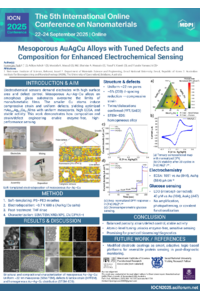
IOCN2025_HPark_poster.pdf
Upcycling Waste into Carbon Electrodes for Sustainable Energy Storage
Electronic structure of Ag-In nanostructures and their functionalization with tryptophan for spectrocopic surface enhancement application