Event submissions
Published
This submission belongs to the session S3. Nanophotonic, Nanoelectronics, Nanosensors and Devices of the event The 5th International Online Conference on Nanomaterials
Published date
19 Sep, 2025
Academic Editor
'%3e%3cpath%20d='M12.6657%2010.9104C12.4185%2010.325%2012.0599%209.79327%2011.6097%209.34482C11.1609%208.89508%2010.6293%208.5365%2010.0442%208.28888C10.0389%208.28626%2010.0337%208.28495%2010.0285%208.28233C10.8446%207.69279%2011.3752%206.73249%2011.3752%205.64904C11.3752%203.8542%209.92103%202.39999%208.1262%202.39999C6.33136%202.39999%204.87715%203.8542%204.87715%205.64904C4.87715%206.73249%205.40774%207.69279%206.22393%208.28364C6.21869%208.28626%206.21345%208.28757%206.20821%208.29019C5.62129%208.5378%205.09463%208.89284%204.64265%209.34613C4.1929%209.79493%203.83432%2010.3266%203.58671%2010.9117C3.34345%2011.4845%203.21226%2012.0987%203.20023%2012.7209C3.19988%2012.7349%203.20233%2012.7488%203.20744%2012.7619C3.21255%2012.7749%203.22022%2012.7867%203.22998%2012.7968C3.23975%2012.8068%203.25142%2012.8147%203.26431%2012.8202C3.2772%2012.8256%203.29105%2012.8284%203.30504%2012.8284H4.09109C4.14874%2012.8284%204.19459%2012.7825%204.1959%2012.7262C4.2221%2011.7148%204.62823%2010.7676%205.34617%2010.0497C6.08899%209.30683%207.0755%208.89808%208.1262%208.89808C9.17689%208.89808%2010.1634%209.30683%2010.9062%2010.0497C11.6242%2010.7676%2012.0303%2011.7148%2012.0565%2012.7262C12.0578%2012.7838%2012.1037%2012.8284%2012.1613%2012.8284H12.9474C12.9613%2012.8284%2012.9752%2012.8256%2012.9881%2012.8202C13.001%2012.8147%2013.0126%2012.8068%2013.0224%2012.7968C13.0322%2012.7867%2013.0398%2012.7749%2013.0449%2012.7619C13.0501%2012.7488%2013.0525%2012.7349%2013.0522%2012.7209C13.0391%2012.0947%2012.9094%2011.4855%2012.6657%2010.9104ZM8.1262%207.9024C7.52486%207.9024%206.9589%207.6679%206.53312%207.24211C6.10733%206.81633%205.87283%206.25037%205.87283%205.64904C5.87283%205.0477%206.10733%204.48174%206.53312%204.05596C6.9589%203.63018%207.52486%203.39567%208.1262%203.39567C8.72753%203.39567%209.29349%203.63018%209.71927%204.05596C10.1451%204.48174%2010.3796%205.0477%2010.3796%205.64904C10.3796%206.25037%2010.1451%206.81633%209.71927%207.24211C9.29349%207.6679%208.72753%207.9024%208.1262%207.9024Z'%20fill='%235D1EE1'/%3e%3c/g%3e%3c/svg%3e) Huanjun Chen
Huanjun ChenCitation
Jialin Yin, Danyang Zhao, Ruiqian Guo, Shiliang Mei, Quasi-2D Perovskite Light-Emitting Diodes with Enhanced Chirality-Induced Spin Selectivity via Mixed Chiral–Achiral Spacer Engineering, in Proceedings of The 5th International Online Conference on Nanomaterials, 22 September–24 September 2025, MDPI: Basel, Switzerland
Share
Email
Facebook
Twitter
LinkedIn
Quasi-2D Perovskite Light-Emitting Diodes with Enhanced Chirality-Induced Spin Selectivity via Mixed Chiral–Achiral Spacer Engineering
'%3e%3cpath%20d='M12.6647%2010.9104C12.4176%2010.325%2012.0589%209.7933%2011.6088%209.34485C11.16%208.89511%2010.6283%208.53653%2010.0432%208.28891C10.038%208.28629%2010.0327%208.28498%2010.0275%208.28236C10.8437%207.69282%2011.3743%206.73252%2011.3743%205.64907C11.3743%203.85423%209.92005%202.40002%208.12522%202.40002C6.33038%202.40002%204.87618%203.85423%204.87618%205.64907C4.87618%206.73252%205.40677%207.69282%206.22296%208.28367C6.21772%208.28629%206.21248%208.2876%206.20724%208.29022C5.62031%208.53783%205.09365%208.89287%204.64167%209.34616C4.19192%209.79496%203.83334%2010.3266%203.58573%2010.9117C3.34247%2011.4846%203.21128%2012.0987%203.19925%2012.721C3.1989%2012.735%203.20135%2012.7489%203.20646%2012.7619C3.21157%2012.7749%203.21924%2012.7868%203.22901%2012.7968C3.23877%2012.8068%203.25045%2012.8148%203.26334%2012.8202C3.27623%2012.8256%203.29007%2012.8284%203.30406%2012.8284H4.09012C4.14776%2012.8284%204.19362%2012.7825%204.19493%2012.7262C4.22113%2011.7148%204.62726%2010.7676%205.34519%2010.0497C6.08802%209.30686%207.07452%208.89811%208.12522%208.89811C9.17592%208.89811%2010.1624%209.30686%2010.9052%2010.0497C11.6232%2010.7676%2012.0293%2011.7148%2012.0555%2012.7262C12.0568%2012.7839%2012.1027%2012.8284%2012.1603%2012.8284H12.9464C12.9604%2012.8284%2012.9742%2012.8256%2012.9871%2012.8202C13%2012.8148%2013.0117%2012.8068%2013.0214%2012.7968C13.0312%2012.7868%2013.0389%2012.7749%2013.044%2012.7619C13.0491%2012.7489%2013.0515%2012.735%2013.0512%2012.721C13.0381%2012.0947%2012.9084%2011.4856%2012.6647%2010.9104ZM8.12522%207.90243C7.52388%207.90243%206.95792%207.66793%206.53214%207.24215C6.10636%206.81636%205.87185%206.2504%205.87185%205.64907C5.87185%205.04773%206.10636%204.48177%206.53214%204.05599C6.95792%203.63021%207.52388%203.3957%208.12522%203.3957C8.72655%203.3957%209.29252%203.63021%209.7183%204.05599C10.1441%204.48177%2010.3786%205.04773%2010.3786%205.64907C10.3786%206.2504%2010.1441%206.81636%209.7183%207.24215C9.29252%207.66793%208.72655%207.90243%208.12522%207.90243Z'%20fill='%235D1EE1'/%3e%3c/g%3e%3c/svg%3e)
Jialin Yin 1
Danyang Zhao 1
Ruiqian Guo 1
Shiliang Mei 2
1. Institute for Electric Light Sources, College of Intelligent Robotics and Advanced Manufacturing, Fudan University, Shanghai 200433, China.
2. Institute for Electric Light Sources, College of Intelligent Robotics and Advanced Manufacturing, Fudan University, Shanghai 200433, China
Abstract
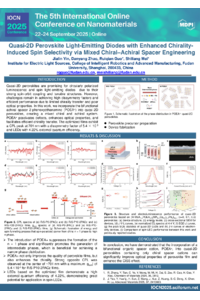
Quasi-two-dimensional (quasi-2D) perovskites are promising candidates for circularly polarized luminescence (CPL) materials and spin light-emitting diodes (LEDs), owing to their strong spin–orbit coupling (SOC), tunable chiral-inducing structures, and compatibility with device fabrication processes. However, achieving high dissymmetry factors and efficient spin-LED performance remains challenging because single chiral cation systems of quasi-2D perovskites suffer from limited chiral induction and poor phase tunability. In this work, we introduced a mixed-cation strategy by incorporating an achiral organic spacer, 2-phenoxyethanamine (POEA⁺), into quasi-2D perovskites based on a single chiral cation. The incorporation of POEA⁺ not only passivated defects and improved the optical properties of the perovskite films, but also enhanced chirality-induced spin selectivity (CISS) by promoting the formation of intermediate phases and facilitating a more efficient energy transfer process. As a result, the mixed-cation perovskite film exhibited a significantly enhanced CPL signal at 702 nm, with a maximum photoluminescence dissymmetry factor (glum) of 4 × 10⁻³ at room temperature. Furthermore, LEDs based on the optimized film demonstrated a high external quantum efficiency (EQE) of 4.22%. This work proposes an effective strategy to simultaneously enhance the chiroptical properties of quasi-2D perovskite and improve the quality of the films, which shows the great potential for future applications in chiroptoelectronics and spintronics.
Keywords
Quasi-2D perovskite
Light-emitting diodes
Circularly polarized luminescence
Poster
poster-yin jialin.pdf
Nano medicine in Dermatology: Exploring the Potential of Ethosomal Gels for Enhanced Topical Drug Delivery
Synergistic Interfacial Engineering Enables High-performance Perovskite LEDs for High-Speed Visible Light Communication