Event submissions
Published
This submission belongs to the session S3. Nanophotonic, Nanoelectronics, Nanosensors and Devices of the event The 5th International Online Conference on Nanomaterials
Published date
19 Sep, 2025
Academic Editor
'%3e%3cpath%20d='M12.6657%2010.9104C12.4185%2010.325%2012.0599%209.79327%2011.6097%209.34482C11.1609%208.89508%2010.6293%208.5365%2010.0442%208.28888C10.0389%208.28626%2010.0337%208.28495%2010.0285%208.28233C10.8446%207.69279%2011.3752%206.73249%2011.3752%205.64904C11.3752%203.8542%209.92103%202.39999%208.1262%202.39999C6.33136%202.39999%204.87715%203.8542%204.87715%205.64904C4.87715%206.73249%205.40774%207.69279%206.22393%208.28364C6.21869%208.28626%206.21345%208.28757%206.20821%208.29019C5.62129%208.5378%205.09463%208.89284%204.64265%209.34613C4.1929%209.79493%203.83432%2010.3266%203.58671%2010.9117C3.34345%2011.4845%203.21226%2012.0987%203.20023%2012.7209C3.19988%2012.7349%203.20233%2012.7488%203.20744%2012.7619C3.21255%2012.7749%203.22022%2012.7867%203.22998%2012.7968C3.23975%2012.8068%203.25142%2012.8147%203.26431%2012.8202C3.2772%2012.8256%203.29105%2012.8284%203.30504%2012.8284H4.09109C4.14874%2012.8284%204.19459%2012.7825%204.1959%2012.7262C4.2221%2011.7148%204.62823%2010.7676%205.34617%2010.0497C6.08899%209.30683%207.0755%208.89808%208.1262%208.89808C9.17689%208.89808%2010.1634%209.30683%2010.9062%2010.0497C11.6242%2010.7676%2012.0303%2011.7148%2012.0565%2012.7262C12.0578%2012.7838%2012.1037%2012.8284%2012.1613%2012.8284H12.9474C12.9613%2012.8284%2012.9752%2012.8256%2012.9881%2012.8202C13.001%2012.8147%2013.0126%2012.8068%2013.0224%2012.7968C13.0322%2012.7867%2013.0398%2012.7749%2013.0449%2012.7619C13.0501%2012.7488%2013.0525%2012.7349%2013.0522%2012.7209C13.0391%2012.0947%2012.9094%2011.4855%2012.6657%2010.9104ZM8.1262%207.9024C7.52486%207.9024%206.9589%207.6679%206.53312%207.24211C6.10733%206.81633%205.87283%206.25037%205.87283%205.64904C5.87283%205.0477%206.10733%204.48174%206.53312%204.05596C6.9589%203.63018%207.52486%203.39567%208.1262%203.39567C8.72753%203.39567%209.29349%203.63018%209.71927%204.05596C10.1451%204.48174%2010.3796%205.0477%2010.3796%205.64904C10.3796%206.25037%2010.1451%206.81633%209.71927%207.24211C9.29349%207.6679%208.72753%207.9024%208.1262%207.9024Z'%20fill='%235D1EE1'/%3e%3c/g%3e%3c/svg%3e) Huanjun Chen
Huanjun ChenCitation
Danyang Zhao, Jialin Yin, Shiliang Mei, Pengfei Tian, Ruiqian Guo, Synergistic Interfacial Engineering Enables High-performance Perovskite LEDs for High-Speed Visible Light Communication, in Proceedings of The 5th International Online Conference on Nanomaterials, 22 September–24 September 2025, MDPI: Basel, Switzerland
Share
Email
Facebook
Twitter
LinkedIn
Synergistic Interfacial Engineering Enables High-performance Perovskite LEDs for High-Speed Visible Light Communication
'%3e%3cpath%20d='M12.6647%2010.9104C12.4176%2010.325%2012.0589%209.7933%2011.6088%209.34485C11.16%208.89511%2010.6283%208.53653%2010.0432%208.28891C10.038%208.28629%2010.0327%208.28498%2010.0275%208.28236C10.8437%207.69282%2011.3743%206.73252%2011.3743%205.64907C11.3743%203.85423%209.92005%202.40002%208.12522%202.40002C6.33038%202.40002%204.87618%203.85423%204.87618%205.64907C4.87618%206.73252%205.40677%207.69282%206.22296%208.28367C6.21772%208.28629%206.21248%208.2876%206.20724%208.29022C5.62031%208.53783%205.09365%208.89287%204.64167%209.34616C4.19192%209.79496%203.83334%2010.3266%203.58573%2010.9117C3.34247%2011.4846%203.21128%2012.0987%203.19925%2012.721C3.1989%2012.735%203.20135%2012.7489%203.20646%2012.7619C3.21157%2012.7749%203.21924%2012.7868%203.22901%2012.7968C3.23877%2012.8068%203.25045%2012.8148%203.26334%2012.8202C3.27623%2012.8256%203.29007%2012.8284%203.30406%2012.8284H4.09012C4.14776%2012.8284%204.19362%2012.7825%204.19493%2012.7262C4.22113%2011.7148%204.62726%2010.7676%205.34519%2010.0497C6.08802%209.30686%207.07452%208.89811%208.12522%208.89811C9.17592%208.89811%2010.1624%209.30686%2010.9052%2010.0497C11.6232%2010.7676%2012.0293%2011.7148%2012.0555%2012.7262C12.0568%2012.7839%2012.1027%2012.8284%2012.1603%2012.8284H12.9464C12.9604%2012.8284%2012.9742%2012.8256%2012.9871%2012.8202C13%2012.8148%2013.0117%2012.8068%2013.0214%2012.7968C13.0312%2012.7868%2013.0389%2012.7749%2013.044%2012.7619C13.0491%2012.7489%2013.0515%2012.735%2013.0512%2012.721C13.0381%2012.0947%2012.9084%2011.4856%2012.6647%2010.9104ZM8.12522%207.90243C7.52388%207.90243%206.95792%207.66793%206.53214%207.24215C6.10636%206.81636%205.87185%206.2504%205.87185%205.64907C5.87185%205.04773%206.10636%204.48177%206.53214%204.05599C6.95792%203.63021%207.52388%203.3957%208.12522%203.3957C8.72655%203.3957%209.29252%203.63021%209.7183%204.05599C10.1441%204.48177%2010.3786%205.04773%2010.3786%205.64907C10.3786%206.2504%2010.1441%206.81636%209.7183%207.24215C9.29252%207.66793%208.72655%207.90243%208.12522%207.90243Z'%20fill='%235D1EE1'/%3e%3c/g%3e%3c/svg%3e)
Danyang Zhao 1
Jialin Yin 1
Shiliang Mei 2

Pengfei Tian 1
Ruiqian Guo 1
1. Institute for Electric Light Sources, College of Intelligent Robotics and Advanced Manufacturing, Fudan University, Shanghai 200433, China.
2. Institute for Electric Light Sources, College of Intelligent Robotics and Advanced Manufacturing, Fudan University, Shanghai 200433, China
Abstract
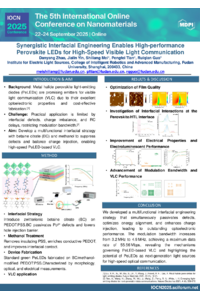
Metal halide perovskite light-emitting diodes (PeLEDs) have emerged as promising emitters for visible light communication (VLC) applications owing to their excellent optoelectronic properties and cost-effective fabrication. While various strategies have been proposed to enhance PeLEDs’ modulation performance, their practical application in VLC systems remains at an early, demonstrative stage. A key challenge lies in imbalanced charge injection and interfacial defects, which severely limit the modulation bandwidth and VLC performance. Specifically, the potential of interfacial engineering in solving these issues remains underexplored. Herein, we propose a multifunctional interfacial modification strategy by employing zwitterionic betaine citrate (BC) to simultaneously passivate defects and achieve balanced charge injection. The BC molecules effectively coordinate with undercoordinated Pb²⁺ ions, reducing the trap state density, while their ionic interaction with PEDOT:PSS decreases the hole injection barrier. Additionally, the employed methanol solvent selectively removes insulating PSS, improving interfacial conductivity and morphology. The synergistic effects of improved charge injection, defect passivation and optimized interface morphology lead to reduced non-radiative losses and a significantly lower resistance–capacitance (RC) time constant, both of which are critical for enhancing VLC performance. Consequently, optimized devices achieve a modulation bandwidth of 4.9 MHz and a data rate of 55.56 Mbps, far exceeding those of control devices and representing the best performance reported to date for devices with comparable active areas. This work systematically investigates the role of interfacial engineering in VLC performance and offers a viable pathway toward high-speed PeLED-based VLC systems.
Keywords
Perovskite LEDs
Interfacial Engineering
Visible Light Communication
Poster
poster-zhao danyang.pdf
Quasi-2D Perovskite Light-Emitting Diodes with Enhanced Chirality-Induced Spin Selectivity via Mixed Chiral–Achiral Spacer Engineering
Temperature-Dependent Amplified Spontaneous Emission Across Crystalline Phase Transitions in Solution-Processed MAPbBr₃ Thin Films