Event submissions
Published
This submission belongs to the session S6. Synthesis, Characterization, and Properties of Nanomaterials of the event The 5th International Online Conference on Nanomaterials
Published date
19 Sep, 2025
Academic Editor
'%3e%3cpath%20d='M12.6657%2010.9104C12.4185%2010.325%2012.0599%209.79327%2011.6097%209.34482C11.1609%208.89508%2010.6293%208.5365%2010.0442%208.28888C10.0389%208.28626%2010.0337%208.28495%2010.0285%208.28233C10.8446%207.69279%2011.3752%206.73249%2011.3752%205.64904C11.3752%203.8542%209.92103%202.39999%208.1262%202.39999C6.33136%202.39999%204.87715%203.8542%204.87715%205.64904C4.87715%206.73249%205.40774%207.69279%206.22393%208.28364C6.21869%208.28626%206.21345%208.28757%206.20821%208.29019C5.62129%208.5378%205.09463%208.89284%204.64265%209.34613C4.1929%209.79493%203.83432%2010.3266%203.58671%2010.9117C3.34345%2011.4845%203.21226%2012.0987%203.20023%2012.7209C3.19988%2012.7349%203.20233%2012.7488%203.20744%2012.7619C3.21255%2012.7749%203.22022%2012.7867%203.22998%2012.7968C3.23975%2012.8068%203.25142%2012.8147%203.26431%2012.8202C3.2772%2012.8256%203.29105%2012.8284%203.30504%2012.8284H4.09109C4.14874%2012.8284%204.19459%2012.7825%204.1959%2012.7262C4.2221%2011.7148%204.62823%2010.7676%205.34617%2010.0497C6.08899%209.30683%207.0755%208.89808%208.1262%208.89808C9.17689%208.89808%2010.1634%209.30683%2010.9062%2010.0497C11.6242%2010.7676%2012.0303%2011.7148%2012.0565%2012.7262C12.0578%2012.7838%2012.1037%2012.8284%2012.1613%2012.8284H12.9474C12.9613%2012.8284%2012.9752%2012.8256%2012.9881%2012.8202C13.001%2012.8147%2013.0126%2012.8068%2013.0224%2012.7968C13.0322%2012.7867%2013.0398%2012.7749%2013.0449%2012.7619C13.0501%2012.7488%2013.0525%2012.7349%2013.0522%2012.7209C13.0391%2012.0947%2012.9094%2011.4855%2012.6657%2010.9104ZM8.1262%207.9024C7.52486%207.9024%206.9589%207.6679%206.53312%207.24211C6.10733%206.81633%205.87283%206.25037%205.87283%205.64904C5.87283%205.0477%206.10733%204.48174%206.53312%204.05596C6.9589%203.63018%207.52486%203.39567%208.1262%203.39567C8.72753%203.39567%209.29349%203.63018%209.71927%204.05596C10.1451%204.48174%2010.3796%205.0477%2010.3796%205.64904C10.3796%206.25037%2010.1451%206.81633%209.71927%207.24211C9.29349%207.6679%208.72753%207.9024%208.1262%207.9024Z'%20fill='%235D1EE1'/%3e%3c/g%3e%3c/svg%3e) Catalin-Daniel CONSTANTINESCU
Catalin-Daniel CONSTANTINESCUCitation
Stefania Milanese, Maria Luisa De Giorgi, Giovanni Morello, Maryna I. Bodnarchuk, Marco Anni, Ligand and environment dependence of the spontaneous and stimulated emission properties of fully inorganic CsPbBr3 perovskite nanocrystals, in Proceedings of The 5th International Online Conference on Nanomaterials, 22 September–24 September 2025, MDPI: Basel, Switzerland
Share
Email
Facebook
Twitter
LinkedIn
Ligand and environment dependence of the spontaneous and stimulated emission properties of fully inorganic CsPbBr3 perovskite nanocrystals
'%3e%3cpath%20d='M12.6647%2010.9104C12.4176%2010.325%2012.0589%209.7933%2011.6088%209.34485C11.16%208.89511%2010.6283%208.53653%2010.0432%208.28891C10.038%208.28629%2010.0327%208.28498%2010.0275%208.28236C10.8437%207.69282%2011.3743%206.73252%2011.3743%205.64907C11.3743%203.85423%209.92005%202.40002%208.12522%202.40002C6.33038%202.40002%204.87618%203.85423%204.87618%205.64907C4.87618%206.73252%205.40677%207.69282%206.22296%208.28367C6.21772%208.28629%206.21248%208.2876%206.20724%208.29022C5.62031%208.53783%205.09365%208.89287%204.64167%209.34616C4.19192%209.79496%203.83334%2010.3266%203.58573%2010.9117C3.34247%2011.4846%203.21128%2012.0987%203.19925%2012.721C3.1989%2012.735%203.20135%2012.7489%203.20646%2012.7619C3.21157%2012.7749%203.21924%2012.7868%203.22901%2012.7968C3.23877%2012.8068%203.25045%2012.8148%203.26334%2012.8202C3.27623%2012.8256%203.29007%2012.8284%203.30406%2012.8284H4.09012C4.14776%2012.8284%204.19362%2012.7825%204.19493%2012.7262C4.22113%2011.7148%204.62726%2010.7676%205.34519%2010.0497C6.08802%209.30686%207.07452%208.89811%208.12522%208.89811C9.17592%208.89811%2010.1624%209.30686%2010.9052%2010.0497C11.6232%2010.7676%2012.0293%2011.7148%2012.0555%2012.7262C12.0568%2012.7839%2012.1027%2012.8284%2012.1603%2012.8284H12.9464C12.9604%2012.8284%2012.9742%2012.8256%2012.9871%2012.8202C13%2012.8148%2013.0117%2012.8068%2013.0214%2012.7968C13.0312%2012.7868%2013.0389%2012.7749%2013.044%2012.7619C13.0491%2012.7489%2013.0515%2012.735%2013.0512%2012.721C13.0381%2012.0947%2012.9084%2011.4856%2012.6647%2010.9104ZM8.12522%207.90243C7.52388%207.90243%206.95792%207.66793%206.53214%207.24215C6.10636%206.81636%205.87185%206.2504%205.87185%205.64907C5.87185%205.04773%206.10636%204.48177%206.53214%204.05599C6.95792%203.63021%207.52388%203.3957%208.12522%203.3957C8.72655%203.3957%209.29252%203.63021%209.7183%204.05599C10.1441%204.48177%2010.3786%205.04773%2010.3786%205.64907C10.3786%206.2504%2010.1441%206.81636%209.7183%207.24215C9.29252%207.66793%208.72655%207.90243%208.12522%207.90243Z'%20fill='%235D1EE1'/%3e%3c/g%3e%3c/svg%3e)
Stefania Milanese 1

Maria Luisa De Giorgi 1
Giovanni Morello 2
Maryna I. Bodnarchuk 3,4

Marco Anni 1
1. Department of Mathematics and Physics "Ennio De Giorgi", University of Salento, 73100 Lecce, Italy
2. CNR IMM – Institute for Microelectronics and Microsystems – Unit of Lecce, 73100 Lecce, Italy
3. Institute of Inorganic Chemistry, Department of Chemistry and Applied Bioscience, ETH Zürich 8000, Switzerland
4. Laboratory for Thin Films and Photovoltaics, Empa – Swiss Federal Laboratories for Materials Science and Technology,
Dübendorf CH-8600, Switzerland
Abstract
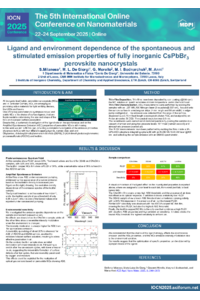
Perovskite nanocrystals (NCs) of a fully inorganic composition have emerged as effective materials for optoelectronic applications over the past decade. Their photoluminescence and stability are significantly influenced by the surface chemistry, particularly the surfactant molecules used for defect passivation. While several experiments have investigated the ligand dependence of the spontaneous emission properties, the ligand's role in the optical gain and stimulated emission for perovskite NCs has almost entirely been unexplored.
In this work, we aim to fill this gap, investigating how the capping ligand of CsPbBr3 perovskite NC thin films affects their amplified spontaneous emission (ASE) characteristics, their photostability, and their sensitivity to ambient air.
We analyzed four distinct samples with different capping ligands, namely oleic acid/oleylamine, didodecyldimethylammonium bromide, 3-(N,N-dimethyloctadecylammonio)-propanesulfonate, and lecithin. We discuss the impact of these four ligands on the NCs' quantum efficiency, optical gain, optical stability, and atmospheric sensing properties, investigating the underlying chemical–physical mechanisms responsible for the observed variations. In particular, we show that all of the samples show ASEs under nanosecond pumping, but with very different thresholds, and that the dependence of the ASE's intensity on the sample environment is also strongly ligand-dependent.
Finally, we performed a comparison between these four ligands, demonstrating that lecithin capping allows the optimal performance to be obtained concerning the ASE threshold and sensing capabilities.
Keywords
lead halide perovskites
nanocrystal
optical gain
photoluminescence
Poster
poster_IOCN25.pdf
Nanostructure-Driven SERS and AI for Selective Identification of Bacterial Biomarkers
Optimization of synthesis and thermoresponsive characteristics of Hydroxypropyl Cellulose nanogels