Event submissions
Published
This submission belongs to the session S3. Nanophotonic, Nanoelectronics, Nanosensors and Devices of the event The 5th International Online Conference on Nanomaterials
Published date
19 Sep, 2025
Academic Editor
'%3e%3cpath%20d='M12.6657%2010.9104C12.4185%2010.325%2012.0599%209.79327%2011.6097%209.34482C11.1609%208.89508%2010.6293%208.5365%2010.0442%208.28888C10.0389%208.28626%2010.0337%208.28495%2010.0285%208.28233C10.8446%207.69279%2011.3752%206.73249%2011.3752%205.64904C11.3752%203.8542%209.92103%202.39999%208.1262%202.39999C6.33136%202.39999%204.87715%203.8542%204.87715%205.64904C4.87715%206.73249%205.40774%207.69279%206.22393%208.28364C6.21869%208.28626%206.21345%208.28757%206.20821%208.29019C5.62129%208.5378%205.09463%208.89284%204.64265%209.34613C4.1929%209.79493%203.83432%2010.3266%203.58671%2010.9117C3.34345%2011.4845%203.21226%2012.0987%203.20023%2012.7209C3.19988%2012.7349%203.20233%2012.7488%203.20744%2012.7619C3.21255%2012.7749%203.22022%2012.7867%203.22998%2012.7968C3.23975%2012.8068%203.25142%2012.8147%203.26431%2012.8202C3.2772%2012.8256%203.29105%2012.8284%203.30504%2012.8284H4.09109C4.14874%2012.8284%204.19459%2012.7825%204.1959%2012.7262C4.2221%2011.7148%204.62823%2010.7676%205.34617%2010.0497C6.08899%209.30683%207.0755%208.89808%208.1262%208.89808C9.17689%208.89808%2010.1634%209.30683%2010.9062%2010.0497C11.6242%2010.7676%2012.0303%2011.7148%2012.0565%2012.7262C12.0578%2012.7838%2012.1037%2012.8284%2012.1613%2012.8284H12.9474C12.9613%2012.8284%2012.9752%2012.8256%2012.9881%2012.8202C13.001%2012.8147%2013.0126%2012.8068%2013.0224%2012.7968C13.0322%2012.7867%2013.0398%2012.7749%2013.0449%2012.7619C13.0501%2012.7488%2013.0525%2012.7349%2013.0522%2012.7209C13.0391%2012.0947%2012.9094%2011.4855%2012.6657%2010.9104ZM8.1262%207.9024C7.52486%207.9024%206.9589%207.6679%206.53312%207.24211C6.10733%206.81633%205.87283%206.25037%205.87283%205.64904C5.87283%205.0477%206.10733%204.48174%206.53312%204.05596C6.9589%203.63018%207.52486%203.39567%208.1262%203.39567C8.72753%203.39567%209.29349%203.63018%209.71927%204.05596C10.1451%204.48174%2010.3796%205.0477%2010.3796%205.64904C10.3796%206.25037%2010.1451%206.81633%209.71927%207.24211C9.29349%207.6679%208.72753%207.9024%208.1262%207.9024Z'%20fill='%235D1EE1'/%3e%3c/g%3e%3c/svg%3e) Huanjun Chen
Huanjun ChenCitation
Andrei Honciuc, Mirela Honciuc, Ana-Maria Solonaru, Piezoelectric-Like Response and Energy Harvesting Potential of a Moldable PVA/PANi Composite Prepared via Frozen-Gel Polymerization, in Proceedings of The 5th International Online Conference on Nanomaterials, 22 September–24 September 2025, MDPI: Basel, Switzerland
Share
Email
Facebook
Twitter
LinkedIn
Piezoelectric-Like Response and Energy Harvesting Potential of a Moldable PVA/PANi Composite Prepared via Frozen-Gel Polymerization

Andrei Honciuc 1

Mirela Honciuc 1
'%3e%3cpath%20d='M12.6647%2010.9104C12.4176%2010.325%2012.0589%209.7933%2011.6088%209.34485C11.16%208.89511%2010.6283%208.53653%2010.0432%208.28891C10.038%208.28629%2010.0327%208.28498%2010.0275%208.28236C10.8437%207.69282%2011.3743%206.73252%2011.3743%205.64907C11.3743%203.85423%209.92005%202.40002%208.12522%202.40002C6.33038%202.40002%204.87618%203.85423%204.87618%205.64907C4.87618%206.73252%205.40677%207.69282%206.22296%208.28367C6.21772%208.28629%206.21248%208.2876%206.20724%208.29022C5.62031%208.53783%205.09365%208.89287%204.64167%209.34616C4.19192%209.79496%203.83334%2010.3266%203.58573%2010.9117C3.34247%2011.4846%203.21128%2012.0987%203.19925%2012.721C3.1989%2012.735%203.20135%2012.7489%203.20646%2012.7619C3.21157%2012.7749%203.21924%2012.7868%203.22901%2012.7968C3.23877%2012.8068%203.25045%2012.8148%203.26334%2012.8202C3.27623%2012.8256%203.29007%2012.8284%203.30406%2012.8284H4.09012C4.14776%2012.8284%204.19362%2012.7825%204.19493%2012.7262C4.22113%2011.7148%204.62726%2010.7676%205.34519%2010.0497C6.08802%209.30686%207.07452%208.89811%208.12522%208.89811C9.17592%208.89811%2010.1624%209.30686%2010.9052%2010.0497C11.6232%2010.7676%2012.0293%2011.7148%2012.0555%2012.7262C12.0568%2012.7839%2012.1027%2012.8284%2012.1603%2012.8284H12.9464C12.9604%2012.8284%2012.9742%2012.8256%2012.9871%2012.8202C13%2012.8148%2013.0117%2012.8068%2013.0214%2012.7968C13.0312%2012.7868%2013.0389%2012.7749%2013.044%2012.7619C13.0491%2012.7489%2013.0515%2012.735%2013.0512%2012.721C13.0381%2012.0947%2012.9084%2011.4856%2012.6647%2010.9104ZM8.12522%207.90243C7.52388%207.90243%206.95792%207.66793%206.53214%207.24215C6.10636%206.81636%205.87185%206.2504%205.87185%205.64907C5.87185%205.04773%206.10636%204.48177%206.53214%204.05599C6.95792%203.63021%207.52388%203.3957%208.12522%203.3957C8.72655%203.3957%209.29252%203.63021%209.7183%204.05599C10.1441%204.48177%2010.3786%205.04773%2010.3786%205.64907C10.3786%206.2504%2010.1441%206.81636%209.7183%207.24215C9.29252%207.66793%208.72655%207.90243%208.12522%207.90243Z'%20fill='%235D1EE1'/%3e%3c/g%3e%3c/svg%3e)
Ana-Maria Solonaru 1
1. “Petru Poni” Institute of Macromolecular Chemistry, 41A Grigore Ghica Voda Alley, Iasi 700487, Romania
Abstract
Introduction:
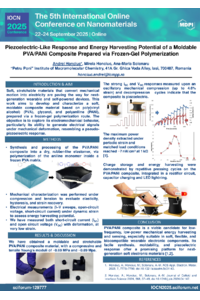
Soft, mechanically compliant materials capable of converting mechanical energy into electrical output are essential for the next generation of wearable electronics and self-powered sensors. While piezoelectricity is typically associated with crystalline ceramics or ferroelectric polymers, recent efforts have focused on organic mixed ionic–electronic conductors (OMIECs) as functional alternatives. Here, we report a moldable, water-processable PVA/PANi composite exhibiting strain-sensitive electrical response and piezoelectric-like energy conversion, synthesized through a straightforward frozen-gel polymerization method.
Methods:
Poly(vinyl alcohol) and glycerol were dissolved in water to form a hydrogel precursor, followed by in situ polymerization of aniline under frozen conditions. The composite was subjected to mechanical compression and stretching cycles, and its electrical output was evaluated via open-circuit voltage (VOC), short-circuit current (ISC), and power output across various load resistances. The structure was characterized via scanning electron microscopy (SEM), revealing platelet-like nanoparticle PANi domains embedded in the soft matrix.
Results:
The composite exhibited a reproducible piezoelectric-like response under compressive strain, with VOC reaching 0.08 mV/mm and ISC exceeding 8 µA/mm² at ~4.6% strain. Maximum power density of ~7 nW/cm³ was obtained at an optimal load of 1 kΩ. Theoretical Pmax estimates based on VOC × ISC closely matched experimental results. SEM revealed granular and fibrillar self-assembled nanoparticle PANi domains, likely templated by ice grains during polymerization, suggesting an interface-driven morphological control.
Conclusions:
The PVA/PANi composite exhibits mechano-electrical conversion in the absence of conventional piezoelectric phases, enabled by a unique morphology arising from frozen-gel polymerization. Its moldability, conductivity, and scalability highlight its potential for low-cost, flexible energy harvesting and sensing applications.
Keywords
OMIECS
semiconducting polymers
polyaniline
hydrogels
energy harvesting
Poster
Presentation sciforum-129777_Honciuc Andrei.pdf
Platinum-Decorated Transition Metal Phosphides for High-Efficiency Renewable Hydrogen Production
Development of Enzyme-Free Biosensors Based on Silver Nanoparticles for Rapid and Stable Biomolecule Detection