Event submissions
Published
This submission belongs to the session S6. Synthesis, Characterization, and Properties of Nanomaterials of the event The 5th International Online Conference on Nanomaterials
Published date
19 Sep, 2025
Academic Editor
'%3e%3cpath%20d='M12.6657%2010.9104C12.4185%2010.325%2012.0599%209.79327%2011.6097%209.34482C11.1609%208.89508%2010.6293%208.5365%2010.0442%208.28888C10.0389%208.28626%2010.0337%208.28495%2010.0285%208.28233C10.8446%207.69279%2011.3752%206.73249%2011.3752%205.64904C11.3752%203.8542%209.92103%202.39999%208.1262%202.39999C6.33136%202.39999%204.87715%203.8542%204.87715%205.64904C4.87715%206.73249%205.40774%207.69279%206.22393%208.28364C6.21869%208.28626%206.21345%208.28757%206.20821%208.29019C5.62129%208.5378%205.09463%208.89284%204.64265%209.34613C4.1929%209.79493%203.83432%2010.3266%203.58671%2010.9117C3.34345%2011.4845%203.21226%2012.0987%203.20023%2012.7209C3.19988%2012.7349%203.20233%2012.7488%203.20744%2012.7619C3.21255%2012.7749%203.22022%2012.7867%203.22998%2012.7968C3.23975%2012.8068%203.25142%2012.8147%203.26431%2012.8202C3.2772%2012.8256%203.29105%2012.8284%203.30504%2012.8284H4.09109C4.14874%2012.8284%204.19459%2012.7825%204.1959%2012.7262C4.2221%2011.7148%204.62823%2010.7676%205.34617%2010.0497C6.08899%209.30683%207.0755%208.89808%208.1262%208.89808C9.17689%208.89808%2010.1634%209.30683%2010.9062%2010.0497C11.6242%2010.7676%2012.0303%2011.7148%2012.0565%2012.7262C12.0578%2012.7838%2012.1037%2012.8284%2012.1613%2012.8284H12.9474C12.9613%2012.8284%2012.9752%2012.8256%2012.9881%2012.8202C13.001%2012.8147%2013.0126%2012.8068%2013.0224%2012.7968C13.0322%2012.7867%2013.0398%2012.7749%2013.0449%2012.7619C13.0501%2012.7488%2013.0525%2012.7349%2013.0522%2012.7209C13.0391%2012.0947%2012.9094%2011.4855%2012.6657%2010.9104ZM8.1262%207.9024C7.52486%207.9024%206.9589%207.6679%206.53312%207.24211C6.10733%206.81633%205.87283%206.25037%205.87283%205.64904C5.87283%205.0477%206.10733%204.48174%206.53312%204.05596C6.9589%203.63018%207.52486%203.39567%208.1262%203.39567C8.72753%203.39567%209.29349%203.63018%209.71927%204.05596C10.1451%204.48174%2010.3796%205.0477%2010.3796%205.64904C10.3796%206.25037%2010.1451%206.81633%209.71927%207.24211C9.29349%207.6679%208.72753%207.9024%208.1262%207.9024Z'%20fill='%235D1EE1'/%3e%3c/g%3e%3c/svg%3e) José Luis Arias Mediano
José Luis Arias MedianoCitation
Miguel Angel Hernandez Martinez, Lazaro Ruiz Virgen, Rúben Caro Briones, Gabriela Martínez Mejía, José Manuel del Río García, Mónica de la Luz Corea Téllez, Smart Polymeric Nanoparticles: Influence of Functional Groups on Their Structural Behavior Under Specific Physical and Chemical Stimuli, in Proceedings of The 5th International Online Conference on Nanomaterials, 22 September–24 September 2025, MDPI: Basel, Switzerland
Share
Email
Facebook
Twitter
LinkedIn
Smart Polymeric Nanoparticles: Influence of Functional Groups on Their Structural Behavior Under Specific Physical and Chemical Stimuli

Miguel Angel Hernandez Martinez 1

Lazaro Ruiz Virgen 1

Rúben Caro Briones 2

Gabriela Martínez Mejía 1
'%3e%3cpath%20d='M12.6647%2010.9104C12.4176%2010.325%2012.0589%209.7933%2011.6088%209.34485C11.16%208.89511%2010.6283%208.53653%2010.0432%208.28891C10.038%208.28629%2010.0327%208.28498%2010.0275%208.28236C10.8437%207.69282%2011.3743%206.73252%2011.3743%205.64907C11.3743%203.85423%209.92005%202.40002%208.12522%202.40002C6.33038%202.40002%204.87618%203.85423%204.87618%205.64907C4.87618%206.73252%205.40677%207.69282%206.22296%208.28367C6.21772%208.28629%206.21248%208.2876%206.20724%208.29022C5.62031%208.53783%205.09365%208.89287%204.64167%209.34616C4.19192%209.79496%203.83334%2010.3266%203.58573%2010.9117C3.34247%2011.4846%203.21128%2012.0987%203.19925%2012.721C3.1989%2012.735%203.20135%2012.7489%203.20646%2012.7619C3.21157%2012.7749%203.21924%2012.7868%203.22901%2012.7968C3.23877%2012.8068%203.25045%2012.8148%203.26334%2012.8202C3.27623%2012.8256%203.29007%2012.8284%203.30406%2012.8284H4.09012C4.14776%2012.8284%204.19362%2012.7825%204.19493%2012.7262C4.22113%2011.7148%204.62726%2010.7676%205.34519%2010.0497C6.08802%209.30686%207.07452%208.89811%208.12522%208.89811C9.17592%208.89811%2010.1624%209.30686%2010.9052%2010.0497C11.6232%2010.7676%2012.0293%2011.7148%2012.0555%2012.7262C12.0568%2012.7839%2012.1027%2012.8284%2012.1603%2012.8284H12.9464C12.9604%2012.8284%2012.9742%2012.8256%2012.9871%2012.8202C13%2012.8148%2013.0117%2012.8068%2013.0214%2012.7968C13.0312%2012.7868%2013.0389%2012.7749%2013.044%2012.7619C13.0491%2012.7489%2013.0515%2012.735%2013.0512%2012.721C13.0381%2012.0947%2012.9084%2011.4856%2012.6647%2010.9104ZM8.12522%207.90243C7.52388%207.90243%206.95792%207.66793%206.53214%207.24215C6.10636%206.81636%205.87185%206.2504%205.87185%205.64907C5.87185%205.04773%206.10636%204.48177%206.53214%204.05599C6.95792%203.63021%207.52388%203.3957%208.12522%203.3957C8.72655%203.3957%209.29252%203.63021%209.7183%204.05599C10.1441%204.48177%2010.3786%205.04773%2010.3786%205.64907C10.3786%206.2504%2010.1441%206.81636%209.7183%207.24215C9.29252%207.66793%208.72655%207.90243%208.12522%207.90243Z'%20fill='%235D1EE1'/%3e%3c/g%3e%3c/svg%3e)
José Manuel del Río García 3
Mónica de la Luz Corea Téllez 1
1. School of Chemical Engineering and Extractive Industries, ESIQIE, Polymer and Nanomaterials Research Laboratory, National Polytechnic Institute, Mexico City, Mexico
2. School of Mechanical and Electrical Engineering, ESIME, National Polytechnic Institute, Mexico City, Mexico
3. School of Physics and Mathematics, National Polytechnic Institute. Av. Luis Enrique Erro S/N, Adolfo López Mateos Professional Unit, Zacatenco, Gustavo A. Madero Borough, 07738, Mexico City, Mexico
Abstract
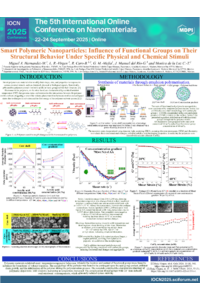
Smart materials at the nanoscale level have seen significant advancements, leading to innovative applications in materials science and engineering. These materials are able to respond to physical, chemical, and/or biological stimuli. In particular, the behavior of sensitive polymer particles and their unique properties are strongly influenced by functional groups (GFs) attached to the main chain. For this reason, they can be used in several knowledge areas. The aim of this research is to synthesize Ph-thermo-responsive polymeric nanoparticles functionalized with carboxylic and amide groups by emulsion polymerization to be used as drug delivery systems. According to the methodology, series 1 (core–shell) and series 2 (core with concentration gradient) were prepared using a two-stage semicontinuous process and a power feed process, respectively. Polymers were characterized using dynamic light scattering (DLS), electrophoresis (zeta potential, ζ), and scanning electron microscopy (SEM), and viscosity (η) values, storage (G’) and loss (G’’) moduli were determined via rheological analysis. Measurements were performed in a temperature range of 25 ºC to 70 ºC. DLS analysis showed changes in the particle diameter (250≤Dz/nm≤1000) over the entire temperature range attributed to the phase transition temperatures. Negative zeta potential values (-45 ≤ ζ/mv ≤ -22) were observed, indicating high stability. As temperature rose, ζ approached zero, suggesting a loss of stability. Rheological tests revealed shear-thinning behavior for all polymers. Their elastic and viscous moduli provided insights into the linear viscoelastic regions and how yield points change with temperature variations. After a titration process, SEM images revealed distinct surface morphologies, including popcorn-like, cauliflower-like, and semi-spherical structures. In conclusion, the materials exhibit high sensitivity to temperature and pH changes, which induce conformational and morphological alterations influenced by the location and concentration of GFs within the particles. Therefore, they are suitable for use as nanocarries.
Keywords
Polymeric nanoparticles
Smart materials
Sensitive polymer particles
Poster
Poster300.pdf
Preparation and characterization of NaYF4-based upconverting nanoparticles for solar energy storage systems
The Composition and intensity-driven sign reversal of the nonlinear optical response of nanoparticle-doped liquid crystal glass