Event submissions
Published
This submission belongs to the session S3. Nanophotonic, Nanoelectronics, Nanosensors and Devices of the event The 5th International Online Conference on Nanomaterials
Published date
19 Sep, 2025
Academic Editor
'%3e%3cpath%20d='M12.6657%2010.9104C12.4185%2010.325%2012.0599%209.79327%2011.6097%209.34482C11.1609%208.89508%2010.6293%208.5365%2010.0442%208.28888C10.0389%208.28626%2010.0337%208.28495%2010.0285%208.28233C10.8446%207.69279%2011.3752%206.73249%2011.3752%205.64904C11.3752%203.8542%209.92103%202.39999%208.1262%202.39999C6.33136%202.39999%204.87715%203.8542%204.87715%205.64904C4.87715%206.73249%205.40774%207.69279%206.22393%208.28364C6.21869%208.28626%206.21345%208.28757%206.20821%208.29019C5.62129%208.5378%205.09463%208.89284%204.64265%209.34613C4.1929%209.79493%203.83432%2010.3266%203.58671%2010.9117C3.34345%2011.4845%203.21226%2012.0987%203.20023%2012.7209C3.19988%2012.7349%203.20233%2012.7488%203.20744%2012.7619C3.21255%2012.7749%203.22022%2012.7867%203.22998%2012.7968C3.23975%2012.8068%203.25142%2012.8147%203.26431%2012.8202C3.2772%2012.8256%203.29105%2012.8284%203.30504%2012.8284H4.09109C4.14874%2012.8284%204.19459%2012.7825%204.1959%2012.7262C4.2221%2011.7148%204.62823%2010.7676%205.34617%2010.0497C6.08899%209.30683%207.0755%208.89808%208.1262%208.89808C9.17689%208.89808%2010.1634%209.30683%2010.9062%2010.0497C11.6242%2010.7676%2012.0303%2011.7148%2012.0565%2012.7262C12.0578%2012.7838%2012.1037%2012.8284%2012.1613%2012.8284H12.9474C12.9613%2012.8284%2012.9752%2012.8256%2012.9881%2012.8202C13.001%2012.8147%2013.0126%2012.8068%2013.0224%2012.7968C13.0322%2012.7867%2013.0398%2012.7749%2013.0449%2012.7619C13.0501%2012.7488%2013.0525%2012.7349%2013.0522%2012.7209C13.0391%2012.0947%2012.9094%2011.4855%2012.6657%2010.9104ZM8.1262%207.9024C7.52486%207.9024%206.9589%207.6679%206.53312%207.24211C6.10733%206.81633%205.87283%206.25037%205.87283%205.64904C5.87283%205.0477%206.10733%204.48174%206.53312%204.05596C6.9589%203.63018%207.52486%203.39567%208.1262%203.39567C8.72753%203.39567%209.29349%203.63018%209.71927%204.05596C10.1451%204.48174%2010.3796%205.0477%2010.3796%205.64904C10.3796%206.25037%2010.1451%206.81633%209.71927%207.24211C9.29349%207.6679%208.72753%207.9024%208.1262%207.9024Z'%20fill='%235D1EE1'/%3e%3c/g%3e%3c/svg%3e) Huanjun Chen
Huanjun ChenCitation
Valentyn Rudenko, Anatolii Tolochko, Svitlana Bugaychuk, Dmytro Zhulai, Gertruda Klimusheva, Galina Yaremchuk, Tatyana Mirnaya, Yuriy Garbovskiy, The Composition and intensity-driven sign reversal of the nonlinear optical response of nanoparticle-doped liquid crystal glass, in Proceedings of The 5th International Online Conference on Nanomaterials, 22 September–24 September 2025, MDPI: Basel, Switzerland
Share
Email
Facebook
Twitter
LinkedIn
The Composition and intensity-driven sign reversal of the nonlinear optical response of nanoparticle-doped liquid crystal glass
'%3e%3cpath%20d='M12.6647%2010.9104C12.4176%2010.325%2012.0589%209.7933%2011.6088%209.34485C11.16%208.89511%2010.6283%208.53653%2010.0432%208.28891C10.038%208.28629%2010.0327%208.28498%2010.0275%208.28236C10.8437%207.69282%2011.3743%206.73252%2011.3743%205.64907C11.3743%203.85423%209.92005%202.40002%208.12522%202.40002C6.33038%202.40002%204.87618%203.85423%204.87618%205.64907C4.87618%206.73252%205.40677%207.69282%206.22296%208.28367C6.21772%208.28629%206.21248%208.2876%206.20724%208.29022C5.62031%208.53783%205.09365%208.89287%204.64167%209.34616C4.19192%209.79496%203.83334%2010.3266%203.58573%2010.9117C3.34247%2011.4846%203.21128%2012.0987%203.19925%2012.721C3.1989%2012.735%203.20135%2012.7489%203.20646%2012.7619C3.21157%2012.7749%203.21924%2012.7868%203.22901%2012.7968C3.23877%2012.8068%203.25045%2012.8148%203.26334%2012.8202C3.27623%2012.8256%203.29007%2012.8284%203.30406%2012.8284H4.09012C4.14776%2012.8284%204.19362%2012.7825%204.19493%2012.7262C4.22113%2011.7148%204.62726%2010.7676%205.34519%2010.0497C6.08802%209.30686%207.07452%208.89811%208.12522%208.89811C9.17592%208.89811%2010.1624%209.30686%2010.9052%2010.0497C11.6232%2010.7676%2012.0293%2011.7148%2012.0555%2012.7262C12.0568%2012.7839%2012.1027%2012.8284%2012.1603%2012.8284H12.9464C12.9604%2012.8284%2012.9742%2012.8256%2012.9871%2012.8202C13%2012.8148%2013.0117%2012.8068%2013.0214%2012.7968C13.0312%2012.7868%2013.0389%2012.7749%2013.044%2012.7619C13.0491%2012.7489%2013.0515%2012.735%2013.0512%2012.721C13.0381%2012.0947%2012.9084%2011.4856%2012.6647%2010.9104ZM8.12522%207.90243C7.52388%207.90243%206.95792%207.66793%206.53214%207.24215C6.10636%206.81636%205.87185%206.2504%205.87185%205.64907C5.87185%205.04773%206.10636%204.48177%206.53214%204.05599C6.95792%203.63021%207.52388%203.3957%208.12522%203.3957C8.72655%203.3957%209.29252%203.63021%209.7183%204.05599C10.1441%204.48177%2010.3786%205.04773%2010.3786%205.64907C10.3786%206.2504%2010.1441%206.81636%209.7183%207.24215C9.29252%207.66793%208.72655%207.90243%208.12522%207.90243Z'%20fill='%235D1EE1'/%3e%3c/g%3e%3c/svg%3e)
Valentyn Rudenko 1
Anatolii Tolochko 1
Svitlana Bugaychuk 1,2
Dmytro Zhulai 1,3
Gertruda Klimusheva 1
Galina Yaremchuk 4
Tatyana Mirnaya 4

Yuriy Garbovskiy 5
1. Institute of Physics of National Academy of Sciences of Ukraine, 03680 Kyiv, Ukraine
2. Laboratory of Physics of Lasers, Atoms and Molecules, University of Lille, Lille 59800, France
3. Jülich Research Center, Institute of Biological Information Processing (IBI-3), Jülich 52428, Germany
4. V.I. Vernadsky Institute of General and Inorganic Chemistry of National Academy of Sciences of Ukraine, Kyiv 03142, Ukraine
5. Department of Physics and Engineering Physics, Central Connecticut State University, New Britain, CT 06050, USA
Abstract
The combination of liquid crystals and nanotechnology has resulted in a variety of tunable multifunctional materials suitable for advanced nanophotonic applications, including miniature lasers, structured light, nonlinear optics, quantum technologies, sensing, imaging, communication, and soft robotics. The development of new nanocomposites made of liquid crystals and various types of nanoparticles is critical for future progress in this rapidly evolving field. Traditionally, conventional molecular liquid crystals are used as anisotropic hosts for nanomaterials to create advanced nonlinear optical materials. Recently, we proposed using glass-forming ionic liquid crystals made of metal alkanoates to produce glass nanocomposites exhibiting long-term stability and strong third-order nonlinear optical response. In this paper, we provide a comparative analysis of the nonlinear optical response of vitrified mesogenic cadmium octanoate containing gold, carbon, or both gold and carbon nanoparticles. Z-scan measurements, conducted using both nanosecond and femtosecond laser pulses, revealed an unusual nonlinear optical response in the studied materials. The measured values of the nonlinear absorption coefficients and nonlinear refractive indices are intensity-dependent. In addition, the excitation of the studied samples by nanosecond laser pulses can lead to the sign reversal of the nonlinear absorption coefficient, whereas the use of femtosecond laser pulses leads to sign reversal in the nonlinear refractive index. This sign reversal of nonlinear optical parameters depends on both light intensity and the composition of the studied nanocomposites. The obtained results can benefit the rapidly growing field of advanced nanophotonics, as they demonstrate different ways to control the effective nonlinear optical response of liquid crystal nanocomposites.
Keywords
liquid crystals
glass
nanocomposite
Z-scan
nonlinear optics
nanophotonics
Poster
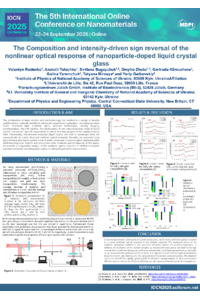
IOCN 2025 YG et al.pdf
Smart Polymeric Nanoparticles: Influence of Functional Groups on Their Structural Behavior Under Specific Physical and Chemical Stimuli
Preparation and Thermodynamic Characterization of Nanoliposomes for Cosmeceutical Applications