Event submissions
Published
This submission belongs to the session S6. Synthesis, Characterization, and Properties of Nanomaterials of the event The 5th International Online Conference on Nanomaterials
Published date
19 Sep, 2025
Academic Editor
'%3e%3cpath%20d='M12.6657%2010.9104C12.4185%2010.325%2012.0599%209.79327%2011.6097%209.34482C11.1609%208.89508%2010.6293%208.5365%2010.0442%208.28888C10.0389%208.28626%2010.0337%208.28495%2010.0285%208.28233C10.8446%207.69279%2011.3752%206.73249%2011.3752%205.64904C11.3752%203.8542%209.92103%202.39999%208.1262%202.39999C6.33136%202.39999%204.87715%203.8542%204.87715%205.64904C4.87715%206.73249%205.40774%207.69279%206.22393%208.28364C6.21869%208.28626%206.21345%208.28757%206.20821%208.29019C5.62129%208.5378%205.09463%208.89284%204.64265%209.34613C4.1929%209.79493%203.83432%2010.3266%203.58671%2010.9117C3.34345%2011.4845%203.21226%2012.0987%203.20023%2012.7209C3.19988%2012.7349%203.20233%2012.7488%203.20744%2012.7619C3.21255%2012.7749%203.22022%2012.7867%203.22998%2012.7968C3.23975%2012.8068%203.25142%2012.8147%203.26431%2012.8202C3.2772%2012.8256%203.29105%2012.8284%203.30504%2012.8284H4.09109C4.14874%2012.8284%204.19459%2012.7825%204.1959%2012.7262C4.2221%2011.7148%204.62823%2010.7676%205.34617%2010.0497C6.08899%209.30683%207.0755%208.89808%208.1262%208.89808C9.17689%208.89808%2010.1634%209.30683%2010.9062%2010.0497C11.6242%2010.7676%2012.0303%2011.7148%2012.0565%2012.7262C12.0578%2012.7838%2012.1037%2012.8284%2012.1613%2012.8284H12.9474C12.9613%2012.8284%2012.9752%2012.8256%2012.9881%2012.8202C13.001%2012.8147%2013.0126%2012.8068%2013.0224%2012.7968C13.0322%2012.7867%2013.0398%2012.7749%2013.0449%2012.7619C13.0501%2012.7488%2013.0525%2012.7349%2013.0522%2012.7209C13.0391%2012.0947%2012.9094%2011.4855%2012.6657%2010.9104ZM8.1262%207.9024C7.52486%207.9024%206.9589%207.6679%206.53312%207.24211C6.10733%206.81633%205.87283%206.25037%205.87283%205.64904C5.87283%205.0477%206.10733%204.48174%206.53312%204.05596C6.9589%203.63018%207.52486%203.39567%208.1262%203.39567C8.72753%203.39567%209.29349%203.63018%209.71927%204.05596C10.1451%204.48174%2010.3796%205.0477%2010.3796%205.64904C10.3796%206.25037%2010.1451%206.81633%209.71927%207.24211C9.29349%207.6679%208.72753%207.9024%208.1262%207.9024Z'%20fill='%235D1EE1'/%3e%3c/g%3e%3c/svg%3e) José Luis Arias Mediano
José Luis Arias MedianoCitation
Daniel Carteño, Monica Corea, Jose Manuel del Rio, Preparation and Thermodynamic Characterization of Nanoliposomes for Cosmeceutical Applications, in Proceedings of The 5th International Online Conference on Nanomaterials, 22 September–24 September 2025, MDPI: Basel, Switzerland
Share
Email
Facebook
Twitter
LinkedIn
Preparation and Thermodynamic Characterization of Nanoliposomes for Cosmeceutical Applications
'%3e%3cpath%20d='M12.6647%2010.9104C12.4176%2010.325%2012.0589%209.7933%2011.6088%209.34485C11.16%208.89511%2010.6283%208.53653%2010.0432%208.28891C10.038%208.28629%2010.0327%208.28498%2010.0275%208.28236C10.8437%207.69282%2011.3743%206.73252%2011.3743%205.64907C11.3743%203.85423%209.92005%202.40002%208.12522%202.40002C6.33038%202.40002%204.87618%203.85423%204.87618%205.64907C4.87618%206.73252%205.40677%207.69282%206.22296%208.28367C6.21772%208.28629%206.21248%208.2876%206.20724%208.29022C5.62031%208.53783%205.09365%208.89287%204.64167%209.34616C4.19192%209.79496%203.83334%2010.3266%203.58573%2010.9117C3.34247%2011.4846%203.21128%2012.0987%203.19925%2012.721C3.1989%2012.735%203.20135%2012.7489%203.20646%2012.7619C3.21157%2012.7749%203.21924%2012.7868%203.22901%2012.7968C3.23877%2012.8068%203.25045%2012.8148%203.26334%2012.8202C3.27623%2012.8256%203.29007%2012.8284%203.30406%2012.8284H4.09012C4.14776%2012.8284%204.19362%2012.7825%204.19493%2012.7262C4.22113%2011.7148%204.62726%2010.7676%205.34519%2010.0497C6.08802%209.30686%207.07452%208.89811%208.12522%208.89811C9.17592%208.89811%2010.1624%209.30686%2010.9052%2010.0497C11.6232%2010.7676%2012.0293%2011.7148%2012.0555%2012.7262C12.0568%2012.7839%2012.1027%2012.8284%2012.1603%2012.8284H12.9464C12.9604%2012.8284%2012.9742%2012.8256%2012.9871%2012.8202C13%2012.8148%2013.0117%2012.8068%2013.0214%2012.7968C13.0312%2012.7868%2013.0389%2012.7749%2013.044%2012.7619C13.0491%2012.7489%2013.0515%2012.735%2013.0512%2012.721C13.0381%2012.0947%2012.9084%2011.4856%2012.6647%2010.9104ZM8.12522%207.90243C7.52388%207.90243%206.95792%207.66793%206.53214%207.24215C6.10636%206.81636%205.87185%206.2504%205.87185%205.64907C5.87185%205.04773%206.10636%204.48177%206.53214%204.05599C6.95792%203.63021%207.52388%203.3957%208.12522%203.3957C8.72655%203.3957%209.29252%203.63021%209.7183%204.05599C10.1441%204.48177%2010.3786%205.04773%2010.3786%205.64907C10.3786%206.2504%2010.1441%206.81636%209.7183%207.24215C9.29252%207.66793%208.72655%207.90243%208.12522%207.90243Z'%20fill='%235D1EE1'/%3e%3c/g%3e%3c/svg%3e)
Daniel Carteño 1
Monica Corea 1
Jose Manuel del Rio 2
1. School of Chemical Engineering and Extractive Industries, ESIQIE, National Polytechnic Institute, Adolfo López Mateos Professional Unit, Zacatenco, Mexico City 07738, Mexico
2. School of Physics and Mathematics, ESFM, National Polytechnic Institute, Adolfo López Mateos Professional Unit, Zacatenco, Mexico City 07738, Mexico
Abstract
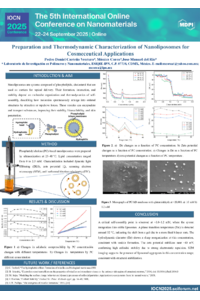
Nanoliposomes are systems composed of phospholipids or cholesterol that are used as carriers for topical delivery. Their formation, interaction, and stability depend on molecular organization and thermodynamics of self-assembly, describing how molecules spontaneously arrange into ordered structures by attractive or repulsive forces. These vesicles can encapsulate and transport substances, improving their stability, bioavailability, and skin penetration.
In this research, phosphatidylcholine (PC)-based nanoliposomes were prepared by ultrasonication at 25–40 °C. Lipid concentration ranged from 0.3 to 2.5 mM. Characterization included dynamic light scattering (DLS), zeta potential (ζ), scanning electron microscopy (SEM), and isothermal titration calorimetry (ITC). Thermodynamic parameters such as Gibbs free energy (ΔG°), enthalpy (ΔH°), and entropy (ΔS°) were determined using the following:
ΔG=−RTlnK
where R is the universal gas constant, T the absolute temperature, and K the equilibrium constant for lipid–lipid or lipid–additive interactions.
To describe micellization-related behavior, critical micelle concentration (CMC) and standard Gibbs energy of micellization were also considered using the following:
ΔGmic=RTln(CMC)
According to the results, the most stable systems were found in a concentration range of 1.0 to1.2 mM, showing z values of -42.7 0.5 mV. This indicates a high stability. DLS measurements reported particle sizes between 115 and 135 nm with 1.1PDI. SEM images show spherical and homogeneous morphologies of liposomes, suggesting an efficient lipid packing and self-assembly. On the other hand, ITC experiments revealed exothermic binding profiles during formation. Thermodynamic analysis yielded negative values for enthalpy change (∆H° = -15 KJ/mol) at 25 ºC and 30 °C due to strong van der Waals and hydrophobic interactions. Nevertheless, positive values of ∆H° = 15 KJ/mol were obtained at 35 ºC and 40 °C attributed to a highly disordered structure. This indicates a reduced enthalpic contribution due to increased membrane fluidity. In summary, nanoliposomes could have a high potential to be used as nanocarriers in the cosmetic area.
Keywords
Nanoliposomes
thermodynamics
curcumin
phosphatidylcholine
cosmeceutical delivery
self-assembly
zeta potential
ITC
Poster
IOCN 2025 Poster Template.pdf
The Composition and intensity-driven sign reversal of the nonlinear optical response of nanoparticle-doped liquid crystal glass
Modulation of Absorption and Gain in a Hybrid Semiconductor Quantum Dot‒Metal Nano-Spheroid System: The Impact of Structural Parameters