Event submissions
Published
This submission belongs to the session S1. Nanomedicine and Bionanotechnology of the event The 5th International Online Conference on Nanomaterials
Published date
19 Sep, 2025
Academic Editor
'%3e%3cpath%20d='M12.6657%2010.9104C12.4185%2010.325%2012.0599%209.79327%2011.6097%209.34482C11.1609%208.89508%2010.6293%208.5365%2010.0442%208.28888C10.0389%208.28626%2010.0337%208.28495%2010.0285%208.28233C10.8446%207.69279%2011.3752%206.73249%2011.3752%205.64904C11.3752%203.8542%209.92103%202.39999%208.1262%202.39999C6.33136%202.39999%204.87715%203.8542%204.87715%205.64904C4.87715%206.73249%205.40774%207.69279%206.22393%208.28364C6.21869%208.28626%206.21345%208.28757%206.20821%208.29019C5.62129%208.5378%205.09463%208.89284%204.64265%209.34613C4.1929%209.79493%203.83432%2010.3266%203.58671%2010.9117C3.34345%2011.4845%203.21226%2012.0987%203.20023%2012.7209C3.19988%2012.7349%203.20233%2012.7488%203.20744%2012.7619C3.21255%2012.7749%203.22022%2012.7867%203.22998%2012.7968C3.23975%2012.8068%203.25142%2012.8147%203.26431%2012.8202C3.2772%2012.8256%203.29105%2012.8284%203.30504%2012.8284H4.09109C4.14874%2012.8284%204.19459%2012.7825%204.1959%2012.7262C4.2221%2011.7148%204.62823%2010.7676%205.34617%2010.0497C6.08899%209.30683%207.0755%208.89808%208.1262%208.89808C9.17689%208.89808%2010.1634%209.30683%2010.9062%2010.0497C11.6242%2010.7676%2012.0303%2011.7148%2012.0565%2012.7262C12.0578%2012.7838%2012.1037%2012.8284%2012.1613%2012.8284H12.9474C12.9613%2012.8284%2012.9752%2012.8256%2012.9881%2012.8202C13.001%2012.8147%2013.0126%2012.8068%2013.0224%2012.7968C13.0322%2012.7867%2013.0398%2012.7749%2013.0449%2012.7619C13.0501%2012.7488%2013.0525%2012.7349%2013.0522%2012.7209C13.0391%2012.0947%2012.9094%2011.4855%2012.6657%2010.9104ZM8.1262%207.9024C7.52486%207.9024%206.9589%207.6679%206.53312%207.24211C6.10733%206.81633%205.87283%206.25037%205.87283%205.64904C5.87283%205.0477%206.10733%204.48174%206.53312%204.05596C6.9589%203.63018%207.52486%203.39567%208.1262%203.39567C8.72753%203.39567%209.29349%203.63018%209.71927%204.05596C10.1451%204.48174%2010.3796%205.0477%2010.3796%205.64904C10.3796%206.25037%2010.1451%206.81633%209.71927%207.24211C9.29349%207.6679%208.72753%207.9024%208.1262%207.9024Z'%20fill='%235D1EE1'/%3e%3c/g%3e%3c/svg%3e) Maria Pilar Vinardell
Maria Pilar VinardellCitation
Sergio Ibáñez Losantos, Jusdin Ruiz Umaña, Javier Goicoechea Fernandez, Ana Isabel Ares Pernas, Pedro José Rivero Fuente, Natural Polymeric (Polylactic Acid (PLA) and Lignin) Membranes manufactured by Casting Solution and Electrospinning with Antimicrobial Applications, in Proceedings of The 5th International Online Conference on Nanomaterials, 22 September–24 September 2025, MDPI: Basel, Switzerland
Share
Email
Facebook
Twitter
LinkedIn
Natural Polymeric (Polylactic Acid (PLA) and Lignin) Membranes manufactured by Casting Solution and Electrospinning with Antimicrobial Applications

Sergio Ibáñez Losantos 1
'%3e%3cpath%20d='M12.6647%2010.9104C12.4176%2010.325%2012.0589%209.7933%2011.6088%209.34485C11.16%208.89511%2010.6283%208.53653%2010.0432%208.28891C10.038%208.28629%2010.0327%208.28498%2010.0275%208.28236C10.8437%207.69282%2011.3743%206.73252%2011.3743%205.64907C11.3743%203.85423%209.92005%202.40002%208.12522%202.40002C6.33038%202.40002%204.87618%203.85423%204.87618%205.64907C4.87618%206.73252%205.40677%207.69282%206.22296%208.28367C6.21772%208.28629%206.21248%208.2876%206.20724%208.29022C5.62031%208.53783%205.09365%208.89287%204.64167%209.34616C4.19192%209.79496%203.83334%2010.3266%203.58573%2010.9117C3.34247%2011.4846%203.21128%2012.0987%203.19925%2012.721C3.1989%2012.735%203.20135%2012.7489%203.20646%2012.7619C3.21157%2012.7749%203.21924%2012.7868%203.22901%2012.7968C3.23877%2012.8068%203.25045%2012.8148%203.26334%2012.8202C3.27623%2012.8256%203.29007%2012.8284%203.30406%2012.8284H4.09012C4.14776%2012.8284%204.19362%2012.7825%204.19493%2012.7262C4.22113%2011.7148%204.62726%2010.7676%205.34519%2010.0497C6.08802%209.30686%207.07452%208.89811%208.12522%208.89811C9.17592%208.89811%2010.1624%209.30686%2010.9052%2010.0497C11.6232%2010.7676%2012.0293%2011.7148%2012.0555%2012.7262C12.0568%2012.7839%2012.1027%2012.8284%2012.1603%2012.8284H12.9464C12.9604%2012.8284%2012.9742%2012.8256%2012.9871%2012.8202C13%2012.8148%2013.0117%2012.8068%2013.0214%2012.7968C13.0312%2012.7868%2013.0389%2012.7749%2013.044%2012.7619C13.0491%2012.7489%2013.0515%2012.735%2013.0512%2012.721C13.0381%2012.0947%2012.9084%2011.4856%2012.6647%2010.9104ZM8.12522%207.90243C7.52388%207.90243%206.95792%207.66793%206.53214%207.24215C6.10636%206.81636%205.87185%206.2504%205.87185%205.64907C5.87185%205.04773%206.10636%204.48177%206.53214%204.05599C6.95792%203.63021%207.52388%203.3957%208.12522%203.3957C8.72655%203.3957%209.29252%203.63021%209.7183%204.05599C10.1441%204.48177%2010.3786%205.04773%2010.3786%205.64907C10.3786%206.2504%2010.1441%206.81636%209.7183%207.24215C9.29252%207.66793%208.72655%207.90243%208.12522%207.90243Z'%20fill='%235D1EE1'/%3e%3c/g%3e%3c/svg%3e)
Jusdin Ruiz Umaña 2

Javier Goicoechea Fernandez 1
Ana Isabel Ares Pernas 3

Pedro José Rivero Fuente 1
1. Department of engineering, Arrosadia's Campus, Navarre's Public University (UPNA) (Avenue: Cataluña's Avenue, S/N), Pamplona, Navarre, 31006, Spain
2. Department of agronomy, biotechnology, and food, Arrosadia's Campus, Navarre's Public University (UPNA) (Avenue: Cataluña's Avenue, S/N) , Pamplona, Navarre, 31006, Spain
3. Department of Physic and Earth's Science, Coruña's Campus, Coruña's University (UDC), A coruña, Coruña, 15008, Spain
Abstract
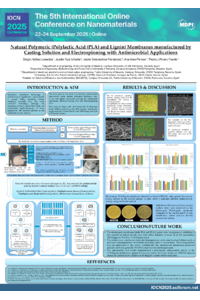
In this study, optimized natural polymeric membranes were developed using two advanced manufacturing methods: solution casting and electrospinning. Both processes required exhaustive optimization to minimize visual and microscopic defects. The natural polymers used were polylactic acid (PLA) and (PLA+ lignin (9 %wt)), while acetone and dichloromethane were the solvents.
Next, the membranes were characterized using several surface analysis techniques. A confocal microscope and scanning electron microscopy (SEM) were employed to examine surface morphology (the diameter of the fibers was between 1.6 for PLA and up to 2.2 micrometers for the PLA+Lignin (9 %wt) fibers (27-35% standard deviation in both situations). Contact angle measurements were taken to assess wettability (between 90-100° for PLA and up to 140-150° for PLA+Lignin (9 %wt)), and UV-Vis spectroscopy was used to evaluate the optical transparency (the PLA+Lignin fiber membranes (9 %wt) were between 70 and 80% less transparent than the PLA fiber membranes).
The main objective of this study was to explore potential industrial applications. Due to the known antimicrobial properties of certain functional groups present in lignin, the membranes were subjected to antimicrobial testing. Two evaluation methods were employed, the Kirby–Bauer disk diffusion method and the direct contact method, following standardized protocols ASTM E2149, JIS Z 2801, and ISO 22196. Four bacterial strains were used: Staphylococcus aureus (Gram-positive), Escherichia coli (Gram-negative), Staphylococcus epidermidis (Gram-positive), and Micrococcus luteus (Gram-positive).
The results revealed notable antimicrobial activity, particularly against Micrococcus Luteus with electrospinning (PLA+Lignin (9 %wt)) membranes with direct contact, suggesting that these membranes could be promising candidates for biomedical applications.
This study demonstrates a sustainable strategy for fabricating nanostructured membranes with inherent antimicrobial properties, paving the way for future biomedical and packaging applications.
Keywords
Membranes
Casting Solution
Electrospinning
Antimicrobial
Poster
sciforum-134017.pdf
Modulation of Absorption and Gain in a Hybrid Semiconductor Quantum Dot‒Metal Nano-Spheroid System: The Impact of Structural Parameters
Characterization of siderophores produced by the genus Glutamicibacter sp.