Event submissions
Published
This submission belongs to the session S6. Synthesis, Characterization, and Properties of Nanomaterials of the event The 5th International Online Conference on Nanomaterials
Published date
19 Sep, 2025
Academic Editor
'%3e%3cpath%20d='M12.6657%2010.9104C12.4185%2010.325%2012.0599%209.79327%2011.6097%209.34482C11.1609%208.89508%2010.6293%208.5365%2010.0442%208.28888C10.0389%208.28626%2010.0337%208.28495%2010.0285%208.28233C10.8446%207.69279%2011.3752%206.73249%2011.3752%205.64904C11.3752%203.8542%209.92103%202.39999%208.1262%202.39999C6.33136%202.39999%204.87715%203.8542%204.87715%205.64904C4.87715%206.73249%205.40774%207.69279%206.22393%208.28364C6.21869%208.28626%206.21345%208.28757%206.20821%208.29019C5.62129%208.5378%205.09463%208.89284%204.64265%209.34613C4.1929%209.79493%203.83432%2010.3266%203.58671%2010.9117C3.34345%2011.4845%203.21226%2012.0987%203.20023%2012.7209C3.19988%2012.7349%203.20233%2012.7488%203.20744%2012.7619C3.21255%2012.7749%203.22022%2012.7867%203.22998%2012.7968C3.23975%2012.8068%203.25142%2012.8147%203.26431%2012.8202C3.2772%2012.8256%203.29105%2012.8284%203.30504%2012.8284H4.09109C4.14874%2012.8284%204.19459%2012.7825%204.1959%2012.7262C4.2221%2011.7148%204.62823%2010.7676%205.34617%2010.0497C6.08899%209.30683%207.0755%208.89808%208.1262%208.89808C9.17689%208.89808%2010.1634%209.30683%2010.9062%2010.0497C11.6242%2010.7676%2012.0303%2011.7148%2012.0565%2012.7262C12.0578%2012.7838%2012.1037%2012.8284%2012.1613%2012.8284H12.9474C12.9613%2012.8284%2012.9752%2012.8256%2012.9881%2012.8202C13.001%2012.8147%2013.0126%2012.8068%2013.0224%2012.7968C13.0322%2012.7867%2013.0398%2012.7749%2013.0449%2012.7619C13.0501%2012.7488%2013.0525%2012.7349%2013.0522%2012.7209C13.0391%2012.0947%2012.9094%2011.4855%2012.6657%2010.9104ZM8.1262%207.9024C7.52486%207.9024%206.9589%207.6679%206.53312%207.24211C6.10733%206.81633%205.87283%206.25037%205.87283%205.64904C5.87283%205.0477%206.10733%204.48174%206.53312%204.05596C6.9589%203.63018%207.52486%203.39567%208.1262%203.39567C8.72753%203.39567%209.29349%203.63018%209.71927%204.05596C10.1451%204.48174%2010.3796%205.0477%2010.3796%205.64904C10.3796%206.25037%2010.1451%206.81633%209.71927%207.24211C9.29349%207.6679%208.72753%207.9024%208.1262%207.9024Z'%20fill='%235D1EE1'/%3e%3c/g%3e%3c/svg%3e) José Luis Arias Mediano
José Luis Arias MedianoCitation
Gabriela Martínez Mejía, Ángel Jesús Martínez Arreola, Rubén Caro Briones, Lazaro Ruiz Virgen, Mónica de la Luz Corea Téllez, Belén Chávez Ramírez, Characterization of siderophores produced by the genus Glutamicibacter sp., in Proceedings of The 5th International Online Conference on Nanomaterials, 22 September–24 September 2025, MDPI: Basel, Switzerland
Share
Email
Facebook
Twitter
LinkedIn
Characterization of siderophores produced by the genus Glutamicibacter sp.
'%3e%3cpath%20d='M12.6647%2010.9104C12.4176%2010.325%2012.0589%209.7933%2011.6088%209.34485C11.16%208.89511%2010.6283%208.53653%2010.0432%208.28891C10.038%208.28629%2010.0327%208.28498%2010.0275%208.28236C10.8437%207.69282%2011.3743%206.73252%2011.3743%205.64907C11.3743%203.85423%209.92005%202.40002%208.12522%202.40002C6.33038%202.40002%204.87618%203.85423%204.87618%205.64907C4.87618%206.73252%205.40677%207.69282%206.22296%208.28367C6.21772%208.28629%206.21248%208.2876%206.20724%208.29022C5.62031%208.53783%205.09365%208.89287%204.64167%209.34616C4.19192%209.79496%203.83334%2010.3266%203.58573%2010.9117C3.34247%2011.4846%203.21128%2012.0987%203.19925%2012.721C3.1989%2012.735%203.20135%2012.7489%203.20646%2012.7619C3.21157%2012.7749%203.21924%2012.7868%203.22901%2012.7968C3.23877%2012.8068%203.25045%2012.8148%203.26334%2012.8202C3.27623%2012.8256%203.29007%2012.8284%203.30406%2012.8284H4.09012C4.14776%2012.8284%204.19362%2012.7825%204.19493%2012.7262C4.22113%2011.7148%204.62726%2010.7676%205.34519%2010.0497C6.08802%209.30686%207.07452%208.89811%208.12522%208.89811C9.17592%208.89811%2010.1624%209.30686%2010.9052%2010.0497C11.6232%2010.7676%2012.0293%2011.7148%2012.0555%2012.7262C12.0568%2012.7839%2012.1027%2012.8284%2012.1603%2012.8284H12.9464C12.9604%2012.8284%2012.9742%2012.8256%2012.9871%2012.8202C13%2012.8148%2013.0117%2012.8068%2013.0214%2012.7968C13.0312%2012.7868%2013.0389%2012.7749%2013.044%2012.7619C13.0491%2012.7489%2013.0515%2012.735%2013.0512%2012.721C13.0381%2012.0947%2012.9084%2011.4856%2012.6647%2010.9104ZM8.12522%207.90243C7.52388%207.90243%206.95792%207.66793%206.53214%207.24215C6.10636%206.81636%205.87185%206.2504%205.87185%205.64907C5.87185%205.04773%206.10636%204.48177%206.53214%204.05599C6.95792%203.63021%207.52388%203.3957%208.12522%203.3957C8.72655%203.3957%209.29252%203.63021%209.7183%204.05599C10.1441%204.48177%2010.3786%205.04773%2010.3786%205.64907C10.3786%206.2504%2010.1441%206.81636%209.7183%207.24215C9.29252%207.66793%208.72655%207.90243%208.12522%207.90243Z'%20fill='%235D1EE1'/%3e%3c/g%3e%3c/svg%3e)
Gabriela Martínez Mejía 1
Ángel Jesús Martínez Arreola 1

Rubén Caro Briones 1

Lazaro Ruiz Virgen 1
Mónica de la Luz Corea Téllez 1
Belén Chávez Ramírez 2
1. Polymers and Nanomaterials Laboratory, ESIQIE, National Polytechnic Institute IPN, Mexico City 07738, Mexico
2. Plant Pathology Laboratory, ENCB, National Polytechnic Institute IPN, Mexico City 06220, Mexico
Abstract
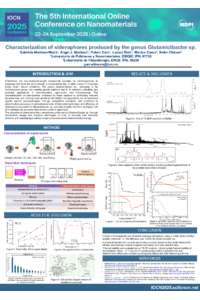
Siderophores are low molecular weight compounds synthesized by bacteria, fungi, and plants under iron-deficient conditions (<1×10⁻⁶ M), often featuring functional groups like C=O, C=C, and C=N, which confer fluorescence, while hydroxyl groups (-OH) facilitate metal chelation, particularly with Fe³⁺ ions (Hider et al., 2010). In this research work, a siderophore belonging to a novel species of the genus Glutamicibacter sp. strain AlTeq-24-F2 was studied. The compound was purified using column chromatography and analyzed through a combination of spectroscopic and physicochemical techniques: FT-IR, UV-Vis, spectrofluorometry, ESI-MS, TGA, electrophoresis, and NMR spectroscopy (¹H, ¹³C, and HSQC). FT-IR spectra indicated the presence of OH, CH₂, CH₃, and C=O groups. Spectrofluorometry revealed strong fluorescence at 305 nm upon excitation at 230 nm, which diminished and shifted to 458 nm upon Fe³⁺ titration. UV/Vis spectroscopy showed bathochromic and hyperchromic shifts after metal complexation. TGA demonstrated high thermal stability. Zeta potential measurements confirmed a surface charge reversal (from negative to positive) after Fe³⁺ addition. NMR and ESI-MS data allowed the proposal of a tentative chemical structure based on fragment analysis and mass-to-charge correlations. The siderophore from Glutamicibacter sp. AlTeq-24-F2 exhibits promising physicochemical properties, especially its fluorescence and metal-binding capacity. These features suggest its potential for applications in metal sensing or bioremediation.
Keywords
Siderophores
Glutamicibacter sp.
Biomaterials
Poster
sciforum-133623.pdf
Natural Polymeric (Polylactic Acid (PLA) and Lignin) Membranes manufactured by Casting Solution and Electrospinning with Antimicrobial Applications
Functionalization of graphene oxide as a drug nanocarrier for anticancer therapy