Event submissions
Published
This submission belongs to the session S6. Synthesis, Characterization, and Properties of Nanomaterials of the event The 5th International Online Conference on Nanomaterials
Published date
19 Sep, 2025
Academic Editor
'%3e%3cpath%20d='M12.6657%2010.9104C12.4185%2010.325%2012.0599%209.79327%2011.6097%209.34482C11.1609%208.89508%2010.6293%208.5365%2010.0442%208.28888C10.0389%208.28626%2010.0337%208.28495%2010.0285%208.28233C10.8446%207.69279%2011.3752%206.73249%2011.3752%205.64904C11.3752%203.8542%209.92103%202.39999%208.1262%202.39999C6.33136%202.39999%204.87715%203.8542%204.87715%205.64904C4.87715%206.73249%205.40774%207.69279%206.22393%208.28364C6.21869%208.28626%206.21345%208.28757%206.20821%208.29019C5.62129%208.5378%205.09463%208.89284%204.64265%209.34613C4.1929%209.79493%203.83432%2010.3266%203.58671%2010.9117C3.34345%2011.4845%203.21226%2012.0987%203.20023%2012.7209C3.19988%2012.7349%203.20233%2012.7488%203.20744%2012.7619C3.21255%2012.7749%203.22022%2012.7867%203.22998%2012.7968C3.23975%2012.8068%203.25142%2012.8147%203.26431%2012.8202C3.2772%2012.8256%203.29105%2012.8284%203.30504%2012.8284H4.09109C4.14874%2012.8284%204.19459%2012.7825%204.1959%2012.7262C4.2221%2011.7148%204.62823%2010.7676%205.34617%2010.0497C6.08899%209.30683%207.0755%208.89808%208.1262%208.89808C9.17689%208.89808%2010.1634%209.30683%2010.9062%2010.0497C11.6242%2010.7676%2012.0303%2011.7148%2012.0565%2012.7262C12.0578%2012.7838%2012.1037%2012.8284%2012.1613%2012.8284H12.9474C12.9613%2012.8284%2012.9752%2012.8256%2012.9881%2012.8202C13.001%2012.8147%2013.0126%2012.8068%2013.0224%2012.7968C13.0322%2012.7867%2013.0398%2012.7749%2013.0449%2012.7619C13.0501%2012.7488%2013.0525%2012.7349%2013.0522%2012.7209C13.0391%2012.0947%2012.9094%2011.4855%2012.6657%2010.9104ZM8.1262%207.9024C7.52486%207.9024%206.9589%207.6679%206.53312%207.24211C6.10733%206.81633%205.87283%206.25037%205.87283%205.64904C5.87283%205.0477%206.10733%204.48174%206.53312%204.05596C6.9589%203.63018%207.52486%203.39567%208.1262%203.39567C8.72753%203.39567%209.29349%203.63018%209.71927%204.05596C10.1451%204.48174%2010.3796%205.0477%2010.3796%205.64904C10.3796%206.25037%2010.1451%206.81633%209.71927%207.24211C9.29349%207.6679%208.72753%207.9024%208.1262%207.9024Z'%20fill='%235D1EE1'/%3e%3c/g%3e%3c/svg%3e) José Luis Arias Mediano
José Luis Arias MedianoCitation
Harim Galilea Díaz Corte, Gabriela Martínez Mejía, Lazaro Ruiz Virgen, Rubén Caro Briones, José Manuel del Río García, Mónica de la Luz Corea Téllez, Synthesis and characterization of alginic acid scaffolds with possible tissue regeneration applications, in Proceedings of The 5th International Online Conference on Nanomaterials, 22 September–24 September 2025, MDPI: Basel, Switzerland
Share
Email
Facebook
Twitter
LinkedIn
Synthesis and characterization of alginic acid scaffolds with possible tissue regeneration applications
'%3e%3cpath%20d='M12.6647%2010.9104C12.4176%2010.325%2012.0589%209.7933%2011.6088%209.34485C11.16%208.89511%2010.6283%208.53653%2010.0432%208.28891C10.038%208.28629%2010.0327%208.28498%2010.0275%208.28236C10.8437%207.69282%2011.3743%206.73252%2011.3743%205.64907C11.3743%203.85423%209.92005%202.40002%208.12522%202.40002C6.33038%202.40002%204.87618%203.85423%204.87618%205.64907C4.87618%206.73252%205.40677%207.69282%206.22296%208.28367C6.21772%208.28629%206.21248%208.2876%206.20724%208.29022C5.62031%208.53783%205.09365%208.89287%204.64167%209.34616C4.19192%209.79496%203.83334%2010.3266%203.58573%2010.9117C3.34247%2011.4846%203.21128%2012.0987%203.19925%2012.721C3.1989%2012.735%203.20135%2012.7489%203.20646%2012.7619C3.21157%2012.7749%203.21924%2012.7868%203.22901%2012.7968C3.23877%2012.8068%203.25045%2012.8148%203.26334%2012.8202C3.27623%2012.8256%203.29007%2012.8284%203.30406%2012.8284H4.09012C4.14776%2012.8284%204.19362%2012.7825%204.19493%2012.7262C4.22113%2011.7148%204.62726%2010.7676%205.34519%2010.0497C6.08802%209.30686%207.07452%208.89811%208.12522%208.89811C9.17592%208.89811%2010.1624%209.30686%2010.9052%2010.0497C11.6232%2010.7676%2012.0293%2011.7148%2012.0555%2012.7262C12.0568%2012.7839%2012.1027%2012.8284%2012.1603%2012.8284H12.9464C12.9604%2012.8284%2012.9742%2012.8256%2012.9871%2012.8202C13%2012.8148%2013.0117%2012.8068%2013.0214%2012.7968C13.0312%2012.7868%2013.0389%2012.7749%2013.044%2012.7619C13.0491%2012.7489%2013.0515%2012.735%2013.0512%2012.721C13.0381%2012.0947%2012.9084%2011.4856%2012.6647%2010.9104ZM8.12522%207.90243C7.52388%207.90243%206.95792%207.66793%206.53214%207.24215C6.10636%206.81636%205.87185%206.2504%205.87185%205.64907C5.87185%205.04773%206.10636%204.48177%206.53214%204.05599C6.95792%203.63021%207.52388%203.3957%208.12522%203.3957C8.72655%203.3957%209.29252%203.63021%209.7183%204.05599C10.1441%204.48177%2010.3786%205.04773%2010.3786%205.64907C10.3786%206.2504%2010.1441%206.81636%209.7183%207.24215C9.29252%207.66793%208.72655%207.90243%208.12522%207.90243Z'%20fill='%235D1EE1'/%3e%3c/g%3e%3c/svg%3e)
Harim Galilea Díaz Corte 1

Gabriela Martínez Mejía 2

Lazaro Ruiz Virgen 2
Rubén Caro Briones 2
José Manuel del Río García 3
Mónica de la Luz Corea Téllez 2
1. Interdisciplinary Professional Unit of Biotechnology, UPIBI, National Polytechnic Institute, Mexico City 07738, Mexico
2. School of Chemical Engineering and Extractive Industries, ESIQIE, Polymer and Nanomaterials Research Laboratory, National Polytechnic Institute, Mexico City 07700, Mexico
3. School of Physics and Mathematics, ESFM, National Polytechnic Institute, Mexico City 07738, Mexico
Abstract
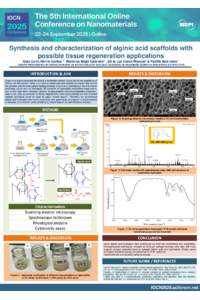
Hydrogels are 3D networks of hydrophilic crosslinked polymers that are obtained from synthetic or natural sources. Previous works have described these materials as having high water retention capacity, biodegradability and biocompatibility. These characteristics allow hydrogels to be used as scaffolds for tissue regeneration.
In this work, three series of alginic acid hydrogels were synthesized using different chemical crosslinker agents, piperazine, spermidine and 1,4-diaminobutane, with concentrations varying between 5 wt.% and 100 wt.%. The syntheses were carried out in a temperature range of 22≤T/ºC≤ 27 and a constant stirring speed. Gels were characterized using scanning electron microscopy (SEM). According to Matos et al (2021) and Ştefan Ţălu’s (2022), it is widely known that SEM analysis provides a relevant morphological map of the surface area, texture and pore size of hydrogels. Another test included infrared spectroscopy (FT-IR), mass spectrometry and rheological analysis (viscosity η), as well as biocompatibility tests with fibroblast cultures at 37 oC. All experimental sets were performed in triplicate.
According to the results, SEM analysis revealed that 1, 4- diaminobutane gels have a pore size of 1 µm to 3 µm, while spermidine and piperazine exhibit values from 1µm to 13 µm and, 1µm to 14 µm, respectively. The pore size range is determined by the molecular structure of the crosslinker agent. This means that spermidine and piperazine gels result in wider pores than 1,4- diaminobutane hydrogels. On the other hand, tests showed that cells did not adhere to the surface of the gels. However, the formulation of each materials has been modified for better adhesion viability. All hydrogels absorb large amounts of solvent in aqueous conditions. However, in saline solutions,piperazine gels dissolve, while 1,4- diaminobutane and spermidine hydrogels tend to fragment. The results obtained suggest that alginic acid hydrogels have a high viability to be applied for tissue regeneration treatments.
Keywords
Hydrogels
tissue engineering
cell regeneration
alginic acid
Poster
IOCN 2025 Poster final.pdf
Functionalization of graphene oxide as a drug nanocarrier for anticancer therapy
Freeze-dried chitosan scaffolds incorporating polyvinylpyrrolidone/polyvinyl alcohol/curcumin (CS-PVP/PVA/Cur) and silicon dioxide nanoparticles (NPs-SiO2)