Event submissions
Published
This submission belongs to the session S3. Nanophotonic, Nanoelectronics, Nanosensors and Devices of the event The 5th International Online Conference on Nanomaterials
Published date
19 Sep, 2025
Academic Editor
'%3e%3cpath%20d='M12.6657%2010.9104C12.4185%2010.325%2012.0599%209.79327%2011.6097%209.34482C11.1609%208.89508%2010.6293%208.5365%2010.0442%208.28888C10.0389%208.28626%2010.0337%208.28495%2010.0285%208.28233C10.8446%207.69279%2011.3752%206.73249%2011.3752%205.64904C11.3752%203.8542%209.92103%202.39999%208.1262%202.39999C6.33136%202.39999%204.87715%203.8542%204.87715%205.64904C4.87715%206.73249%205.40774%207.69279%206.22393%208.28364C6.21869%208.28626%206.21345%208.28757%206.20821%208.29019C5.62129%208.5378%205.09463%208.89284%204.64265%209.34613C4.1929%209.79493%203.83432%2010.3266%203.58671%2010.9117C3.34345%2011.4845%203.21226%2012.0987%203.20023%2012.7209C3.19988%2012.7349%203.20233%2012.7488%203.20744%2012.7619C3.21255%2012.7749%203.22022%2012.7867%203.22998%2012.7968C3.23975%2012.8068%203.25142%2012.8147%203.26431%2012.8202C3.2772%2012.8256%203.29105%2012.8284%203.30504%2012.8284H4.09109C4.14874%2012.8284%204.19459%2012.7825%204.1959%2012.7262C4.2221%2011.7148%204.62823%2010.7676%205.34617%2010.0497C6.08899%209.30683%207.0755%208.89808%208.1262%208.89808C9.17689%208.89808%2010.1634%209.30683%2010.9062%2010.0497C11.6242%2010.7676%2012.0303%2011.7148%2012.0565%2012.7262C12.0578%2012.7838%2012.1037%2012.8284%2012.1613%2012.8284H12.9474C12.9613%2012.8284%2012.9752%2012.8256%2012.9881%2012.8202C13.001%2012.8147%2013.0126%2012.8068%2013.0224%2012.7968C13.0322%2012.7867%2013.0398%2012.7749%2013.0449%2012.7619C13.0501%2012.7488%2013.0525%2012.7349%2013.0522%2012.7209C13.0391%2012.0947%2012.9094%2011.4855%2012.6657%2010.9104ZM8.1262%207.9024C7.52486%207.9024%206.9589%207.6679%206.53312%207.24211C6.10733%206.81633%205.87283%206.25037%205.87283%205.64904C5.87283%205.0477%206.10733%204.48174%206.53312%204.05596C6.9589%203.63018%207.52486%203.39567%208.1262%203.39567C8.72753%203.39567%209.29349%203.63018%209.71927%204.05596C10.1451%204.48174%2010.3796%205.0477%2010.3796%205.64904C10.3796%206.25037%2010.1451%206.81633%209.71927%207.24211C9.29349%207.6679%208.72753%207.9024%208.1262%207.9024Z'%20fill='%235D1EE1'/%3e%3c/g%3e%3c/svg%3e) Huanjun Chen
Huanjun ChenCitation
Guzel Ziyatdinova, Voltammetric sensor based on electropolymerized phenol red for the simultaneous quantification of syringaldehyde and vanillin, in Proceedings of The 5th International Online Conference on Nanomaterials, 22 September–24 September 2025, MDPI: Basel, Switzerland
Share
Email
Facebook
Twitter
LinkedIn
Voltammetric sensor based on electropolymerized phenol red for the simultaneous quantification of syringaldehyde and vanillin

Guzel Ziyatdinova 1
1. Analytical Chemistry Department, Kazan Federal University, Kazan, 420008, Russia
Abstract
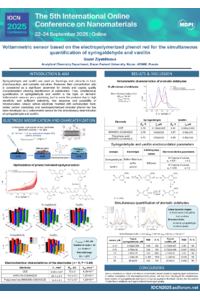
Syringaldehyde and vanillin are used as flavorings and odorants in the food, pharmaceutical, and cosmetic industries. Moreover, their concentration ratio is considered a significant parameter for brandy and cognac quality characterization, allowing for the identification of adulteration. Thus, the simultaneous quantification of syringaldehyde and vanillin is in high demand. Voltammetric sensors are a promising tool to solve this problem due to their high sensitivity, sufficient selectivity, fast response, and possibility of miniaturization. A glassy carbon electrode modified with carboxylated multi-walled carbon nanotubes and electropolymerized indicator phenol red was developed as a voltammetric sensor for the simultaneous determination of syringaldehyde and vanillin. The electropolymerization conditions were optimized using the voltammetric parameters of the syringaldehyde and vanillin mixture. The best resolution of anodic peaks (121 mV) with sufficient currents was obtained for 100 μM phenol red electropolymerized in 0.1 M sodium hydroxide by 10-fold potential cycling from 0.1 to 1.0 V with a scan rate of 75 mV s-1. Polymeric coverage provides an increase in the electroactive surface area of the electrode and a higher heterogeneous electron transfer rate constant vs. bare glassy carbon electrode. The irreversible diffusion-driven electrode reaction with the participation of two electrons and two protons was confirmed for both aldehydes. The linear dynamic ranges of sensor response for both analytes are 0.10-2.5 and 2.5-25 μM, with limits of detection equal to 44 and 33 nM for syringaldehyde and vanillin, respectively.
Keywords
Voltammetry
sensing
electropolymerization
thriphenylmethane compounds
carbon nanomaterials
aromatic compounds
aldehydes
Poster
Poster.pdf
The Consumption of Nanocrystalline Nanocellulose Affects Behavioral Responses in vivo
Thermoresponsive Magnetic Hydrogels for Targeted Doxorubicin Delivery and Magnetic Hyperthermia in Cancer Therapy