Event submissions
Published
This submission belongs to the session S1. Nanomedicine and Bionanotechnology of the event The 5th International Online Conference on Nanomaterials
Published date
19 Sep, 2025
Academic Editor
'%3e%3cpath%20d='M12.6657%2010.9104C12.4185%2010.325%2012.0599%209.79327%2011.6097%209.34482C11.1609%208.89508%2010.6293%208.5365%2010.0442%208.28888C10.0389%208.28626%2010.0337%208.28495%2010.0285%208.28233C10.8446%207.69279%2011.3752%206.73249%2011.3752%205.64904C11.3752%203.8542%209.92103%202.39999%208.1262%202.39999C6.33136%202.39999%204.87715%203.8542%204.87715%205.64904C4.87715%206.73249%205.40774%207.69279%206.22393%208.28364C6.21869%208.28626%206.21345%208.28757%206.20821%208.29019C5.62129%208.5378%205.09463%208.89284%204.64265%209.34613C4.1929%209.79493%203.83432%2010.3266%203.58671%2010.9117C3.34345%2011.4845%203.21226%2012.0987%203.20023%2012.7209C3.19988%2012.7349%203.20233%2012.7488%203.20744%2012.7619C3.21255%2012.7749%203.22022%2012.7867%203.22998%2012.7968C3.23975%2012.8068%203.25142%2012.8147%203.26431%2012.8202C3.2772%2012.8256%203.29105%2012.8284%203.30504%2012.8284H4.09109C4.14874%2012.8284%204.19459%2012.7825%204.1959%2012.7262C4.2221%2011.7148%204.62823%2010.7676%205.34617%2010.0497C6.08899%209.30683%207.0755%208.89808%208.1262%208.89808C9.17689%208.89808%2010.1634%209.30683%2010.9062%2010.0497C11.6242%2010.7676%2012.0303%2011.7148%2012.0565%2012.7262C12.0578%2012.7838%2012.1037%2012.8284%2012.1613%2012.8284H12.9474C12.9613%2012.8284%2012.9752%2012.8256%2012.9881%2012.8202C13.001%2012.8147%2013.0126%2012.8068%2013.0224%2012.7968C13.0322%2012.7867%2013.0398%2012.7749%2013.0449%2012.7619C13.0501%2012.7488%2013.0525%2012.7349%2013.0522%2012.7209C13.0391%2012.0947%2012.9094%2011.4855%2012.6657%2010.9104ZM8.1262%207.9024C7.52486%207.9024%206.9589%207.6679%206.53312%207.24211C6.10733%206.81633%205.87283%206.25037%205.87283%205.64904C5.87283%205.0477%206.10733%204.48174%206.53312%204.05596C6.9589%203.63018%207.52486%203.39567%208.1262%203.39567C8.72753%203.39567%209.29349%203.63018%209.71927%204.05596C10.1451%204.48174%2010.3796%205.0477%2010.3796%205.64904C10.3796%206.25037%2010.1451%206.81633%209.71927%207.24211C9.29349%207.6679%208.72753%207.9024%208.1262%207.9024Z'%20fill='%235D1EE1'/%3e%3c/g%3e%3c/svg%3e) Maria Pilar Vinardell
Maria Pilar VinardellCitation
Luis Osvaldo García Molina, Francisco Javier Enriquez-Medrano, Luis Alfonso García-Cerda, Thermoresponsive Magnetic Hydrogels for Targeted Doxorubicin Delivery and Magnetic Hyperthermia in Cancer Therapy, in Proceedings of The 5th International Online Conference on Nanomaterials, 22 September–24 September 2025, MDPI: Basel, Switzerland
Share
Email
Facebook
Twitter
LinkedIn
Thermoresponsive Magnetic Hydrogels for Targeted Doxorubicin Delivery and Magnetic Hyperthermia in Cancer Therapy
'%3e%3cpath%20d='M12.6647%2010.9104C12.4176%2010.325%2012.0589%209.7933%2011.6088%209.34485C11.16%208.89511%2010.6283%208.53653%2010.0432%208.28891C10.038%208.28629%2010.0327%208.28498%2010.0275%208.28236C10.8437%207.69282%2011.3743%206.73252%2011.3743%205.64907C11.3743%203.85423%209.92005%202.40002%208.12522%202.40002C6.33038%202.40002%204.87618%203.85423%204.87618%205.64907C4.87618%206.73252%205.40677%207.69282%206.22296%208.28367C6.21772%208.28629%206.21248%208.2876%206.20724%208.29022C5.62031%208.53783%205.09365%208.89287%204.64167%209.34616C4.19192%209.79496%203.83334%2010.3266%203.58573%2010.9117C3.34247%2011.4846%203.21128%2012.0987%203.19925%2012.721C3.1989%2012.735%203.20135%2012.7489%203.20646%2012.7619C3.21157%2012.7749%203.21924%2012.7868%203.22901%2012.7968C3.23877%2012.8068%203.25045%2012.8148%203.26334%2012.8202C3.27623%2012.8256%203.29007%2012.8284%203.30406%2012.8284H4.09012C4.14776%2012.8284%204.19362%2012.7825%204.19493%2012.7262C4.22113%2011.7148%204.62726%2010.7676%205.34519%2010.0497C6.08802%209.30686%207.07452%208.89811%208.12522%208.89811C9.17592%208.89811%2010.1624%209.30686%2010.9052%2010.0497C11.6232%2010.7676%2012.0293%2011.7148%2012.0555%2012.7262C12.0568%2012.7839%2012.1027%2012.8284%2012.1603%2012.8284H12.9464C12.9604%2012.8284%2012.9742%2012.8256%2012.9871%2012.8202C13%2012.8148%2013.0117%2012.8068%2013.0214%2012.7968C13.0312%2012.7868%2013.0389%2012.7749%2013.044%2012.7619C13.0491%2012.7489%2013.0515%2012.735%2013.0512%2012.721C13.0381%2012.0947%2012.9084%2011.4856%2012.6647%2010.9104ZM8.12522%207.90243C7.52388%207.90243%206.95792%207.66793%206.53214%207.24215C6.10636%206.81636%205.87185%206.2504%205.87185%205.64907C5.87185%205.04773%206.10636%204.48177%206.53214%204.05599C6.95792%203.63021%207.52388%203.3957%208.12522%203.3957C8.72655%203.3957%209.29252%203.63021%209.7183%204.05599C10.1441%204.48177%2010.3786%205.04773%2010.3786%205.64907C10.3786%206.2504%2010.1441%206.81636%209.7183%207.24215C9.29252%207.66793%208.72655%207.90243%208.12522%207.90243Z'%20fill='%235D1EE1'/%3e%3c/g%3e%3c/svg%3e)
Luis Osvaldo García Molina 1

Francisco Javier Enriquez-Medrano 2
Luis Alfonso García-Cerda 1
1. Department of Advanced Materials, Center for Research in Applied Chemistry, Blvd. Enrique Reyna Hermosillo #140, Saltillo 25294, Mexico
2. Department of Macromolecular Chemistry and Nanomaterials, Center for Research in Applied Chemistry, Blvd. Enrique Reyna Hermosillo #140, Saltillo 25294, Mexico
Abstract
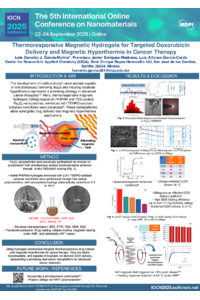
The development of multifunctional nanomaterials capable of simultaneously delivering drugs and inducing localized hyperthermia represents a promising strategy in advanced cancer therapies. In this work, we report the synthesis and characterization of thermoresponsive magnetic hydrogels (GMag) based on poly(N-isopropylacrylamide) (PNIPAM) and superparamagnetic iron oxide nanoparticles (Fe₃O₄) for synergistic chemotherapy and magnetic hyperthermia applications. The superparamagnetic Fe₃O₄ nanoparticles were synthesized via a reverse co-precipitation method, with polyethylene glycol (PEG-8000) incorporated in situ, allowing simultaneous surface modification to improve colloidal stability, dispersion in aqueous media, and biocompatibility. To enhance the mechanical strength and elasticity of the hydrogel matrix, 2.5% (w/w) TEMPO-oxidized cellulose nanofibers (TOCNFs) were incorporated into the formulation. These nanofibers introduced a reinforcing network, improving structural integrity while maintaining responsiveness. The GMag were synthesized through free radical polymerization with varying nanoparticle loadings (2.5% to 10%). The hybrid hydrogels retained superparamagnetic behavior and demonstrated a significant heating response under an alternating magnetic field, reaching a temperature of up to 43.2 °C—suitable for magnetic hyperthermia treatment. These GMag were characterized by XRD, FTIR, and TGA to confirm structural integrity and thermal properties and were subsequently evaluated as platforms for the controlled release of the chemotherapeutic agent doxorubicin (DOX). Drug loading studies revealed a high encapsulation efficiency (up to 8.3 × 10⁻² mg DOX/mg hydrogel), while in vitro release experiments confirmed temperature- and magnetically triggered release. In the in vitro drug release at 37 °C and physiological pH, GMag2.5 released 63% of DOX within 6 hours, followed by sustained release. When exposed to a magnetic field, a burst release of 18% was observed within 10 minutes, demonstrating controllable, on-demand delivery. Biocompatibility was validated via MTT assays on MDA-MB-231 breast cancer cells. These results highlight the potential of GMag hydrogels as dual-action nanoplatforms for targeted, localized, and stimulus-responsive cancer treatment, combining controlled drug delivery with magnetic hyperthermia for enhanced therapeutic efficacy.
Keywords
Thermoresponsive polymers
Poly(N-isopropylacrylamide)
Iron oxide nanoparticles
Superparagmagnetism
Magnetic hyperthermia
LCST.
Poster
LOJGM_IOCN2025.pdf
Voltammetric sensor based on electropolymerized phenol red for the simultaneous quantification of syringaldehyde and vanillin
Dual-Polarity Photocurrent in Photoelectrochemical Cell Based on
P-type Copper Iodide Thin Films
P-type Copper Iodide Thin Films