Event submissions
Published
This submission belongs to the session S1. Nanomedicine and Bionanotechnology of the event The 5th International Online Conference on Nanomaterials
Published date
19 Sep, 2025
Academic Editor
'%3e%3cpath%20d='M12.6657%2010.9104C12.4185%2010.325%2012.0599%209.79327%2011.6097%209.34482C11.1609%208.89508%2010.6293%208.5365%2010.0442%208.28888C10.0389%208.28626%2010.0337%208.28495%2010.0285%208.28233C10.8446%207.69279%2011.3752%206.73249%2011.3752%205.64904C11.3752%203.8542%209.92103%202.39999%208.1262%202.39999C6.33136%202.39999%204.87715%203.8542%204.87715%205.64904C4.87715%206.73249%205.40774%207.69279%206.22393%208.28364C6.21869%208.28626%206.21345%208.28757%206.20821%208.29019C5.62129%208.5378%205.09463%208.89284%204.64265%209.34613C4.1929%209.79493%203.83432%2010.3266%203.58671%2010.9117C3.34345%2011.4845%203.21226%2012.0987%203.20023%2012.7209C3.19988%2012.7349%203.20233%2012.7488%203.20744%2012.7619C3.21255%2012.7749%203.22022%2012.7867%203.22998%2012.7968C3.23975%2012.8068%203.25142%2012.8147%203.26431%2012.8202C3.2772%2012.8256%203.29105%2012.8284%203.30504%2012.8284H4.09109C4.14874%2012.8284%204.19459%2012.7825%204.1959%2012.7262C4.2221%2011.7148%204.62823%2010.7676%205.34617%2010.0497C6.08899%209.30683%207.0755%208.89808%208.1262%208.89808C9.17689%208.89808%2010.1634%209.30683%2010.9062%2010.0497C11.6242%2010.7676%2012.0303%2011.7148%2012.0565%2012.7262C12.0578%2012.7838%2012.1037%2012.8284%2012.1613%2012.8284H12.9474C12.9613%2012.8284%2012.9752%2012.8256%2012.9881%2012.8202C13.001%2012.8147%2013.0126%2012.8068%2013.0224%2012.7968C13.0322%2012.7867%2013.0398%2012.7749%2013.0449%2012.7619C13.0501%2012.7488%2013.0525%2012.7349%2013.0522%2012.7209C13.0391%2012.0947%2012.9094%2011.4855%2012.6657%2010.9104ZM8.1262%207.9024C7.52486%207.9024%206.9589%207.6679%206.53312%207.24211C6.10733%206.81633%205.87283%206.25037%205.87283%205.64904C5.87283%205.0477%206.10733%204.48174%206.53312%204.05596C6.9589%203.63018%207.52486%203.39567%208.1262%203.39567C8.72753%203.39567%209.29349%203.63018%209.71927%204.05596C10.1451%204.48174%2010.3796%205.0477%2010.3796%205.64904C10.3796%206.25037%2010.1451%206.81633%209.71927%207.24211C9.29349%207.6679%208.72753%207.9024%208.1262%207.9024Z'%20fill='%235D1EE1'/%3e%3c/g%3e%3c/svg%3e) Wan-liang Lu
Wan-liang LuCitation
Gloria Saorin, Asia Saorin, Fahriye Duzagac, Pietro Parisse, Ni Cao, Corona Giuseppe, Enrico Cavarzerani, Flavio Rizzolio, Microfluidic Encapsulation of Amiodarone in Lipid-Based Nanocarriers for Ovarian Cancer Therapy, in Proceedings of The 5th International Online Conference on Nanomaterials, 22 September–24 September 2025, MDPI: Basel, Switzerland
Share
Email
Facebook
Twitter
LinkedIn
Microfluidic Encapsulation of Amiodarone in Lipid-Based Nanocarriers for Ovarian Cancer Therapy
'%3e%3cpath%20d='M12.6647%2010.9104C12.4176%2010.325%2012.0589%209.7933%2011.6088%209.34485C11.16%208.89511%2010.6283%208.53653%2010.0432%208.28891C10.038%208.28629%2010.0327%208.28498%2010.0275%208.28236C10.8437%207.69282%2011.3743%206.73252%2011.3743%205.64907C11.3743%203.85423%209.92005%202.40002%208.12522%202.40002C6.33038%202.40002%204.87618%203.85423%204.87618%205.64907C4.87618%206.73252%205.40677%207.69282%206.22296%208.28367C6.21772%208.28629%206.21248%208.2876%206.20724%208.29022C5.62031%208.53783%205.09365%208.89287%204.64167%209.34616C4.19192%209.79496%203.83334%2010.3266%203.58573%2010.9117C3.34247%2011.4846%203.21128%2012.0987%203.19925%2012.721C3.1989%2012.735%203.20135%2012.7489%203.20646%2012.7619C3.21157%2012.7749%203.21924%2012.7868%203.22901%2012.7968C3.23877%2012.8068%203.25045%2012.8148%203.26334%2012.8202C3.27623%2012.8256%203.29007%2012.8284%203.30406%2012.8284H4.09012C4.14776%2012.8284%204.19362%2012.7825%204.19493%2012.7262C4.22113%2011.7148%204.62726%2010.7676%205.34519%2010.0497C6.08802%209.30686%207.07452%208.89811%208.12522%208.89811C9.17592%208.89811%2010.1624%209.30686%2010.9052%2010.0497C11.6232%2010.7676%2012.0293%2011.7148%2012.0555%2012.7262C12.0568%2012.7839%2012.1027%2012.8284%2012.1603%2012.8284H12.9464C12.9604%2012.8284%2012.9742%2012.8256%2012.9871%2012.8202C13%2012.8148%2013.0117%2012.8068%2013.0214%2012.7968C13.0312%2012.7868%2013.0389%2012.7749%2013.044%2012.7619C13.0491%2012.7489%2013.0515%2012.735%2013.0512%2012.721C13.0381%2012.0947%2012.9084%2011.4856%2012.6647%2010.9104ZM8.12522%207.90243C7.52388%207.90243%206.95792%207.66793%206.53214%207.24215C6.10636%206.81636%205.87185%206.2504%205.87185%205.64907C5.87185%205.04773%206.10636%204.48177%206.53214%204.05599C6.95792%203.63021%207.52388%203.3957%208.12522%203.3957C8.72655%203.3957%209.29252%203.63021%209.7183%204.05599C10.1441%204.48177%2010.3786%205.04773%2010.3786%205.64907C10.3786%206.2504%2010.1441%206.81636%209.7183%207.24215C9.29252%207.66793%208.72655%207.90243%208.12522%207.90243Z'%20fill='%235D1EE1'/%3e%3c/g%3e%3c/svg%3e)
Gloria Saorin 1
Asia Saorin 1
Fahriye Duzagac 2
Pietro Parisse 3
Ni Cao 1
Corona Giuseppe 4
Enrico Cavarzerani 1
Flavio Rizzolio 1
1. Department of Molecular Sciences and Nanosystems, Ca’Foscari University of Venice, Venezia-Mestre, Italy
2. Department of Clinical Cancer Prevention, The University of Texas MD Anderson Cancer Center, Houston, TX, USA
3. Elettra-Sincrotrone Trieste S.C.p.A., Area Science Park, Strada Statale 14 km 163.5, 34149 Basovizza, Trieste, Italy
4. Immunopathology and Cancer Biomarkers Unit, Centro di Riferimento Oncologico di Aviano (CRO), IRCCS, Aviano, Italy
Abstract
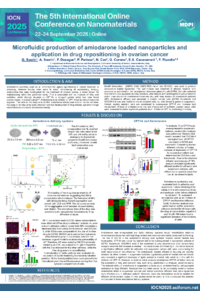
Repositioning amiodarone, an antiarrhythmic agent, for cancer therapy has garnered increasing interest due to its inhibitory effects on carnitine palmitoyltransferase 1A (CPT1A), a key enzyme upregulated in ovarian cancer (OC)1. OC is particularly aggressive and prone to peritoneal metastasis, with a metabolic profile characterized by elevated fatty acid oxidation driven by CPT1A overexpression. Despite its therapeutic potential, the clinical application of amiodarone in oncology is hindered by its systemic toxicity. To address this limitation, drug delivery systems (DDSs) offer a promising strategy, with liposomes emerging as an ideal candidate due to their high biocompatibility and tumor-targeting capabilities. Liposomes can exploit the Enhanced Permeability and Retention (EPR) effect or be surface-modified to enhance receptor-mediated targeting, thereby improving drug accumulation and pharmacokinetics2. The production method of liposomes critically influences their physicochemical properties, with conventional techniques often requiring post-processing steps to achieve clinical-grade formulations. Microfluidics has recently gained attention as a scalable and precise alternative, offering fine control over parameters such as vesicle size, lamellarity, and distribution3. Using a microfluidic approach, amiodarone was successfully encapsulated into liposomes, with simultaneous generation of amiodarone-containing lipidic particles. Optimization of process parameters, including temperature and flow rate ratio, enabled the production of a stable, uniform DDS. Both formulations were extensively characterized and demonstrated significant efficacy in in vitro models of ovarian cancer, underscoring their potential for further development in targeted cancer therapy4.
[1] Sawyer B.T., Qamar L., Yamamoto T.M., McMellen A., Watson Z. L., Richer, J. K., Behbakht K., Schlaepfer I.R., Bitler B. G. 2020, Molecular Cancer Research, 18, 1088.
[2] Bitounis D., Fanciullino R., Iliadis A., Ciccolini J. 2012, ISRN Pharmaceutics, 2012, 1, 11.
[3] Carugo D., Bottaro E., Owen J., Stride E., Nastruzzi, C. 2016, Scientific Reports, 6, 25876.
[4] Saorin A., Saorin G., Duzagac F., Parisse P., Cao N., Corona G., Cavarzerani E., Rizzolio F. 2024, Scientific Reports, 14, 6280.
Keywords
microfluidics
liposomes
drug delivery
cancer
Poster
Gloria_Saori_poster IOCN.pdf
Utilizing SERS to reveal charge transfer mechanism in R6G/InSe optoelectronic synaptic device
Mechanically monitoring thermoset polymer materials using SWCNT thin films