Event submissions
Published
This submission belongs to the session S6. Synthesis, Characterization, and Properties of Nanomaterials of the event The 5th International Online Conference on Nanomaterials
Published date
19 Sep, 2025
Academic Editor
'%3e%3cpath%20d='M12.6657%2010.9104C12.4185%2010.325%2012.0599%209.79327%2011.6097%209.34482C11.1609%208.89508%2010.6293%208.5365%2010.0442%208.28888C10.0389%208.28626%2010.0337%208.28495%2010.0285%208.28233C10.8446%207.69279%2011.3752%206.73249%2011.3752%205.64904C11.3752%203.8542%209.92103%202.39999%208.1262%202.39999C6.33136%202.39999%204.87715%203.8542%204.87715%205.64904C4.87715%206.73249%205.40774%207.69279%206.22393%208.28364C6.21869%208.28626%206.21345%208.28757%206.20821%208.29019C5.62129%208.5378%205.09463%208.89284%204.64265%209.34613C4.1929%209.79493%203.83432%2010.3266%203.58671%2010.9117C3.34345%2011.4845%203.21226%2012.0987%203.20023%2012.7209C3.19988%2012.7349%203.20233%2012.7488%203.20744%2012.7619C3.21255%2012.7749%203.22022%2012.7867%203.22998%2012.7968C3.23975%2012.8068%203.25142%2012.8147%203.26431%2012.8202C3.2772%2012.8256%203.29105%2012.8284%203.30504%2012.8284H4.09109C4.14874%2012.8284%204.19459%2012.7825%204.1959%2012.7262C4.2221%2011.7148%204.62823%2010.7676%205.34617%2010.0497C6.08899%209.30683%207.0755%208.89808%208.1262%208.89808C9.17689%208.89808%2010.1634%209.30683%2010.9062%2010.0497C11.6242%2010.7676%2012.0303%2011.7148%2012.0565%2012.7262C12.0578%2012.7838%2012.1037%2012.8284%2012.1613%2012.8284H12.9474C12.9613%2012.8284%2012.9752%2012.8256%2012.9881%2012.8202C13.001%2012.8147%2013.0126%2012.8068%2013.0224%2012.7968C13.0322%2012.7867%2013.0398%2012.7749%2013.0449%2012.7619C13.0501%2012.7488%2013.0525%2012.7349%2013.0522%2012.7209C13.0391%2012.0947%2012.9094%2011.4855%2012.6657%2010.9104ZM8.1262%207.9024C7.52486%207.9024%206.9589%207.6679%206.53312%207.24211C6.10733%206.81633%205.87283%206.25037%205.87283%205.64904C5.87283%205.0477%206.10733%204.48174%206.53312%204.05596C6.9589%203.63018%207.52486%203.39567%208.1262%203.39567C8.72753%203.39567%209.29349%203.63018%209.71927%204.05596C10.1451%204.48174%2010.3796%205.0477%2010.3796%205.64904C10.3796%206.25037%2010.1451%206.81633%209.71927%207.24211C9.29349%207.6679%208.72753%207.9024%208.1262%207.9024Z'%20fill='%235D1EE1'/%3e%3c/g%3e%3c/svg%3e) José Luis Arias Mediano
José Luis Arias MedianoCitation
Ruben Caro-Briones, Marco Antonio Pérez-Castillo, Hugo Martínez-Gutiérrez, Lazaro Ruiz-Virgen, Gabriela Martínez-Mejía, Mónica Corea, Emilio Muñoz-Sandoval, RHEOLOGICAL BEHAVIOR OF POLY(STYRENE-CO-ACRYLONITRILE)/CARBON NANOTUBE SPONGES DOPED FOR FIBER ELECTROSPINNING, in Proceedings of The 5th International Online Conference on Nanomaterials, 22 September–24 September 2025, MDPI: Basel, Switzerland
Share
Email
Facebook
Twitter
LinkedIn
RHEOLOGICAL BEHAVIOR OF POLY(STYRENE-CO-ACRYLONITRILE)/CARBON NANOTUBE SPONGES DOPED FOR FIBER ELECTROSPINNING

Ruben Caro-Briones 1
'%3e%3cpath%20d='M12.6647%2010.9104C12.4176%2010.325%2012.0589%209.7933%2011.6088%209.34485C11.16%208.89511%2010.6283%208.53653%2010.0432%208.28891C10.038%208.28629%2010.0327%208.28498%2010.0275%208.28236C10.8437%207.69282%2011.3743%206.73252%2011.3743%205.64907C11.3743%203.85423%209.92005%202.40002%208.12522%202.40002C6.33038%202.40002%204.87618%203.85423%204.87618%205.64907C4.87618%206.73252%205.40677%207.69282%206.22296%208.28367C6.21772%208.28629%206.21248%208.2876%206.20724%208.29022C5.62031%208.53783%205.09365%208.89287%204.64167%209.34616C4.19192%209.79496%203.83334%2010.3266%203.58573%2010.9117C3.34247%2011.4846%203.21128%2012.0987%203.19925%2012.721C3.1989%2012.735%203.20135%2012.7489%203.20646%2012.7619C3.21157%2012.7749%203.21924%2012.7868%203.22901%2012.7968C3.23877%2012.8068%203.25045%2012.8148%203.26334%2012.8202C3.27623%2012.8256%203.29007%2012.8284%203.30406%2012.8284H4.09012C4.14776%2012.8284%204.19362%2012.7825%204.19493%2012.7262C4.22113%2011.7148%204.62726%2010.7676%205.34519%2010.0497C6.08802%209.30686%207.07452%208.89811%208.12522%208.89811C9.17592%208.89811%2010.1624%209.30686%2010.9052%2010.0497C11.6232%2010.7676%2012.0293%2011.7148%2012.0555%2012.7262C12.0568%2012.7839%2012.1027%2012.8284%2012.1603%2012.8284H12.9464C12.9604%2012.8284%2012.9742%2012.8256%2012.9871%2012.8202C13%2012.8148%2013.0117%2012.8068%2013.0214%2012.7968C13.0312%2012.7868%2013.0389%2012.7749%2013.044%2012.7619C13.0491%2012.7489%2013.0515%2012.735%2013.0512%2012.721C13.0381%2012.0947%2012.9084%2011.4856%2012.6647%2010.9104ZM8.12522%207.90243C7.52388%207.90243%206.95792%207.66793%206.53214%207.24215C6.10636%206.81636%205.87185%206.2504%205.87185%205.64907C5.87185%205.04773%206.10636%204.48177%206.53214%204.05599C6.95792%203.63021%207.52388%203.3957%208.12522%203.3957C8.72655%203.3957%209.29252%203.63021%209.7183%204.05599C10.1441%204.48177%2010.3786%205.04773%2010.3786%205.64907C10.3786%206.2504%2010.1441%206.81636%209.7183%207.24215C9.29252%207.66793%208.72655%207.90243%208.12522%207.90243Z'%20fill='%235D1EE1'/%3e%3c/g%3e%3c/svg%3e)
Marco Antonio Pérez-Castillo 2
Hugo Martínez-Gutiérrez 3

Lazaro Ruiz-Virgen 4
Gabriela Martínez-Mejía 4
Mónica Corea 4
Emilio Muñoz-Sandoval 5
1. Escuela Superior de Ingeniería Mecánica y Eléctrica (ESIME) Unidad Zacatenco
2. Escuela Superior de Ingeniería Química e Industrias Extractivas del Instituto Politécnico Nacional (ESIQIE-IPN), Laboratorio de Investigación en Polímeros y Nanomateriales, Mexico
3. Centro de Nanociencias y Micro-Nanotecnologías, IPN, Mexico.
4. Escuela Superior de Ingeniería Química e Industrias Extractivas del Instituto Politécnico Nacional (ESIQIE-IPN), Laboratorio de Investigación en Polímeros y Nanomateriales, Mexico.
5. Instituto Potosino de Investigación Científica y Tecnológica, División de Materiales Avanzados, Mexico
Abstract
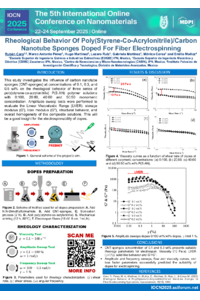
This study investigates the influence of carbon nanotube sponges (CNT-sponges) at concentrations of 0.1, 0.3, and 0.5 wt% on the rheological behavior of three series of poly(styrene-co-acrylonitrile) [P(S:AN)] polymer solutions. Amplitude and frequency sweep tests were performed to evaluate the Linear Viscoelastic Range (LVER), storage modulus (G'), loss modulus (G''), loss factor (tan δ), structural behavior, and overall homogeneity of the composite solutions. The rheological measurements revealed a viscosity range between 0.8 and 20 Pa·s across all samples. The loss factor analysis indicated a liquid-like viscoelastic response for solutions containing 0.1 and 0.3 wt% CNT-sponges, while the 0.5 wt% formulation exhibited a solid-like response, suggesting increased elasticity and network formation at higher CNT concentrations.
These rheological insights are critical for predicting the electrospinnability of the solutions, as viscoelastic behavior significantly influences fiber formation. To validate the suitability of each formulation for electrospinning, all solutions were processed using a standard electrospinning setup. The resulting nanofibers were characterized by scanning electron microscopy (SEM) to assess morphology, fiber continuity, and uniformity.
The findings confirm that rheological evaluation can effectively guide the formulation of electrospinnable composite solutions. Specifically, a CNT content of 0.3 wt% was identified as optimal for achieving balanced flow behavior and fiber quality, highlighting its potential for advanced fiber-based applications.
Keywords
polymeric composite solutions
rheology
CNT-sponges
Poster
IOCN 2025 Poster RCB.pdf
Electro-Optical Dual-Responsive Smart Windows with All-Solid-State Structure
Nanotechnology Innovations in Water Treatment: Emphasis on Green-Synthesized Titanium Dioxide Nanoparticles