Event submissions
Published
This submission belongs to the session S6. Synthesis, Characterization, and Properties of Nanomaterials of the event The 5th International Online Conference on Nanomaterials
Published date
19 Sep, 2025
Academic Editor
'%3e%3cpath%20d='M12.6657%2010.9104C12.4185%2010.325%2012.0599%209.79327%2011.6097%209.34482C11.1609%208.89508%2010.6293%208.5365%2010.0442%208.28888C10.0389%208.28626%2010.0337%208.28495%2010.0285%208.28233C10.8446%207.69279%2011.3752%206.73249%2011.3752%205.64904C11.3752%203.8542%209.92103%202.39999%208.1262%202.39999C6.33136%202.39999%204.87715%203.8542%204.87715%205.64904C4.87715%206.73249%205.40774%207.69279%206.22393%208.28364C6.21869%208.28626%206.21345%208.28757%206.20821%208.29019C5.62129%208.5378%205.09463%208.89284%204.64265%209.34613C4.1929%209.79493%203.83432%2010.3266%203.58671%2010.9117C3.34345%2011.4845%203.21226%2012.0987%203.20023%2012.7209C3.19988%2012.7349%203.20233%2012.7488%203.20744%2012.7619C3.21255%2012.7749%203.22022%2012.7867%203.22998%2012.7968C3.23975%2012.8068%203.25142%2012.8147%203.26431%2012.8202C3.2772%2012.8256%203.29105%2012.8284%203.30504%2012.8284H4.09109C4.14874%2012.8284%204.19459%2012.7825%204.1959%2012.7262C4.2221%2011.7148%204.62823%2010.7676%205.34617%2010.0497C6.08899%209.30683%207.0755%208.89808%208.1262%208.89808C9.17689%208.89808%2010.1634%209.30683%2010.9062%2010.0497C11.6242%2010.7676%2012.0303%2011.7148%2012.0565%2012.7262C12.0578%2012.7838%2012.1037%2012.8284%2012.1613%2012.8284H12.9474C12.9613%2012.8284%2012.9752%2012.8256%2012.9881%2012.8202C13.001%2012.8147%2013.0126%2012.8068%2013.0224%2012.7968C13.0322%2012.7867%2013.0398%2012.7749%2013.0449%2012.7619C13.0501%2012.7488%2013.0525%2012.7349%2013.0522%2012.7209C13.0391%2012.0947%2012.9094%2011.4855%2012.6657%2010.9104ZM8.1262%207.9024C7.52486%207.9024%206.9589%207.6679%206.53312%207.24211C6.10733%206.81633%205.87283%206.25037%205.87283%205.64904C5.87283%205.0477%206.10733%204.48174%206.53312%204.05596C6.9589%203.63018%207.52486%203.39567%208.1262%203.39567C8.72753%203.39567%209.29349%203.63018%209.71927%204.05596C10.1451%204.48174%2010.3796%205.0477%2010.3796%205.64904C10.3796%206.25037%2010.1451%206.81633%209.71927%207.24211C9.29349%207.6679%208.72753%207.9024%208.1262%207.9024Z'%20fill='%235D1EE1'/%3e%3c/g%3e%3c/svg%3e) José Luis Arias Mediano
José Luis Arias MedianoCitation
Raja Saadan, Mohamed Chigr, Ahmed Fatimi, Chitosan-Based Nanocomposite Hydrogels Reinforced with Nanoparticles: Multifunctional Nanomaterials for Biomedical Applications, in Proceedings of The 5th International Online Conference on Nanomaterials, 22 September–24 September 2025, MDPI: Basel, Switzerland
Share
Email
Facebook
Twitter
LinkedIn
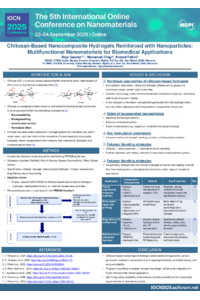
Chitosan-Based Nanocomposite Hydrogels Reinforced with Nanoparticles: Multifunctional Nanomaterials for Biomedical Applications
'%3e%3cpath%20d='M12.6647%2010.9104C12.4176%2010.325%2012.0589%209.7933%2011.6088%209.34485C11.16%208.89511%2010.6283%208.53653%2010.0432%208.28891C10.038%208.28629%2010.0327%208.28498%2010.0275%208.28236C10.8437%207.69282%2011.3743%206.73252%2011.3743%205.64907C11.3743%203.85423%209.92005%202.40002%208.12522%202.40002C6.33038%202.40002%204.87618%203.85423%204.87618%205.64907C4.87618%206.73252%205.40677%207.69282%206.22296%208.28367C6.21772%208.28629%206.21248%208.2876%206.20724%208.29022C5.62031%208.53783%205.09365%208.89287%204.64167%209.34616C4.19192%209.79496%203.83334%2010.3266%203.58573%2010.9117C3.34247%2011.4846%203.21128%2012.0987%203.19925%2012.721C3.1989%2012.735%203.20135%2012.7489%203.20646%2012.7619C3.21157%2012.7749%203.21924%2012.7868%203.22901%2012.7968C3.23877%2012.8068%203.25045%2012.8148%203.26334%2012.8202C3.27623%2012.8256%203.29007%2012.8284%203.30406%2012.8284H4.09012C4.14776%2012.8284%204.19362%2012.7825%204.19493%2012.7262C4.22113%2011.7148%204.62726%2010.7676%205.34519%2010.0497C6.08802%209.30686%207.07452%208.89811%208.12522%208.89811C9.17592%208.89811%2010.1624%209.30686%2010.9052%2010.0497C11.6232%2010.7676%2012.0293%2011.7148%2012.0555%2012.7262C12.0568%2012.7839%2012.1027%2012.8284%2012.1603%2012.8284H12.9464C12.9604%2012.8284%2012.9742%2012.8256%2012.9871%2012.8202C13%2012.8148%2013.0117%2012.8068%2013.0214%2012.7968C13.0312%2012.7868%2013.0389%2012.7749%2013.044%2012.7619C13.0491%2012.7489%2013.0515%2012.735%2013.0512%2012.721C13.0381%2012.0947%2012.9084%2011.4856%2012.6647%2010.9104ZM8.12522%207.90243C7.52388%207.90243%206.95792%207.66793%206.53214%207.24215C6.10636%206.81636%205.87185%206.2504%205.87185%205.64907C5.87185%205.04773%206.10636%204.48177%206.53214%204.05599C6.95792%203.63021%207.52388%203.3957%208.12522%203.3957C8.72655%203.3957%209.29252%203.63021%209.7183%204.05599C10.1441%204.48177%2010.3786%205.04773%2010.3786%205.64907C10.3786%206.2504%2010.1441%206.81636%209.7183%207.24215C9.29252%207.66793%208.72655%207.90243%208.12522%207.90243Z'%20fill='%235D1EE1'/%3e%3c/g%3e%3c/svg%3e)
Raja Saadan 1,2
Mohamed Chigr 2

Ahmed Fatimi 1
1. Chemical Science and Engineering Research Team (ERSIC), Department of Chemistry, Polydisciplinary Faculty of Beni Mellal (FPBM), Sultan Moulay Slimane University (USMS), P.O. Box 592 Mghila, Beni Mellal 23000, Morocco
2. Laboratory of Molecular Chemistry, Materials and Catalysis (LCMMC), Faculty of Science and Technology (FSTBM), University Sultan Moulay Slimane (USMS), Mghila, P.O. Box 523, Beni Mellal 23000, Morocco
Abstract
The capacity of chitosan to form hydrogels under mild conditions and its chemical modifiability have made it widely used in drug delivery, wound healing, and tissue engineering. In recent years, particular attention has been directed toward chitosan-based nanocomposite hydrogels, which incorporate nanoparticles to enhance mechanical, biological, and functional properties. Chitosan-based nanocomposite hydrogels reinforced with nanoparticles were reviewed based on research articles retrieved from scientific databases, including PubMed, Web of Science, Scopus, ScienceDirect, Wiley Online Library, and Google Scholar.
The synthesis approaches are generally classified into ionic gelation, covalent crosslinking, and in situ nanoparticle formation. Ionic gelation relies on electrostatic interactions between the positively charged amino groups of chitosan and multivalent anions, enabling hydrogel formation without the use of toxic solvents or initiators. Covalent crosslinking methods involve the formation of stable chemical bonds between chitosan chains and crosslinkers, often leading to improved mechanical stability and long-term integrity. In situ nanoparticle formation refers to the generation of nanoparticles directly within the hydrogel matrix, allowing uniform dispersion and strong interfacial interactions with the polymer network.
Incorporated nanoparticles serve multiple roles: reinforcing the hydrogel network, enhancing antibacterial activity, or imparting specific functionalities such as magnetism or photothermal responsiveness. Critical formulation parameters greatly influence the resulting hydrogel’s mechanical strength, swelling behavior, porosity, and drug release kinetics. Additionally, blending chitosan with other natural polymers improves structural versatility and enables the design of injectable, self-healing, or stimuli-responsive nanocomposite systems.
In conclusion, the ability of chitosan-based nanocomposite hydrogels to combine bioactivity, controlled release, and structural integrity highlights their potential as next-generation materials in nanomedicine. Continued advances in synthesis methods, nanoparticle engineering, and biopolymer integration are expected to expand their clinical relevance and translational potential.
Keywords
Chitosan
Nanohydrogels
Biocomposites
Nanomedicine
Drug Delivery
Tissue Engineering
Biopolymers
Poster
IOCN 2025 Poster Chitosane_vf.pdf
Carboxymethylcellulose-Anchored Biogenic Selenium Nanoparticles (SeNPs): Synthesis, Characterization, and Application as Smart Fertilizers
Three-Dimensional Printed PLA Microfluidic Device Enables Rapid and Modular Nanoassembly via Bioorthogonal Click Chemistry