Event submissions
Published
This submission belongs to the session S6. Synthesis, Characterization, and Properties of Nanomaterials of the event The 5th International Online Conference on Nanomaterials
Published date
19 Sep, 2025
Academic Editor
'%3e%3cpath%20d='M12.6657%2010.9104C12.4185%2010.325%2012.0599%209.79327%2011.6097%209.34482C11.1609%208.89508%2010.6293%208.5365%2010.0442%208.28888C10.0389%208.28626%2010.0337%208.28495%2010.0285%208.28233C10.8446%207.69279%2011.3752%206.73249%2011.3752%205.64904C11.3752%203.8542%209.92103%202.39999%208.1262%202.39999C6.33136%202.39999%204.87715%203.8542%204.87715%205.64904C4.87715%206.73249%205.40774%207.69279%206.22393%208.28364C6.21869%208.28626%206.21345%208.28757%206.20821%208.29019C5.62129%208.5378%205.09463%208.89284%204.64265%209.34613C4.1929%209.79493%203.83432%2010.3266%203.58671%2010.9117C3.34345%2011.4845%203.21226%2012.0987%203.20023%2012.7209C3.19988%2012.7349%203.20233%2012.7488%203.20744%2012.7619C3.21255%2012.7749%203.22022%2012.7867%203.22998%2012.7968C3.23975%2012.8068%203.25142%2012.8147%203.26431%2012.8202C3.2772%2012.8256%203.29105%2012.8284%203.30504%2012.8284H4.09109C4.14874%2012.8284%204.19459%2012.7825%204.1959%2012.7262C4.2221%2011.7148%204.62823%2010.7676%205.34617%2010.0497C6.08899%209.30683%207.0755%208.89808%208.1262%208.89808C9.17689%208.89808%2010.1634%209.30683%2010.9062%2010.0497C11.6242%2010.7676%2012.0303%2011.7148%2012.0565%2012.7262C12.0578%2012.7838%2012.1037%2012.8284%2012.1613%2012.8284H12.9474C12.9613%2012.8284%2012.9752%2012.8256%2012.9881%2012.8202C13.001%2012.8147%2013.0126%2012.8068%2013.0224%2012.7968C13.0322%2012.7867%2013.0398%2012.7749%2013.0449%2012.7619C13.0501%2012.7488%2013.0525%2012.7349%2013.0522%2012.7209C13.0391%2012.0947%2012.9094%2011.4855%2012.6657%2010.9104ZM8.1262%207.9024C7.52486%207.9024%206.9589%207.6679%206.53312%207.24211C6.10733%206.81633%205.87283%206.25037%205.87283%205.64904C5.87283%205.0477%206.10733%204.48174%206.53312%204.05596C6.9589%203.63018%207.52486%203.39567%208.1262%203.39567C8.72753%203.39567%209.29349%203.63018%209.71927%204.05596C10.1451%204.48174%2010.3796%205.0477%2010.3796%205.64904C10.3796%206.25037%2010.1451%206.81633%209.71927%207.24211C9.29349%207.6679%208.72753%207.9024%208.1262%207.9024Z'%20fill='%235D1EE1'/%3e%3c/g%3e%3c/svg%3e) José Luis Arias Mediano
José Luis Arias MedianoCitation
Jaime Viegas, Luciana Peres, Luca Ferrite, Elvira Fortunato, Rodrigo Martins, Ana Rovisco, Rita Branquinho, Combustion synthesis of ZTO nanostructures, in Proceedings of The 5th International Online Conference on Nanomaterials, 22 September–24 September 2025, MDPI: Basel, Switzerland
Share
Email
Facebook
Twitter
LinkedIn
Combustion synthesis of ZTO nanostructures
'%3e%3cpath%20d='M12.6647%2010.9104C12.4176%2010.325%2012.0589%209.7933%2011.6088%209.34485C11.16%208.89511%2010.6283%208.53653%2010.0432%208.28891C10.038%208.28629%2010.0327%208.28498%2010.0275%208.28236C10.8437%207.69282%2011.3743%206.73252%2011.3743%205.64907C11.3743%203.85423%209.92005%202.40002%208.12522%202.40002C6.33038%202.40002%204.87618%203.85423%204.87618%205.64907C4.87618%206.73252%205.40677%207.69282%206.22296%208.28367C6.21772%208.28629%206.21248%208.2876%206.20724%208.29022C5.62031%208.53783%205.09365%208.89287%204.64167%209.34616C4.19192%209.79496%203.83334%2010.3266%203.58573%2010.9117C3.34247%2011.4846%203.21128%2012.0987%203.19925%2012.721C3.1989%2012.735%203.20135%2012.7489%203.20646%2012.7619C3.21157%2012.7749%203.21924%2012.7868%203.22901%2012.7968C3.23877%2012.8068%203.25045%2012.8148%203.26334%2012.8202C3.27623%2012.8256%203.29007%2012.8284%203.30406%2012.8284H4.09012C4.14776%2012.8284%204.19362%2012.7825%204.19493%2012.7262C4.22113%2011.7148%204.62726%2010.7676%205.34519%2010.0497C6.08802%209.30686%207.07452%208.89811%208.12522%208.89811C9.17592%208.89811%2010.1624%209.30686%2010.9052%2010.0497C11.6232%2010.7676%2012.0293%2011.7148%2012.0555%2012.7262C12.0568%2012.7839%2012.1027%2012.8284%2012.1603%2012.8284H12.9464C12.9604%2012.8284%2012.9742%2012.8256%2012.9871%2012.8202C13%2012.8148%2013.0117%2012.8068%2013.0214%2012.7968C13.0312%2012.7868%2013.0389%2012.7749%2013.044%2012.7619C13.0491%2012.7489%2013.0515%2012.735%2013.0512%2012.721C13.0381%2012.0947%2012.9084%2011.4856%2012.6647%2010.9104ZM8.12522%207.90243C7.52388%207.90243%206.95792%207.66793%206.53214%207.24215C6.10636%206.81636%205.87185%206.2504%205.87185%205.64907C5.87185%205.04773%206.10636%204.48177%206.53214%204.05599C6.95792%203.63021%207.52388%203.3957%208.12522%203.3957C8.72655%203.3957%209.29252%203.63021%209.7183%204.05599C10.1441%204.48177%2010.3786%205.04773%2010.3786%205.64907C10.3786%206.2504%2010.1441%206.81636%209.7183%207.24215C9.29252%207.66793%208.72655%207.90243%208.12522%207.90243Z'%20fill='%235D1EE1'/%3e%3c/g%3e%3c/svg%3e)
Jaime Viegas 1
Luciana Peres 2
Luca Ferrite 2
Elvira Fortunato 1
Rodrigo Martins 1

Ana Rovisco 1

Rita Branquinho 1
1. Cenimat, Department of Materials Science, FCT, Nova University of Lisbon, 2829-516 Monte da Caparica, Portugal
2. Department of Chemistry, Faculty of Sciences and Technology, Universidade Nova de Lisboa, 2829‑516 Caparica, Portugal.
Abstract
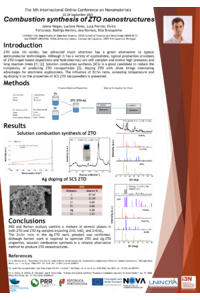
Ternary oxides like ZTO have attracted much attention as a green alternative to typical semiconductor technologies. ZTO has a wide variety of applications, but its current production methods, (vapor-based depositions and hydrothermal) are complex and involve high pressures and long reaction times. Solution Combustion Synthesis is a great candidate to overcome these issues, allowing to reduce the complexity of producing ZTO nanostructures. Solution combustion synthesis was used to produce ZTO- and ZTO-Ag-doped nanostructures. Precursor solutions of ZnO and SnO were produced and mixed in several ratios to form a ZTO precursor solution. The solutions were placed in a furnace, the synthesis was performed at 300ºC, and several annealing temperatures were explored. ZTO powders presented a mixture of ZnO, SnO2, and ZnSnO3 phases. When increasing the annealing temperature, a crystallinity increase and the growth of different nanostructures were observed. In order to obtain a pure ZTO phase, the influence of the surfactant in the growth of the nanostructures was studied using EDA but the formation of ZnO was favoured. Doping ZTO with silver might bring interesting advantages for electronic applications, therefore ZTO-Ag nanostructures were also produced. The use of silver nitrate led to the precipitation of SnCl2. ZTO-Ag doped powders revealed the dominance of the ZnO phase. Finaly, the Zn:Sn ratio was confirmed to be identical to the Zn:Sn ratio of the ZTO precursor solution. The obtained results proved that solution combustion synthesis is a reliable method to produce ZTO nanostructures and can be a low-cost, green, alternative to typical production methods.
Branquinho, et al,(2016). Solution Combustion Synthesis: Applications in Oxide Electronics https://doi.org/10.5772/64761
Rovisco, et al,(2018). Seed-layer free zinc tin oxide tailored nanostructures for nanoelectronic applications: Effect of chemical parameters https://doi.org/10.1021/acsanm.8b00743
Keywords
Combustion synthesis
ZTO
nanostructures
Poster
Poster Combustion synthesis of ZTO nanostructures.pdf
Coaxial fibers modified with grape extract endowed with halochromic properties for potential detection of infection state in burns.
Enhanced Electrochemical Performance of Hard Carbon Anodes via Oxygen-Rich Nano-Graphene Oxide for Sodium-Ion Batteries