Event submissions
Published
This submission belongs to the session S6. Synthesis, Characterization, and Properties of Nanomaterials of the event The 5th International Online Conference on Nanomaterials
Published date
19 Sep, 2025
Academic Editor
'%3e%3cpath%20d='M12.6657%2010.9104C12.4185%2010.325%2012.0599%209.79327%2011.6097%209.34482C11.1609%208.89508%2010.6293%208.5365%2010.0442%208.28888C10.0389%208.28626%2010.0337%208.28495%2010.0285%208.28233C10.8446%207.69279%2011.3752%206.73249%2011.3752%205.64904C11.3752%203.8542%209.92103%202.39999%208.1262%202.39999C6.33136%202.39999%204.87715%203.8542%204.87715%205.64904C4.87715%206.73249%205.40774%207.69279%206.22393%208.28364C6.21869%208.28626%206.21345%208.28757%206.20821%208.29019C5.62129%208.5378%205.09463%208.89284%204.64265%209.34613C4.1929%209.79493%203.83432%2010.3266%203.58671%2010.9117C3.34345%2011.4845%203.21226%2012.0987%203.20023%2012.7209C3.19988%2012.7349%203.20233%2012.7488%203.20744%2012.7619C3.21255%2012.7749%203.22022%2012.7867%203.22998%2012.7968C3.23975%2012.8068%203.25142%2012.8147%203.26431%2012.8202C3.2772%2012.8256%203.29105%2012.8284%203.30504%2012.8284H4.09109C4.14874%2012.8284%204.19459%2012.7825%204.1959%2012.7262C4.2221%2011.7148%204.62823%2010.7676%205.34617%2010.0497C6.08899%209.30683%207.0755%208.89808%208.1262%208.89808C9.17689%208.89808%2010.1634%209.30683%2010.9062%2010.0497C11.6242%2010.7676%2012.0303%2011.7148%2012.0565%2012.7262C12.0578%2012.7838%2012.1037%2012.8284%2012.1613%2012.8284H12.9474C12.9613%2012.8284%2012.9752%2012.8256%2012.9881%2012.8202C13.001%2012.8147%2013.0126%2012.8068%2013.0224%2012.7968C13.0322%2012.7867%2013.0398%2012.7749%2013.0449%2012.7619C13.0501%2012.7488%2013.0525%2012.7349%2013.0522%2012.7209C13.0391%2012.0947%2012.9094%2011.4855%2012.6657%2010.9104ZM8.1262%207.9024C7.52486%207.9024%206.9589%207.6679%206.53312%207.24211C6.10733%206.81633%205.87283%206.25037%205.87283%205.64904C5.87283%205.0477%206.10733%204.48174%206.53312%204.05596C6.9589%203.63018%207.52486%203.39567%208.1262%203.39567C8.72753%203.39567%209.29349%203.63018%209.71927%204.05596C10.1451%204.48174%2010.3796%205.0477%2010.3796%205.64904C10.3796%206.25037%2010.1451%206.81633%209.71927%207.24211C9.29349%207.6679%208.72753%207.9024%208.1262%207.9024Z'%20fill='%235D1EE1'/%3e%3c/g%3e%3c/svg%3e) José Luis Arias Mediano
José Luis Arias MedianoCitation
Mariana Chelu, Adriana Rusu, Irina Atkinson, Jeanina Pandele Cusu, Adina Magdalena Musuc Musuc, José María Calderón Moreno, New Multifunctional Natural Biomaterials Based on ZnO Nanoparticles and Polysaccharide Gums Obtained by Green Synthesis, in Proceedings of The 5th International Online Conference on Nanomaterials, 22 September–24 September 2025, MDPI: Basel, Switzerland
Share
Email
Facebook
Twitter
LinkedIn
New Multifunctional Natural Biomaterials Based on ZnO Nanoparticles and Polysaccharide Gums Obtained by Green Synthesis

Mariana Chelu 1
'%3e%3cpath%20d='M12.6647%2010.9104C12.4176%2010.325%2012.0589%209.7933%2011.6088%209.34485C11.16%208.89511%2010.6283%208.53653%2010.0432%208.28891C10.038%208.28629%2010.0327%208.28498%2010.0275%208.28236C10.8437%207.69282%2011.3743%206.73252%2011.3743%205.64907C11.3743%203.85423%209.92005%202.40002%208.12522%202.40002C6.33038%202.40002%204.87618%203.85423%204.87618%205.64907C4.87618%206.73252%205.40677%207.69282%206.22296%208.28367C6.21772%208.28629%206.21248%208.2876%206.20724%208.29022C5.62031%208.53783%205.09365%208.89287%204.64167%209.34616C4.19192%209.79496%203.83334%2010.3266%203.58573%2010.9117C3.34247%2011.4846%203.21128%2012.0987%203.19925%2012.721C3.1989%2012.735%203.20135%2012.7489%203.20646%2012.7619C3.21157%2012.7749%203.21924%2012.7868%203.22901%2012.7968C3.23877%2012.8068%203.25045%2012.8148%203.26334%2012.8202C3.27623%2012.8256%203.29007%2012.8284%203.30406%2012.8284H4.09012C4.14776%2012.8284%204.19362%2012.7825%204.19493%2012.7262C4.22113%2011.7148%204.62726%2010.7676%205.34519%2010.0497C6.08802%209.30686%207.07452%208.89811%208.12522%208.89811C9.17592%208.89811%2010.1624%209.30686%2010.9052%2010.0497C11.6232%2010.7676%2012.0293%2011.7148%2012.0555%2012.7262C12.0568%2012.7839%2012.1027%2012.8284%2012.1603%2012.8284H12.9464C12.9604%2012.8284%2012.9742%2012.8256%2012.9871%2012.8202C13%2012.8148%2013.0117%2012.8068%2013.0214%2012.7968C13.0312%2012.7868%2013.0389%2012.7749%2013.044%2012.7619C13.0491%2012.7489%2013.0515%2012.735%2013.0512%2012.721C13.0381%2012.0947%2012.9084%2011.4856%2012.6647%2010.9104ZM8.12522%207.90243C7.52388%207.90243%206.95792%207.66793%206.53214%207.24215C6.10636%206.81636%205.87185%206.2504%205.87185%205.64907C5.87185%205.04773%206.10636%204.48177%206.53214%204.05599C6.95792%203.63021%207.52388%203.3957%208.12522%203.3957C8.72655%203.3957%209.29252%203.63021%209.7183%204.05599C10.1441%204.48177%2010.3786%205.04773%2010.3786%205.64907C10.3786%206.2504%2010.1441%206.81636%209.7183%207.24215C9.29252%207.66793%208.72655%207.90243%208.12522%207.90243Z'%20fill='%235D1EE1'/%3e%3c/g%3e%3c/svg%3e)
Adriana Rusu 1
Irina Atkinson 1
Jeanina Pandele Cusu 1

Adina Magdalena Musuc Musuc 1
José María Calderón Moreno 1
1. “Ilie Murgulescu” Institute of Physical Chemistry, 202 Spl. Independentei, 060021 Bucharest, Romania
Abstract
Zinc oxide plays a crucial role across various industries thanks to its wide-ranging properties, which become even more effective when produced at the nanoscale. However, growing environmental concerns have driven the search for greener methods of obtaining this material. Nanomaterials synthesized using raw plant materials offer great potential for biomedical applications, thanks to their nanoscale dimensions, high surface area, biocompatibility, and favorable physical and chemical characteristics. Moreover, these materials are cost-effective, readily accessible, energy-efficient, and environmentally sustainable. In this regard, herbal gums are widely utilized across various applications because of their exceptional traits, including high stability, viscosity, adhesive and emulsifying capabilities, and notable surface activity. A simple and environmentally friendly synthesis method was developed for the production of ZnO nanoparticles, utilizing three naturally derived polysaccharide gums—acacia gum, guar gum, and xanthan gum—for biomedical applications. Each of these gums acts as a stabilizing and reducing agent, contributing to the efficient formation of ZnO nanoparticles while also enhancing their biocompatibility and functional properties. The formation of ZnO nanoparticles using polysaccharide gums was validated through FTIR, XRD, thermal analysis, SEM, Raman, and photoluminescence spectroscopies. ZnO is a notable semiconductor known for its wide band gap and high exciton binding energy, all while being non-toxic. Its impressive characteristics, including excellent thermal and mechanical stability, biodegradability, strong room-temperature luminescence, and inherent antibacterial activity, make it highly versatile. As a result, ZnO finds applications across a broad spectrum of fields such as catalysis, piezoelectric devices, chemical sensing, the paint and cosmetics industries, the food sector, and various biomedical uses. ZnO nanoparticles exhibit notable antimicrobial activity, primarily due to their capacity to disrupt bacterial cell walls. Additionally, they can induce the overproduction of reactive oxygen species (ROS) and facilitate the release of metal ions within cells, both of which contribute to their strong antibacterial effects.
Keywords
Green synthesis
ZnO nanoparticles
polysaccharide gums
multifunctional natural biomaterials.
Poster
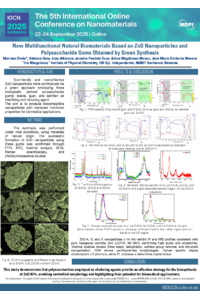
poster IOCN 2025 MC.pdf
Synthesis and characterization of ZnO-TiO2 binary nanomaterials for the development of electrochemical sensors
Polyaniline Composites Obtained from Pickering Emulsion Stabilized by Silica Modified Nanoparticles